
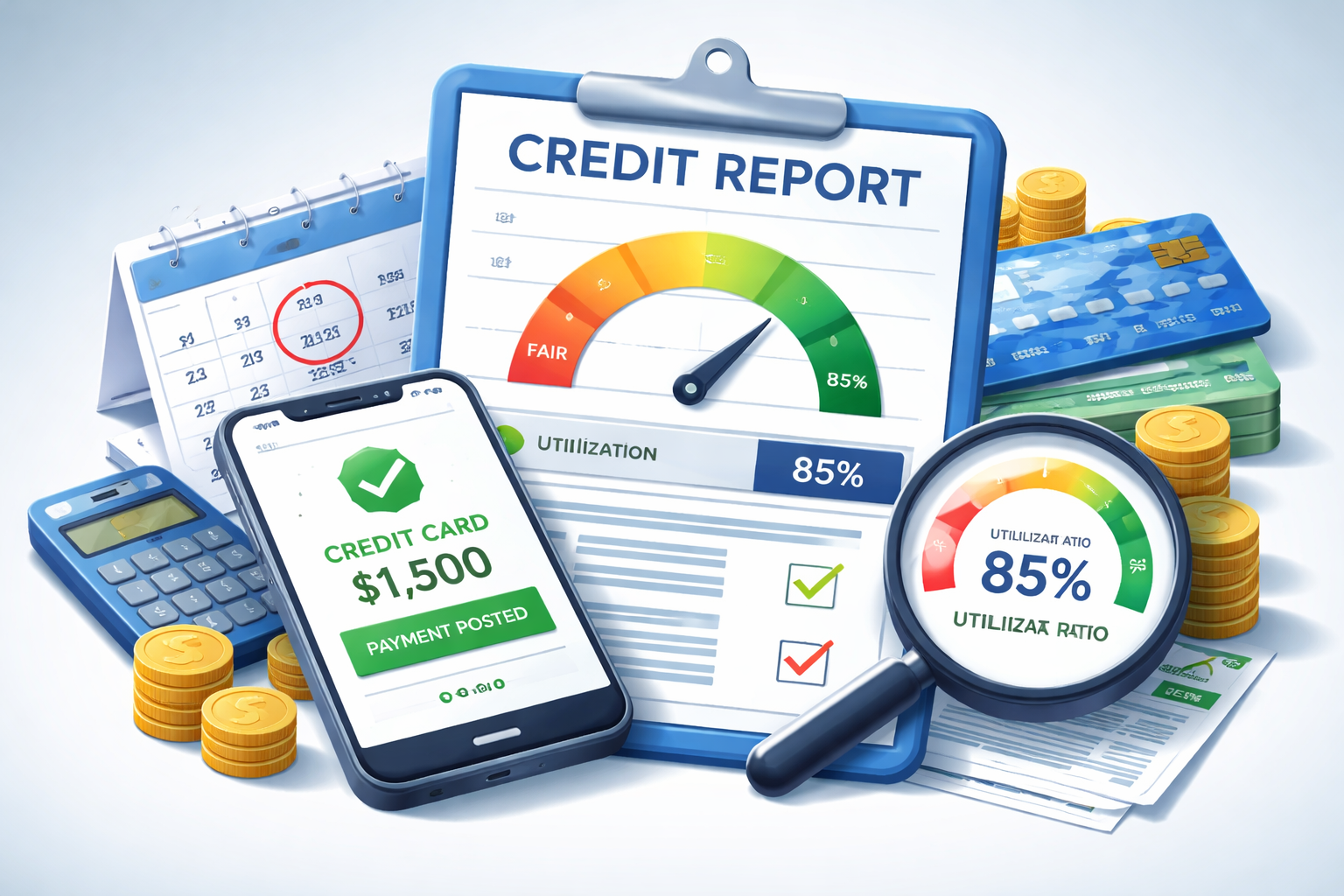
Credit card payment posted but utilization ratio not updated was not the phrase I expected to type into a search bar that morning. The payment had already gone through. The balance inside the app looked lower. The transaction history showed it clearly. So when my score tracker still showed the same utilization, I assumed it was just lag and would clean itself up in a few hours.
It did not. I refreshed again later that day, then again the next morning. Same percentage. Same score range. Same feeling that something important had not caught up. The payment was real, but the number shaping the outside view of the account was still frozen. That is the part people do not expect, because from the customer side everything appears resolved already.
If you want the fastest system-level explanation before you go deeper, this reporting guide helps frame what credit bureaus actually receive and when they receive it.
What usually causes the mismatch
Credit card payment posted but utilization ratio not updated usually happens because two different timelines are moving at once. One is the account timeline you can see in the card app. The other is the reporting timeline used to send account status to the credit bureaus. Those timelines are related, but they are not the same thing.
That means your payment can post, your current balance can drop, and your available credit can even start to improve, while the utilization number used outside that account still reflects an earlier snapshot. Most people think payment equals immediate utilization change, but the system often works on a reporting lag rather than a live-balance model.
This is why credit card payment posted but utilization ratio not updated feels so confusing. Nothing looks broken on the surface. The app is not showing a failed payment. The issuer is not saying the account is delinquent. Yet the effect you expected on your score or utilization never shows up when you thought it would.
Where people misread the timeline
The biggest mistake is assuming that the day you pay is also the day the issuer updates every outside data point. In real life, most people watch the payment date and ignore the statement closing date. That is the wrong date to ignore.
In many situations, credit card payment posted but utilization ratio not updated happens because the issuer already captured the balance that would be reported for the cycle. Once that snapshot is taken, a payment made right after it may help your real balance immediately, but it may do nothing for reported utilization until the next reporting event.
Check which version of the problem you have
- Your payment posted before the statement closed, but utilization still stayed high for more than one reporting cycle
- Your payment posted after the statement closed, so the reported balance may still reflect the old amount
- Your payment lowered the balance, but another large transaction posted before the reporting snapshot
- Your card issuer updated the account, but your score tracker is using older bureau data
Those are not small differences. They determine whether you should wait, document, call, or dispute.
The most common timing patterns
Credit card payment posted but utilization ratio not updated usually falls into one of several patterns.
Pattern 1: Payment after statement close
You paid as soon as you saw the statement. That feels responsible, but if the statement had already closed, the issuer may already have captured the balance that gets reported. Your internal balance improves, but reported utilization stays tied to the prior snapshot.
Pattern 2: Payment before close, but new charges posted fast
You paid early, but then used the card again. By the time the issuer took the reporting snapshot, the balance had climbed back up. From your perspective, the payment should have helped. From the system perspective, the reported balance still looked elevated.
Pattern 3: Score tracker delay
Your issuer may have already sent newer information, but the credit monitoring tool you are using has not refreshed yet. In that version, the problem is not the payment and not the issuer, but the way the third-party display updates.
Pattern 4: Account-level irregularity
If credit card payment posted but utilization ratio not updated lasts through a full additional cycle, the issue may no longer be normal timing. It can point to payment allocation issues, delayed internal updating, or a reporting mismatch that deserves documentation.
The key is to stop treating all utilization delays as the same problem. Some are harmless cycle timing. Others are early signs of a deeper account-data mismatch.
What the issuer may be doing internally
From the issuer side, the account is not being managed around your score tracker. It is being managed around internal balance buckets, statement production, risk logic, payment application, and scheduled furnishing to the bureaus. That is why the customer experience often feels out of sync with the back-end design.
Credit card payment posted but utilization ratio not updated can happen even when the payment itself was applied correctly. The reason is that the issuer may have separate internal moments for:
- posting the payment to the account ledger
- updating the displayed current balance
- closing the billing cycle
- selecting the amount furnished externally
- syncing that furnished data into consumer-facing score tools
When people say, “But the money already left my bank,” they are talking about only one part of the chain. Money movement, account display, and reported utilization are not always synchronized events.
If you suspect the balance was applied in a way that changed what counted for the cycle, this explainer gives the right supporting angle rather than repeating the same issue in a different title.
When waiting is reasonable and when it is not
There is a point where waiting makes sense, and a point where waiting turns into wasted time.
Waiting is usually reasonable when:
- the payment posted only recently
- the statement had already closed before you paid
- you are relying on a third-party credit score display that may refresh slowly
Waiting is usually not reasonable when:
- the utilization is still unchanged after the next full statement cycle
- the issuer and bureau data continue to show obviously inconsistent numbers
- the same account is also showing delinquent or past-due signals that do not match the payment history
- you are in a mortgage, auto loan, or rental screening window and need corrected reporting now
Credit card payment posted but utilization ratio not updated becomes a different level of problem once it starts affecting a live borrowing decision. At that point, your goal is not patience. Your goal is documentation and correction.
How to document the problem the right way
Do not call customer service with only a general complaint like “my score did not go up.” That usually leads nowhere because score movement itself is not something the frontline agent can fix. You need to present the issue as a timing and reporting mismatch.
Build a simple file with:
- payment date
- payment amount
- bank confirmation or cleared transaction screenshot
- statement closing date
- balance shown before and after payment
- utilization or bureau screenshot if available
Then ask a narrower question: what balance was furnished, on what date, and whether a more recent update has already been sent. That is a much stronger escalation path than arguing about your score in the abstract.
Use this decision split
- If the issuer says the lower balance has already been furnished, check the bureau-facing display delay first
- If the issuer says the prior statement balance was furnished, wait for the next reporting event unless another credit decision is pending
- If the issuer gives no usable answer and the mismatch continues beyond the next cycle, preserve evidence and move toward a formal dispute path
What not to do
People often make the situation worse by reacting in ways that feel productive but do not solve the actual problem.
- Do not keep making random extra payments without checking the statement close timing
- Do not max the card again right after paying it down and expect utilization to stay low
- Do not assume the app balance is the same as the furnished balance
- Do not wait multiple cycles without saving screenshots
- Do not frame the problem only as “my score is wrong” when the better issue is reporting timing or account data mismatch
Credit card payment posted but utilization ratio not updated often survives longer than it should because the consumer is chasing the wrong symptom.
What actually helps the next cycle
If your goal is not just to understand this situation but to prevent it from repeating, the practical fix is to manage the reporting window instead of only the due date. Pay attention to when the statement closes, not just when the minimum is due. Paying before the snapshot matters more than paying proudly after it.
For many people, the better routine is:
- make a payment before statement close
- reduce card usage right before the close date
- check what balance appears on the statement itself
- verify whether the next bureau-facing update reflects that lower number
The goal is not merely paying on time. The goal is getting the lower balance captured at the right reporting moment.
FAQ
Why did my balance go down but my utilization stay the same?
Because the account display and the reported balance do not always update at the same time. The payment may be posted while the utilization visible through score tools still reflects an older furnished balance.
Does this always mean something is wrong?
No. Sometimes credit card payment posted but utilization ratio not updated is just a cycle-timing issue. It becomes more concerning when it continues through the next full reporting cycle.
Should I make another payment right away?
Not automatically. First confirm the statement closing date and whether the earlier payment missed the reporting snapshot. Another payment without timing control may not solve the real issue.
When should I escalate?
Escalate when the mismatch survives into the next reporting cycle, when the issuer’s answer is inconsistent, or when the reporting is actively hurting a pending credit decision.
Key Takeaways
- Credit card payment posted but utilization ratio not updated is usually a reporting-timing issue before it is an error issue
- The payment date and the statement closing date are not interchangeable
- Internal balance updates and external utilization updates can move on different schedules
- If the mismatch survives a full additional cycle, document it and push for a specific reporting explanation
- The strongest fix is usually changing payment timing before the reporting snapshot, not just paying more often
Recommended Reading
If this turns out to be bigger than utilization alone, the next useful step is checking whether the account’s usable credit side updated properly too. That helps separate a reporting-lag issue from a broader account-state issue.
Credit card payment posted but utilization ratio not updated is frustrating because it creates the worst kind of credit problem: one where the account looks fixed to you but still looks stressed to the outside system. That gap is where people lose time, misread the cycle, and sometimes damage an important borrowing window without realizing it.
If you are dealing with it right now, do not just refresh and hope. Check the statement closing date, confirm what balance was actually furnished, save your screenshots, and move quickly if the mismatch survives into the next cycle. For a general official starting point on credit reports, scores, and how to correct errors, see the Consumer Financial Protection Bureau’s resource here: CFPB credit reports and scores.