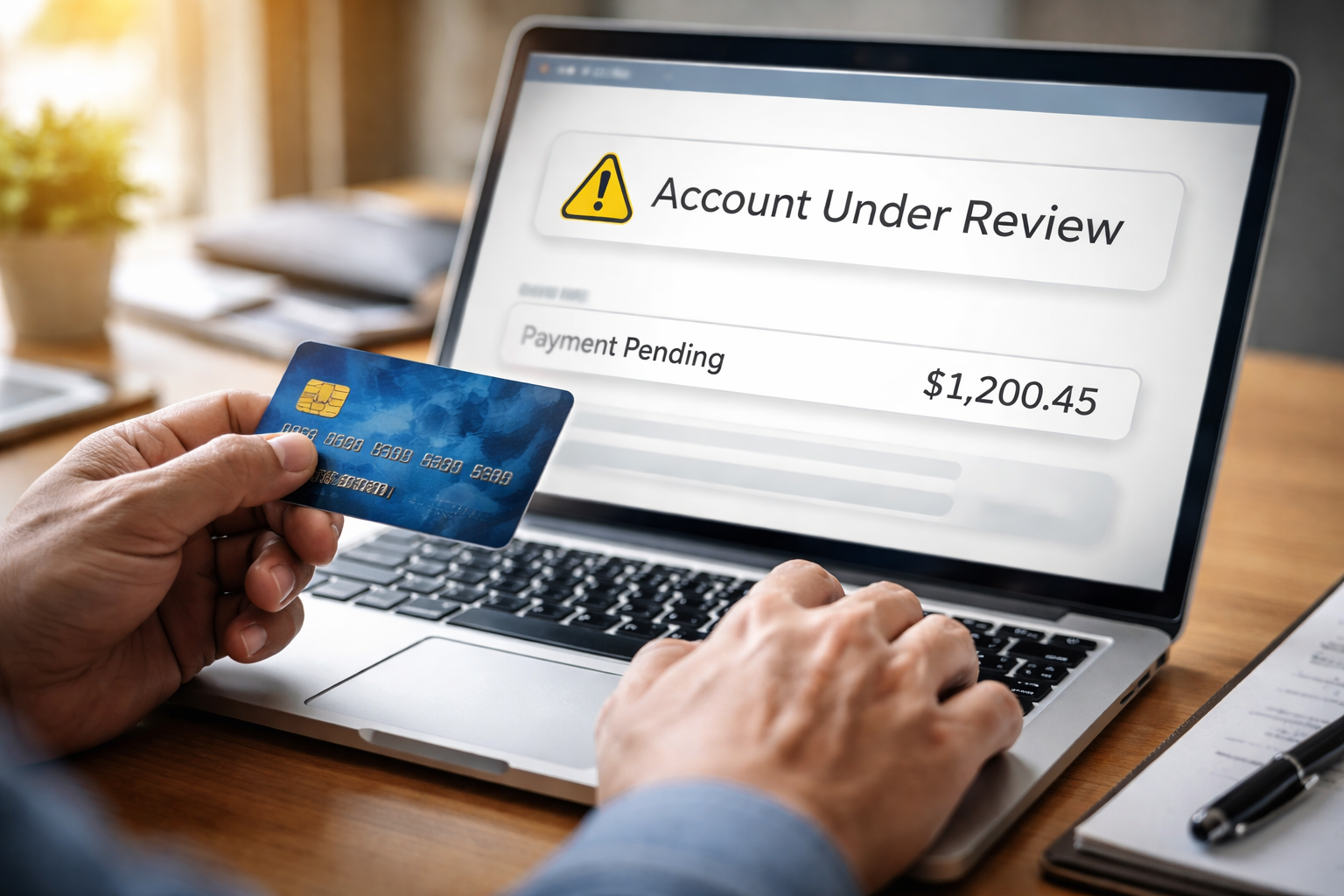
Credit card payment triggered account review before posting was the last thing I expected to see after making a payment I had already double-checked three times. I had logged in because I wanted relief, not another problem. The bank account showed the money was on the way. The card account showed the payment pending. But instead of the balance dropping, I saw language that sounded vague and serious at the same time: the account was being reviewed, some features were temporarily limited, and the payment had not fully posted yet. That was the moment the problem stopped looking like a normal processing delay and started feeling like a risk event inside the issuer’s system.
What makes this situation so unsettling is that it creates two kinds of pressure at once. First, your money may already be in motion, which means you cannot simply use it elsewhere. Second, the card account may still act as if nothing has been fixed. Your available credit may stay low. A purchase may decline. A past-due warning may still sit there. In some situations, credit card payment triggered account review before posting happens quietly in the background. In others, the issuer places restrictions before the payment ever settles onto the account ledger in the way you expected.
If your issue feels broader than one stuck payment line, this hub explains how posting, timing, and statement errors often connect across the same account system.
What you are probably seeing
When credit card payment triggered account review before posting shows up in real life, it usually does not arrive with a clean explanation. You may see one or more of these signs at the same time:
- the payment says pending or processing for longer than usual
- the balance does not drop even though the payment was initiated
- available credit does not replenish
- the account becomes restricted, soft blocked, or review-only
- customer service says the payment is received but not yet released
- the issuer asks for identity, bank, or payment source verification
- autopay and manual payment activity seem to conflict on the same cycle
The important thing to understand is that this is not always a “missing payment” problem. Sometimes the payment is sitting inside an internal hold queue. Sometimes the issuer has decided the payment pattern itself needs review before it credits the account in a normal way. That distinction matters because the right response depends on where the payment is stuck: intake, fraud screening, bank verification, risk review, or account restriction.
Why this happens before the payment posts
Credit card payment triggered account review before posting usually happens when the issuer’s systems decide the payment is not routine enough to move straight through. That does not automatically mean you did anything wrong. It can happen when the issuer sees a sudden large payment, a new linked bank account, a payment from an account that has not been used before, several rapid payments close together, a recent returned payment history, unusual spending right before payment, or behavior that looks inconsistent with the account’s normal pattern.
In plain terms, the issuer may be asking itself whether the payment is real, whether it will clear, whether it is connected to a risky usage pattern, and whether releasing credit immediately would expose the issuer if the payment later fails. That is why credit card payment triggered account review before posting often affects available credit first. The bank may want the payment to survive internal checks before it gives you the practical benefit of that payment.
This also explains why two people can make the same dollar payment and get different outcomes. One payment posts normally in hours. Another ends up in review because the system sees recent disputes, prior returned ACH activity, a fresh bank link, or spending that spiked right before the payment. The review is often about pattern recognition, not just the amount.
Quick self-check
If credit card payment triggered account review before posting happened to you, ask these four questions immediately:
- Was this payment much larger than your normal payment?
- Did you use a new bank account or recently change payment details?
- Did you make large purchases, cash-like transactions, or multiple payments close together first?
- Did the account already have restrictions, disputes, or a recent returned payment?
If you answered yes to any of these, you are more likely dealing with a risk hold than a simple posting lag.
What the issuer may be doing behind the scenes
From the issuer’s side, credit card payment triggered account review before posting is often a control step, not a final decision. The issuer may place the payment into a review status, confirm the payment source, compare the account’s recent activity against internal risk models, and delay the replenishment of available credit until the risk team or automated system clears it. Some issuers also separate “payment received” from “payment fully credited for line availability,” which is why the account can look half-updated and still be functionally restricted.
This is also why frontline agents sometimes sound inconsistent. One representative may say the payment is there. Another may say the account is under review. Another may say nothing is wrong except normal processing. Those statements can all be partially true because they are reading different system notes. The problem is not always that the payment vanished. The problem is that different layers of the account may update on different timelines.
If your account already shows a restriction or soft block after the payment attempt, this related guide can help you separate a review hold from a broader access problem.
Your rights when the payment does not reflect correctly
If credit card payment triggered account review before posting turns into a statement problem, fee problem, or past-due problem, your rights matter. Under Regulation Z, a creditor generally must credit a payment as of the date of receipt, with limited exceptions around conforming requirements and situations where delayed crediting does not result in additional charges. The CFPB also says that if a payment does not show on your statement, you should contact the card company and, to protect your rights, send a written billing error notice within 60 days of the statement that should have reflected the payment. :contentReference[oaicite:0]{index=0}
That does not mean every review delay is illegal. It does mean the issuer cannot simply let a posting issue create avoidable finance charges or billing damage without giving you a path to dispute it. If credit card payment triggered account review before posting later causes a late fee, past-due notation, or incorrect balance reporting, the matter moves beyond “please wait a few more days” and into documented billing-error territory. :contentReference[oaicite:1]{index=1}
For a general official starting point on payment posting and billing error rights, see the Consumer Financial Protection Bureau resource here: Consumer Financial Protection Bureau – What should I do if my payment does not show on my credit card statement?
How to fix it in the right order
If credit card payment triggered account review before posting is happening right now, do not start with a long emotional explanation. Start with a clean sequence.
- Take screenshots of the payment status, current balance, available credit, any restriction notice, and the bank-side payment confirmation.
- Call the issuer and ask one narrow question first: is the payment pending in normal processing, or has it been placed into review or hold status?
- Ask whether the payment was received, whether available credit is being withheld, and whether the account itself is under review separate from the payment.
- Ask if the issuer needs any verification from you right now, including bank ownership confirmation or identity confirmation.
- Write down the date, time, representative name, and exact wording used.
- If the payment should have appeared on the statement but did not, prepare a written billing error notice instead of relying only on phone calls.
When credit card payment triggered account review before posting, the biggest mistake is arguing about fairness before you identify the hold type. If it is a verification hold, you need release conditions. If it is a payment review, you need timeline and documentation. If it is a statement error, you need the written notice path. If it is a restriction problem, you need account-status clarification first.
Situation split
1. Payment left your bank, but card balance did not move.
Focus on proof of receipt and posting date. Ask whether the issuer has the payment medium but has not credited the account yet.
2. Payment shows on the card, but available credit is still frozen.
This points more toward review or risk hold than a pure posting issue. Ask whether credit-line replenishment is delayed pending internal review.
3. Payment is pending and the account is suddenly restricted.
Ask whether the restriction is payment-related, fraud-related, or due to broader internal risk monitoring.
4. Payment delay caused a fee or past-due status.
Move quickly into billing-error documentation and ask for reversal review tied to the payment timeline.
Mistakes that make it worse
Credit card payment triggered account review before posting can get worse when people panic-pay again. A second payment may not fix the first hold. It may deepen the review, especially if it comes from another new account or arrives before the first one settles. Another common mistake is spending against expected available credit before the issuer releases it. That can produce more declines, more flags, or more confusion about whether the payment mattered.
Do not close the linked bank account, do not stop communicating after one phone call, and do not assume the issue is resolved just because a representative says the payment is “there.” If credit card payment triggered account review before posting, your proof needs to cover the entire chain: money initiated, money received, account credited, available credit updated, fees corrected, and reporting damage prevented.
If the issue shifts from review to visible balance damage, this guide can help you handle the version where the payment is still processing but the balance does not update the way it should.
Key Takeaways
- credit card payment triggered account review before posting is usually a timing-plus-risk problem, not just a slow payment problem
- your balance, available credit, and account status may update on different timelines
- a phone call helps, but statement-level errors may require a written billing error notice
- do not send repeated backup payments unless the issuer clearly tells you the first one failed
- the goal is not only to get the payment posted, but to make sure the hold, restriction, fees, and reporting consequences are addressed in the correct order
FAQ
Can a credit card issuer review my account before posting my payment?
Yes. In practice, some issuers separate payment receipt from final release of credit or account normalization. That is why credit card payment triggered account review before posting can happen even when the money appears to be in motion.
Does this mean my payment failed?
No. It may mean the payment is pending review, verification, or delayed application. You need confirmation of whether the issuer received it, whether the bank transfer is good, and whether the account is under a separate review status.
Should I make another payment right away?
Usually not unless the issuer confirms the first one failed. A second payment can create more confusion or deepen the review trail.
What if I get charged a late fee while this is happening?
Document everything and push the issue beyond customer-service reassurance. If the payment should have been reflected and was not, you may need to dispute it formally as a billing error.
Can this hurt my credit report?
It can if the delay turns into an incorrectly reported delinquency or unresolved statement balance. That is why speed and documentation matter.
Recommended Reading
If you want to move from this payment-review problem into the next most likely issue, start with the account-status side first, then the balance-adjustment side, then the reporting side.
This first guide helps when the issuer’s systems seem to be evaluating the whole account instead of just one payment event.
The next step is simple. Call the issuer today, ask whether the payment is in processing or review, ask whether available credit is being intentionally withheld, and document the answer word for word. If the statement should have reflected the payment but did not, prepare the written billing-error notice now, not next week. Do not let a vague “please wait” response turn into a late fee, restriction, or reporting problem that becomes harder to unwind later.
Credit card payment triggered account review before posting feels confusing because it mixes payment timing with risk controls, but the fix becomes much more manageable once you separate those layers. You do not need to guess what the issuer means. You need to pin down the exact hold type, preserve proof, and force the issue into the right channel before the account history gets worse.