
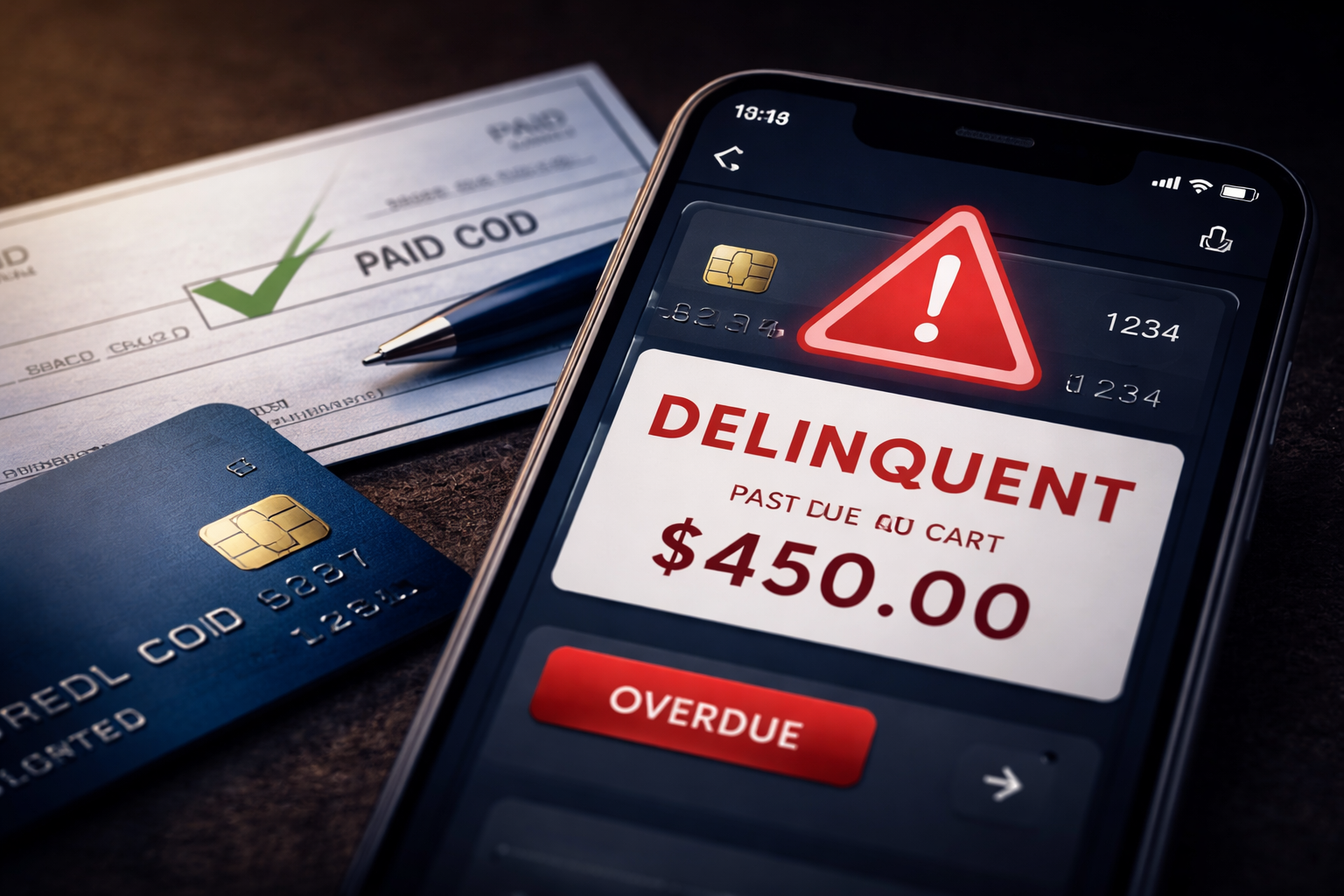
Credit card payment cleared but account still shows delinquent status was the first thing I thought when I logged in expecting the account to look normal again. The money was already gone from my bank. The payment confirmation was sitting in my email. The balance had moved. But the account still had that same delinquent label sitting on it like nothing had changed.
That is the moment this stops feeling like a simple payment issue. It becomes something heavier, because you realize the card issuer accepted the money but did not remove the status that makes the account look late, risky, or still broken. When that happens, the problem is no longer just about whether you paid. It is about which system updated, which system did not, and what gets reported before those systems catch up.
If you need the broader payment-processing background first, start here. This is the closest hub to understand how a posted payment can still leave a separate account flag behind:
Why this happens after the payment already cleared
Credit card payment cleared but account still shows delinquent status usually happens because card issuers do not run one single all-in-one account system. One layer receives and posts money. Another layer decides whether the account is current, past due, restricted, or still in a delinquency bucket. Another layer decides what gets sent to credit reporting. Those layers often move in sequence rather than at the same time.
That is why a payment can be real, final, and visible, while the delinquent label stays in place. The balance screen may say one thing. The account status screen may say another. The next statement may preserve an older label even though the customer already acted. The mistake most people make is assuming that a cleared payment automatically resets every downstream status. It often does not.
Credit card payment cleared but account still shows delinquent status is especially common when the payment came in near a cutoff date, after a statement had already generated, after late-stage delinquency logic had already run, or while the account was under a separate review track. In other words, this is often a timing and hierarchy problem inside the issuer, not proof that your payment failed.
What the issuer may still be waiting on
When credit card payment cleared but account still shows delinquent status, the issuer may still be waiting for one of several internal events to happen before the label disappears.
- The next statement cycle closes and recalculates the status.
- The account satisfies the exact minimum due logic tied to delinquency reversal.
- An internal overnight batch resets the days-past-due bucket.
- A risk or compliance hold is lifted.
- A bureau reporting file refreshes after the internal account catches up.
That means you can have a real payment and still sit in a stale delinquent position for a period of time. Credit card payment cleared but account still shows delinquent status is not always an error on day one. Sometimes it is a lagging state that resolves only when the issuer’s next scheduled event runs.
Find your version of the problem
Payment posted, but the minimum due still shows active
This usually means the payment was real, but not applied in the exact way needed to clear delinquency logic. The account may still treat part of the required amount as unpaid.
Balance dropped, but the delinquent label did not
This often means the balance engine updated first, while the account-status engine has not run its next refresh cycle yet.
Payment arrived after statement close
In this version, the account can still show delinquent status because the prior cycle already locked that status in. The payment may help the next cycle, but not rewrite the already-produced one.
Payment was enough, but the account is under review
If the issuer’s internal monitoring or risk team touched the account, the status can remain frozen until that review path clears.
Internal status corrected, but credit report still looks late
This is a separate reporting-timing issue. The issuer may fix the account first, while the bureau file still reflects the older delinquent status until the next reporting batch.
Payment was applied, but to a different bucket than you expected
If fees, past-due amounts, or prior-cycle obligations consumed the payment differently than you assumed, the delinquent code may remain even though you see movement on the account.
Each version above is different, but they all fall under the same surface experience: credit card payment cleared but account still shows delinquent status. The point is not to panic too early, but also not to treat every situation as harmless delay.
Why this can feel worse than a normal payment delay
A normal payment delay is annoying. This is different because the status label can affect how the account behaves and how the customer sees their risk. Delinquent status can interact with late fees, internal restriction logic, collection workflows, and credit reporting. Even before a bureau file updates, the account may already be categorized internally in a way that changes how the issuer treats it.
Credit card payment cleared but account still shows delinquent status becomes more serious when the account keeps showing past-due behavior after the money has already settled. That is when you need to stop looking only at the payment confirmation and start looking at the status fields around it.
What to check before you call anyone
Before contacting the issuer, compare these fields carefully:
- Current balance
- Statement balance
- Minimum payment due
- Past due amount, if shown
- Payment date
- Statement closing date
- Any message about review, hold, or restricted status
If the minimum due or past-due field is still active, the account may still be coded delinquent even if your balance already changed.
This is where many people miss the real issue. They see the payment deducted from the bank and assume the matter is over. But credit card payment cleared but account still shows delinquent status often survives in those other fields first.
If you also need to compare this with the closely related “paid but still restricted” situation, this article helps separate access restrictions from status-code problems:
When it is probably a timing issue
Credit card payment cleared but account still shows delinquent status is often still a timing issue when all of the following are true:
- The payment posted very recently.
- The account balance reflects the payment.
- The statement cycle has not turned over yet.
- No new fees or fresh delinquency notices are appearing.
- The account is not showing a separate review or freeze message.
In that version, the safest read is that the balance system moved first and the status system has not caught up yet. That does not make the experience less frustrating, but it means the likely fix is the next scheduled system event, not a dramatic intervention.
When it is probably a real account error
There is a point where credit card payment cleared but account still shows delinquent status stops looking like normal lag and starts looking like something that needs to be corrected.
Treat it as a real issue when:
- More than about a week has passed with no status change.
- The account keeps adding late treatment despite a cleared payment.
- The issuer tells you the payment posted, but the system still shows delinquent with no explanation.
- Your credit report updates with the wrong late status after the payment should have fixed it.
- The account shows zero or near-zero exposure, but the delinquent label remains frozen.
Once reporting or fee consequences start attaching to the stale status, you are no longer just waiting on timing. You are dealing with a correction problem.
That distinction matters because the next step changes. At that stage, you should document everything, contact the issuer clearly, and be ready to escalate if the status continues affecting your account or credit file.
What the issuer is likely to say, and what that really means
Sometimes the representative says the payment “went through” but the account “needs time to update.” That can mean several different things. It may mean the representative sees the posted payment but cannot override the delinquency bucket manually. It may mean a status reset only runs overnight or at cycle close. It may mean the account is on a review path the frontline team cannot fully see.
Credit card payment cleared but account still shows delinquent status is one of those problems where customer service language can sound vague because the rep is describing a system dependency without calling it that. If they confirm the payment but cannot explain the status, ask direct questions:
- Is the account still marked delinquent internally?
- Is there a past-due amount still active?
- Has the next cycle update not occurred yet?
- Is there any hold or review delaying the correction?
- Will the current status be reported if nothing changes before the next reporting batch?
What you should do right now
If credit card payment cleared but account still shows delinquent status, take these steps in order:
- Save proof of the payment clearing from both the bank and the card account.
- Take screenshots of the current balance, minimum due, and delinquent label.
- Check whether the statement closing date has passed since the payment.
- Contact the issuer and ask whether the delinquent code is still active internally.
- If the status remains wrong after a reasonable update window, ask for a correction and note the time, name, and summary of the conversation.
Do not make a second payment just because the label is still there unless the issuer clearly explains that an unpaid amount remains. Credit card payment cleared but account still shows delinquent status can trick people into paying twice out of fear. That is one of the most expensive mistakes in this kind of situation.
What not to do while this is unfolding
- Do not assume “paid” and “current” always mean the same thing in the issuer’s system.
- Do not ignore the next statement if the label is still present.
- Do not rely only on a chat summary if reporting damage may happen.
- Do not wait quietly if the status survives long enough to affect your credit profile.
This is also the point where a broader reporting explanation can help. If you are worried about what the issuer may send out next, this article is the right follow-up before the issue reaches your credit file:
Consumer rights and the practical line you should watch
When a payment does not appear properly on a credit card statement or a billing issue needs correction, CFPB guidance says consumers should notify the card company and, to protect their rights, send a written billing error notice within 60 days of the statement that should have reflected the problem. CFPB also provides a complaint channel for unresolved credit card issues.
That does not mean every stale delinquent label is automatically a formal billing-error claim on day one. But it does mean you should not drift for weeks if the issuer admits the payment posted while the harmful status remains. If the stale delinquent status starts affecting fees, account treatment, or credit reporting, move from casual follow-up to documented correction mode.
Official source: Consumer Financial Protection Bureau
Key Takeaways
- Credit card payment cleared but account still shows delinquent status usually means the payment system updated before the status system did.
- A balance change does not always reset delinquency immediately.
- Statement timing, minimum due logic, internal review, and reporting batches can all keep the delinquent label active longer than expected.
- The problem becomes more serious once fees, restrictions, or credit reporting consequences attach to the stale status.
- The right move is to document the payment, compare the status fields, and push for correction if the issue survives the normal update window.
FAQ
Why does my card still show delinquent if the payment already cleared?
Because the payment layer and the account-status layer often update separately. Your money can be posted while the delinquent code waits for the next system refresh.
Does this mean the issuer did not receive my payment?
Not necessarily. If the balance changed and the payment shows as posted, the issuer likely received it. The issue may be the status logic, not the payment itself.
How long should I wait before treating it as a real problem?
A short update lag can be normal, especially around statement dates. But if the status remains long enough to create fees, restrictions, or credit-report damage, you should escalate.
Can this hurt my credit even if I already paid?
Yes. If the stale delinquent status reaches the next reporting cycle before the account is corrected, it may still affect what gets reported.
Should I make another payment just to be safe?
No, not unless the issuer specifically confirms an unpaid amount remains. Otherwise you risk creating a duplicate or unnecessary payment.