
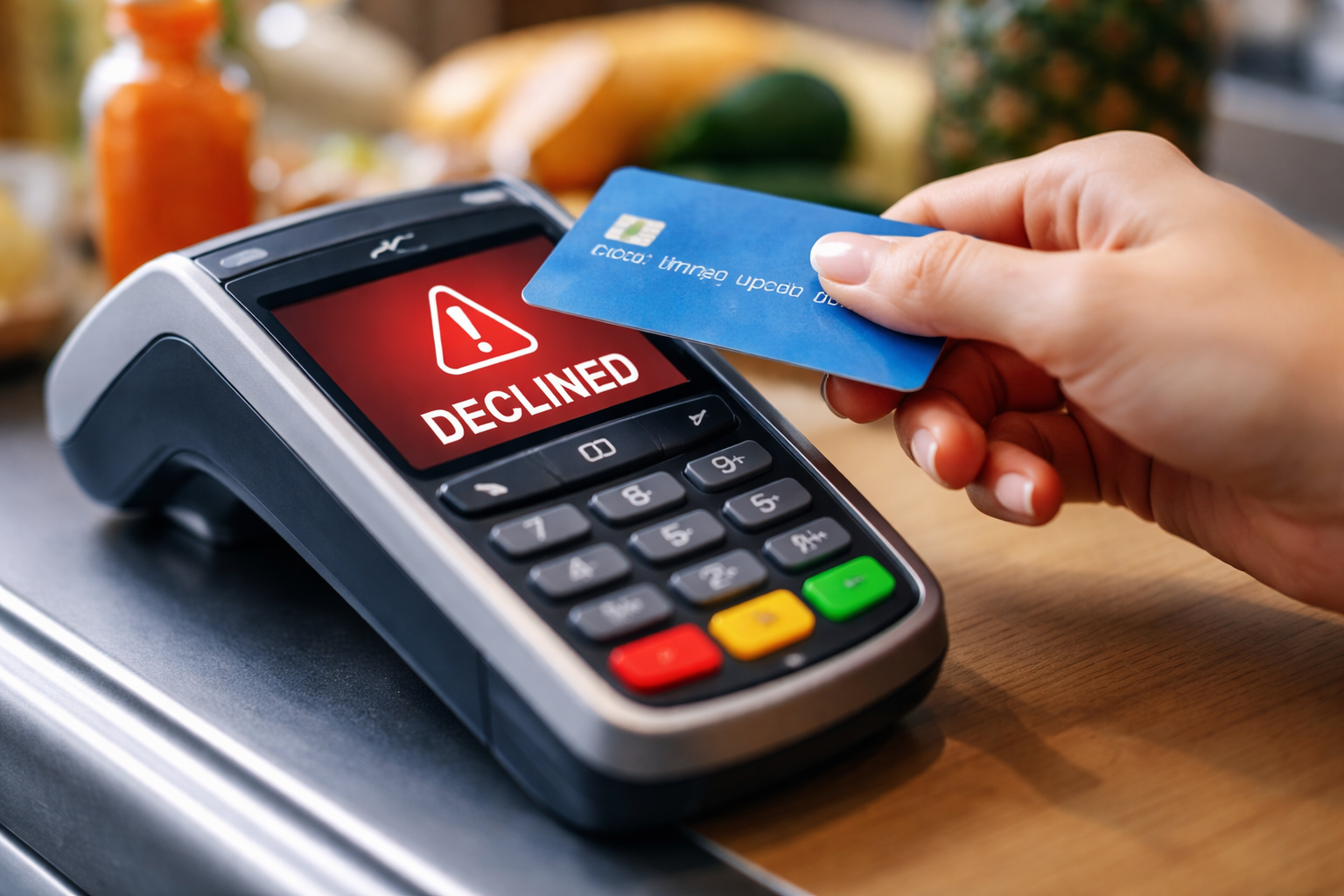
Credit Card Transaction Declined But Account Is In Good Standing — it happened to me at a normal checkout, not some sketchy website. The cashier tried again, I tapped again, and the same quiet “declined” showed up like a dead-end sign. No drama. Just that weird moment where everyone’s polite, but you can feel the line behind you moving in slow motion.
I stepped aside and opened my banking app expecting to see the obvious: “past due,” “over limit,” anything. But nothing. Payments were current. Available credit was fine. No fraud alert. That’s when I realized the decline was probably about the transaction itself, not my overall account health. If you’re here because Credit Card Transaction Declined But Account Is In Good Standing just hit you, the goal is to stop guessing and isolate which layer blocked the purchase.
Before you do anything else, it helps to understand how issuers run risk reviews and scoring behind the scenes (this is often the “hub” that explains the logic you’re bumping into).
Most people who see Credit Card Transaction Declined But Account Is In Good Standing are actually dealing with a short-lived “authorization decision,” not a permanent restriction.
Do This First (2 Minutes, No Guessing)
If Credit Card Transaction Declined But Account Is In Good Standing happens, do these steps in order. This sequence prevents you from accidentally triggering more blocks.
- Stop retrying for 60–120 seconds. Repeated rapid attempts can look like fraud testing.
- Check for issuer alerts. Look in-app notifications, SMS, email, and “security center” messages.
- Confirm the basics. Expiration date, billing ZIP, and whether you’re using the correct card (sounds obvious, but it catches real cases).
- Try a different method once. If it was tap, try chip. If it was online, try entering the billing ZIP carefully.
- If it’s still declined: call the number on the back of the card. Ask specifically: “Was this declined by the merchant, the network, or the issuer?”
The single most useful phrase on the phone is: “Please read me the decline reason or the authorization code / denial code shown on your side.” It forces clarity.
Where the Decline Really Happens (Transaction vs Account)
Credit Card Transaction Declined But Account Is In Good Standing is usually one of three things:
- Issuer decline: your bank says “no” in real time based on risk rules or limits.
- Network/verification failure: the request never completes properly (token, verification, routing issue).
- Merchant-side decline: the merchant’s processor or fraud filter blocks before the issuer even fully evaluates it.
This matters because the fix is different. A merchant-side decline won’t be solved by raising your credit limit. And an issuer-side decline won’t be solved by trying five different stores in a row.
Match Your Exact Scenario
Branch A — In-person store, chip/tap decline, no alerts
- Most likely: issuer risk rule, token/tap mismatch, or merchant category risk.
- Best next step: wait 2 minutes, then try chip once; if it fails, call issuer and ask for “real-time authorization decline reason.”
Branch B — Online checkout, “verification failed,” or “couldn’t process”
- Most likely: billing ZIP mismatch, address mismatch, 3-D Secure / identity verification not completing, browser/device flagged.
- Best next step: confirm billing ZIP + address, switch browser/device, disable VPN, try again once.
Branch C — Gas station / hotel / car rental
- Most likely: large pre-authorization hold or deposit rule (the issuer blocks unusually high temporary holds).
- Best next step: ask merchant what amount they are trying to authorize; request a smaller deposit option; call issuer to pre-clear the merchant type.
Branch D — It worked earlier today, now it’s declining everywhere
- Most likely: velocity rules, suspected fraud pattern, or a temporary internal block.
- Best next step: stop attempts, call issuer immediately. Ask if your account is in “monitoring,” “review,” or “temporary block.”
The “Good Standing” Trap: Why the App Looks Fine
Credit Card Transaction Declined But Account Is In Good Standing feels personal because your app is basically saying “everything’s okay,” while the real world is saying “no.” That mismatch happens because many issuer controls live in the authorization engine, and your consumer-facing portal updates on a different schedule.
Common reasons your account can look normal while a transaction fails:
- Real-time fraud scoring: the transaction looks unusual versus your normal pattern.
- Merchant category policy: some categories are treated as higher risk (tickets, electronics resellers, certain digital goods).
- Temporary limits: daily spend caps, cash-like caps, or “online purchase” caps that aren’t obvious in the app.
- Token/tap issues: mobile wallet token mismatch, expired token, or terminal failing token verification.
If you only do one thing: get the decline reason from the issuer. Without that, you’re just experimenting in public.
Deep Causes You Can Actually Confirm (Not Guess)
Below are the most common “deep causes” behind Credit Card Transaction Declined But Account Is In Good Standing, with confirmation steps you can use immediately.
1) Pre-authorization hold too large
Hotels, gas stations, and rentals may request a large temporary authorization. Even with plenty of available credit, some issuers deny unusual holds.
- How to confirm: ask the merchant, “What amount are you authorizing right now?”
- Fix: request a smaller deposit option, use a different card, or call issuer to approve that merchant type.
2) “Velocity” flags from repeated attempts
Multiple swipes/taps in a short period can trigger a safety rule.
- How to confirm: issuer sees multiple rapid authorizations and may label it as “testing.”
- Fix: stop attempts, wait 5–10 minutes, then call issuer if still blocked.
3) Device / browser / identity verification failure
Online purchases may require behind-the-scenes verification steps that fail silently.
- How to confirm: merchant shows “verification failed” or “cannot authenticate.”
- Fix: correct billing ZIP/address, turn off VPN, try a different device once, then call issuer.
4) Merchant-side fraud filter
Some merchants block transactions before the issuer even fully processes them.
- How to confirm: issuer says, “We didn’t receive the authorization,” or “No record of the attempt.”
- Fix: ask merchant to try a different terminal/processor, or use a different payment method.
In all four situations, Credit Card Transaction Declined But Account Is In Good Standing is a symptom. The “why” lives in the denial code and the layer that produced it.
What the Issuer Is Trying to Prevent (Their Side)
When Credit Card Transaction Declined But Account Is In Good Standing hits, it often means the issuer is prioritizing “stop fraud first, apologize later.” Their systems are trained to block patterns that correlate with stolen cards, card testing, and account takeover.
From the issuer’s perspective, these patterns are high risk:
- first-time merchant + unusually large amount
- new location + digital wallet token
- multiple authorizations in minutes
- online purchase from a new device with inconsistent signals
Even if you are 100% legitimate, your transaction can look like a known fraud pattern. That’s why the fix is usually verification, not “arguing.”
Your Rights (YMYL-Safe, Practical)
Credit Card Transaction Declined But Account Is In Good Standing is usually not a “billing error,” but you still have consumer protections if issues escalate into disputes, unauthorized charges, or merchant problems.
For official federal guidance on using credit cards and disputing charges, see:
Federal Trade Commission – Using Credit Cards and Disputing Charges
This matters because people often confuse a decline with a dispute. A decline means the charge didn’t post. A dispute means it posted and you’re challenging it. Keep those two tracks separate so you don’t waste time in the wrong workflow.
The Clean Fix Script (What to Say on the Phone)
If Credit Card Transaction Declined But Account Is In Good Standing continues after one careful retry, call the issuer and use this script. It’s short, specific, and gets you an answer faster:
Phone Script
- “A transaction was declined, but my account is current. Can you confirm whether the decline was issuer-side?”
- “Please read the decline reason / denial code shown on your side.”
- “Was it fraud scoring, a limit rule, or merchant category policy?”
- “Can you lift the temporary block and note the account for this merchant type today?”
- “If I retry once, should it approve immediately?”
When you do this, Credit Card Transaction Declined But Account Is In Good Standing usually turns into a quick “verified” note and the next attempt works.
Don’t Do These Things (They Backfire)
These are the fastest ways to turn Credit Card Transaction Declined But Account Is In Good Standing into a longer mess:
- trying the same charge 6–10 times in under a minute
- testing multiple merchants rapidly to “see if it works somewhere else”
- changing billing ZIP repeatedly with random guesses
- asking the merchant to split the charge into many small charges without guidance
These behaviors can look exactly like card testing. If the system escalates, you can end up with a temporary restriction that takes longer to clear.
If you suspect this is becoming more than a one-off decline, it helps to understand what account restrictions look like and how they’re triggered.
Key Takeaways
- Credit Card Transaction Declined But Account Is In Good Standing usually means a transaction-level rule fired, not that you’re behind on payments.
- Get the decline source: merchant-side, network/verification, or issuer-side. The fix depends on the layer.
- Pre-authorization holds (hotel/gas/rental) and velocity flags are top causes.
- One careful retry is fine; repeated rapid attempts can escalate monitoring.
- The fastest resolution is calling the issuer and requesting the decline reason/denial code.
FAQ
Why did this happen if my available credit is high?
Credit Card Transaction Declined But Account Is In Good Standing can occur because the issuer is evaluating risk signals (merchant type, location, unusual amount) that are separate from your credit limit.
Does a decline mean my account is restricted?
Not always. A single decline is often a transaction-level decision. If it starts declining across multiple merchants, ask the issuer if you are in monitoring/review.
Will a declined transaction affect my credit score?
No. A decline is an authorization decision and does not appear on credit reports.
Why does it decline online but work in person?
Online transactions may require extra verification steps and device-based risk checks. Address/ZIP mismatches and authentication failures are common.
Should I open a dispute?
If the transaction was declined, there is usually nothing to dispute because it did not post. If a charge posts later unexpectedly, that is when dispute workflows may apply.
What To Do Next (One Clear Action Plan)
Credit Card Transaction Declined But Account Is In Good Standing is frustrating mostly because it feels like the system is contradicting itself. But once you treat it as an authorization-layer problem, it becomes solvable.
Here’s your plan:
- Stop retries for 2 minutes.
- Check for alerts and confirm billing ZIP/address (if online).
- Ask the merchant what amount they are authorizing (hotel/gas/rental especially).
- Call the issuer and request the decline reason/denial code.
- Retry once after the issuer confirms the block is cleared.
If your declines are spreading across merchants, treat it as urgent and get the account status clarified today. This is the point where a “simple decline” can turn into a temporary hold if you keep testing it.
To understand what a hold looks like and what changes when the issuer moves from “transaction decline” to “account state,” read this next before you make more attempts.
Credit Card Transaction Declined But Account Is In Good Standing is usually resolved the same day when you isolate the layer and get a clear decline reason. No guessing, no repeated swipes, no accidental escalation—just the shortest path to “approved” again.