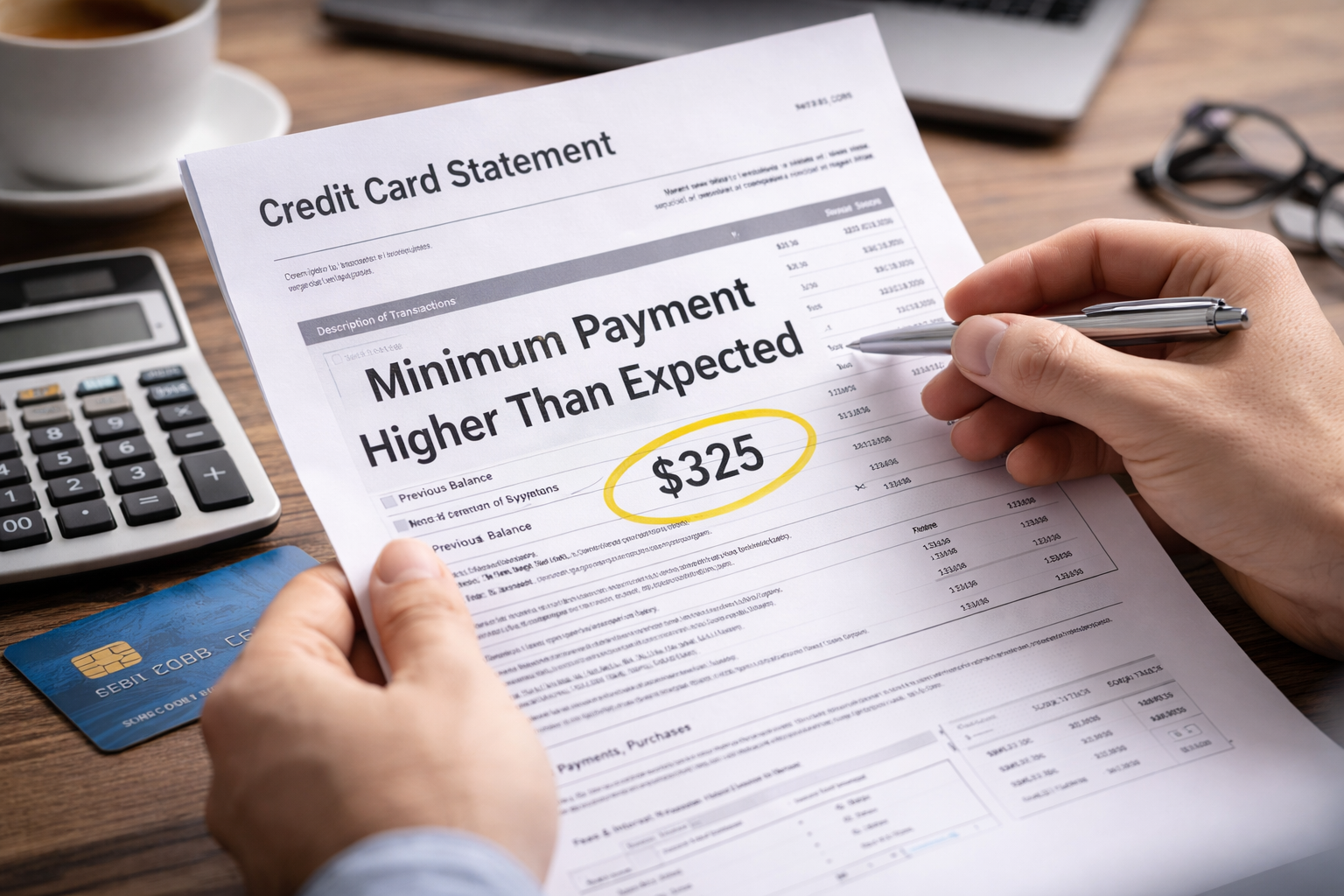
Credit card statement minimum payment higher than expected is usually the moment people stop trusting what they are seeing on the screen.
I noticed it in the least dramatic way possible. I opened the statement expecting the usual routine number, already half-thinking about paying it and moving on. Instead, the minimum due had jumped enough to make me pause. Not double. Not absurd. Just high enough that it no longer matched the account history I had gotten used to. That kind of change is worse in some ways, because it makes you question whether you missed something obvious.
There hadn’t been a spending spike. There wasn’t a large emergency purchase sitting on the account. No obvious late payment warning. No fraud alert. Just a statement that suddenly looked more expensive than the one before it. When credit card statement minimum payment higher than expected shows up like that, most people make the same mistake first: they focus only on the total balance and ignore the moving parts underneath it.
The minimum payment can increase even when your overall balance does not rise much, and that is exactly why this issue feels so confusing.
If you want to understand how hidden billing logic appears on a statement before you assume something is broken, this hub is the closest internal starting point:
Why This Feels Wrong Even When The Issuer Thinks It Is Normal
Credit card statement minimum payment higher than expected usually does not come from one dramatic event. It comes from small components that changed at the same time. A little more interest. A fee that posted near the cutoff. A grace period that quietly disappeared. A previous payment that was credited, then partially reversed. None of those always look major by themselves, but the minimum due formula reacts to them fast.
That is why this issue often feels personal even though it is mechanical. You are looking at the account from the outside. The issuer is calculating it from the inside.
What usually changed behind the scenes:
- Interest increased because the prior statement balance was not fully paid
- A late fee, annual fee, or penalty fee was added into the cycle
- A promotional APR expired and the account shifted into standard interest calculation
- A payment posted after the statement cutoff, so the statement used an older figure
- A returned or reversed payment forced the system to recalculate the minimum
- The issuer’s formula hit a threshold where a fixed minimum amount no longer applied
What makes this so frustrating is that statements rarely explain which of these caused the jump in plain language.
The Most Common Pattern: Interest Quietly Took Over More Of The Formula
For many accounts, the minimum is not just a flat percentage of the balance. It can include interest, fees, and a portion of principal. That means credit card statement minimum payment higher than expected may appear even when you thought you were managing the balance responsibly.
This happens a lot when someone paid a large amount last month, but not the full statement balance. From the consumer side, that feels close enough. From the issuer side, it may mean the grace period did not fully apply. Once that happens, trailing interest or continued purchase interest can push the new minimum up.
If this sounds like your month, compare these signs:
- You paid most of the balance, but not all of the statement balance
- You assumed a small remaining amount would not matter much
- The next statement showed interest that was larger than expected
- The minimum due rose even though spending stayed similar
In that version of the problem, credit card statement minimum payment higher than expected is not about a broken formula. It is about the formula using more interest than you expected it to use.
If your confusion is really about where the payment went across different interest buckets, this related internal explainer fits naturally here:
When The Statement Cutoff Makes A Normal Payment Look Useless
Another very common version is timing. You made a payment. The account even shows the payment. But the statement minimum still rose. That makes people think the issuer ignored the payment, when what actually happened is more narrow than that.
Statements are snapshots. If your payment arrived after the cycle closed, then the new statement may still reflect the earlier unpaid amount for minimum calculation purposes. In that situation, credit card statement minimum payment higher than expected can appear even though the payment was real and properly processed.
Timing-driven version of the problem:
- You paid near the due date or near the statement close date
- The payment posted, but too late to affect the cycle snapshot
- The new statement used the older balance for minimum due calculation
- You feel like the account is counting money twice, even though it is really a cutoff issue
This is one of the most misleading situations because the payment can be real, visible, and still not reduce that month’s minimum in the way you expected.
That is why you should compare not just the payment date, but the posting date and the statement closing date. When credit card statement minimum payment higher than expected is driven by timing, those two dates usually explain almost everything.
When Fees, Expired Promotions, Or Risk Changes Push It Up Fast
Some increases are small. Others feel sudden because the account moved into a different cost structure.
A promotional APR ending is a classic example. Many people watch the balance but not the promo end date. Once that promotional period ends, the interest portion of the minimum can change fast. The same thing can happen when a late fee is added, when a payment is returned by the bank, or when the account shifts into a higher-risk servicing posture after unusual payment activity.
Credit card statement minimum payment higher than expected becomes especially noticeable when two things happen together: a promo ends and a fee hits in the same cycle, or a payment reversal lands in the same month as new interest.
Watch for these trigger combinations:
- Promotional APR expired + standard purchase APR resumed
- Returned payment + new fee + higher next minimum
- Annual fee posted + balance already carrying interest
- Late fee added + statement generated before replacement payment settled
In those situations, credit card statement minimum payment higher than expected is the output, not the cause. The real issue is the chain reaction underneath it.
Issuer Logic: What The Bank Is Trying To Protect
From the card issuer’s point of view, the minimum payment is not just a courtesy number. It is a risk-control number. It is designed to recover enough money each cycle to cover at least part of the account’s carrying cost and reduce the chance of deeper delinquency.
That means the issuer is usually trying to pull in:
- Accrued interest
- Recent fees
- A required slice of principal
- Any amount needed under its internal floor rules
So when credit card statement minimum payment higher than expected appears, the issuer may view that as a normal system response to changes in account economics. The problem is not always legality. The problem is visibility.
The statement often tells you the result without showing the full logic that produced it.
How To Tell Which Version You Are Dealing With
You should not approach every increase the same way. The right fix depends on which pattern you are in.
If your balance barely changed:
Look first for interest, fees, or promo expiration.
If you made a recent payment:
Check statement closing date versus posting date.
If a prior payment failed or was reversed:
Review whether the account recalculated the minimum after removing that credit.
If available credit also looks strange:
You may be dealing with both payment timing and account update lag.
This matters because credit card statement minimum payment higher than expected is not one single consumer problem. It is a visible symptom shared by several different internal account paths.
What You Should Ask The Issuer, Exactly
Do not call and say, “Why is my minimum so high?” That often gets you a vague answer. Ask narrower questions that force the issuer to identify the driver.
- What exact components make up this month’s minimum payment?
- How much of it is interest?
- How much of it is fees?
- Did a previous payment post after the statement closing date?
- Did a promotional rate end before this statement was generated?
- Was any payment reversed, returned, or treated as unavailable credit?
The more specific your question, the harder it is for the issuer to hide behind a generic script.
For a plain-language official consumer explanation of minimum payment basics, use this one source:
Consumer Financial Protection Bureau — Minimum Payment Basics
What To Do Right Now So It Does Not Turn Into A Past-Due Problem
If credit card statement minimum payment higher than expected is on your screen right now, act in this order.
- Open the previous statement and current statement side by side
- Mark any new interest line, fee line, or APR change notice
- Find the statement closing date and your last payment posting date
- Confirm whether the payment was posted, reversed, or only pending during the cycle
- Call the issuer and ask for the minimum due breakdown in dollars, not in general terms
- Pay at least the required minimum shown while you investigate, unless the issuer confirms a correction immediately
This last point matters most. If you decide on your own that the old minimum “should have been enough,” you can accidentally create a real late-payment issue out of a statement you were only trying to question.
What Not To Do
Do not assume it will self-correct next month. Do not ignore a higher minimum because your total balance “looks about the same.” Do not focus only on current balance while skipping the statement detail. And do not confuse available credit movement with minimum due logic. Those can overlap, but they are not the same problem.
Many people also jump straight to “billing error” when credit card statement minimum payment higher than expected appears. Sometimes that is true. Often it is not. Often it is a timing or interest-structure issue that only becomes obvious after a line-by-line comparison.
Recommended Next Reading
If your statement now looks inconsistent in more than one place, this next article helps when the payment seems processed but the account still behaves like it is behind:
Key Takeaways
- credit card statement minimum payment higher than expected is usually caused by interest, fees, timing, or promo changes
- The problem is often structural, not random
- A visible payment does not always reduce the statement minimum if the cutoff already passed
- Small account changes can create a surprisingly larger minimum due
- You need the dollar breakdown of the minimum, not a generic explanation
- Pay the required minimum shown while you verify details so you do not create a new delinquency problem
FAQ
Why did my minimum payment go up when I did not use the card much?
Because the increase may come from interest, fees, or the end of a promotional rate rather than new spending.
Can my minimum payment rise even if I already made a payment?
Yes. If the payment posted after the statement cutoff, the statement may still calculate the minimum using the earlier amount.
Does this always mean the issuer made a mistake?
No. But the issuer should still be able to explain the exact components of the new minimum.
Should I only pay what I think the old minimum should have been?
No. Pay the required amount shown unless the issuer confirms a correction immediately.
What is the first document I should compare?
Compare the previous statement and the current statement side by side, focusing on interest, fees, APR notices, and payment posting dates.
credit card statement minimum payment higher than expected usually feels alarming because it arrives without context. You are shown the demand before you are shown the reason. That is why the problem feels bigger than the number itself.
The right move is to slow down and break it apart in order. Check the statement close date, trace new interest and fees, ask for the exact minimum calculation, and make sure this month does not turn into an avoidable late-payment month while you investigate. That is how you solve the problem without letting the account get worse.