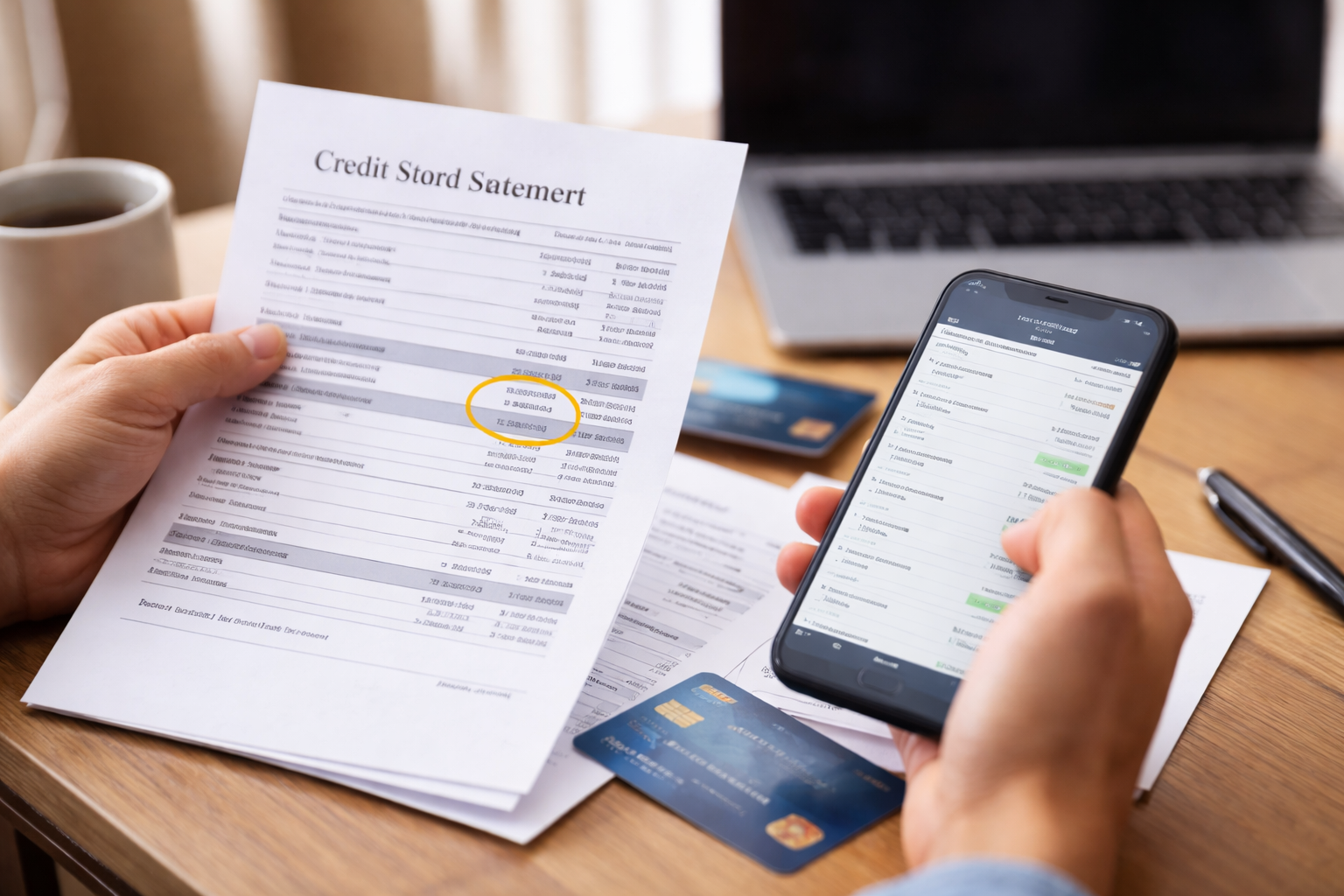
Credit card statement error what to do hit me in the most ordinary moment: I was half-awake, scrolling my statement like I always do, and one line item looked… off. Not “alarm bells” off. Just wrong enough that my stomach dropped a little and my brain started doing math it didn’t want to do.
I didn’t rage. I didn’t post about it. I just sat there staring at the screen, trying to decide if I was overreacting. That’s the trap. The mistake doesn’t have to be huge to become expensive—especially if it triggers interest, fees, or a missed payment while you’re waiting for it to “sort itself out.” If you’re here, you’re likely in the same moment, and you need a clean plan you can follow today.
If your situation turns into a denied dispute later, this hub-style guide helps you avoid the common pitfalls that weaken claims:
First: Confirm It’s Actually an Error (10-Minute Triage)
Before you call anyone, treat this like a short investigation. When people search credit card statement error what to do, they often skip this step—then they sound uncertain on the phone and the whole process slows down.
Do these checks in order:
- Merchant name mismatch: Search the merchant name. Many brands bill under a parent company.
- Pending vs posted: Is it a pending authorization, or fully posted?
- Tip adjustment: Restaurants can update totals after authorization.
- Hotel/rental hold: Temporary holds can look like real charges for days.
- Split shipment: Some retailers charge per shipment.
- Trial conversion: “Free” trials often convert on day 7, 14, or 30.
If none of these explain it, you’re not “being picky”—you’re being financially responsible.
Choose Your Situation Path (This Changes What You Do Next)
The fastest results come when you choose the correct path. This is the real meaning of credit card statement error what to do: the action depends on the type of error, not your frustration level.
Pick the closest match:
- Path A: The charge is real, but the amount is wrong.
- Path B: You got charged twice for the same thing.
- Path C: A fee appeared that you didn’t expect or agree to.
- Path D: Your payment posted late, wasn’t applied, or looks reversed.
- Path E: You do not recognize the charge at all.
Don’t try to force your situation into the wrong category. Banks investigate differently depending on which path you choose.
Path A: The Amount Is Wrong (Undercharged/Overcharged/Tip Problems)
If the purchase is yours but the number is wrong, credit card statement error what to do starts with evidence that proves the “expected” amount.
- Screenshot the order confirmation, receipt, or email total.
- If it was in-person, take a photo of the receipt (front and back if needed).
- Write down what you agreed to pay and why (example: “$42.17 + $8 tip = $50.17”).
Best sequence:
- Contact the merchant first (same day if possible).
- Ask for a correction or refund timeline in writing.
- If they stall, open a dispute with your issuer and attach proof.
If you wait “to be nice,” you’re the only one carrying the risk.
For wrong totals specifically, use this focused guide (it helps you frame the dispute cleanly):
Path B: Duplicate Charge (Same Merchant, Same Day, Same Amount)
Duplicate charges can be terminal retries, online glitches, or a cashier “re-running” a payment when a receipt didn’t print. The key with credit card statement error what to do here is not to guess—confirm the merchant’s records.
What to request from the merchant:
- Transaction IDs for both charges
- Proof one was voided (void receipt or refund confirmation)
- Refund date and expected posting window (often 3–10 business days)
If the merchant can’t prove one was voided, treat it as unresolved and escalate.
If it’s a fee-type duplicate (not a purchase) like accidental fee stacking, you may need a different path below.
Path C: Surprise Fees (Late Fee, Annual Fee, Over-Limit, Cash Advance)
Fees are where people lose money quietly. A fee can trigger interest, increase utilization, and snowball into more fees. In this path, credit card statement error what to do means identifying whether the fee was policy-based or truly incorrect.
- Late fee: Was your payment actually on time, or did it post after the cutoff?
- Over-limit: Did a merchant finalize a larger amount than the authorization?
- Cash advance: Was a transaction coded as “cash-like” (some apps and money transfers are)?
- Annual fee: Was there a first-year waiver that ended?
How to win fee disputes:
- Be specific: name the fee and the statement date.
- Show your timeline: when you paid, when it posted, what the due date was.
- Ask for a one-time courtesy reversal only after you state the facts.
If you’re dealing with a late-fee situation, this is the most relevant internal guide to align your steps:
Path D: Payment Not Applied, Posted Late, or “Reversed”
This path is stressful because it can create instant damage: interest charges, late fees, or a sudden balance jump. The core of credit card statement error what to do here is to protect your account while the bank investigates.
Do this today:
- Screenshot payment confirmation (your bank/app receipt).
- Verify the payment method and account number used.
- Call the issuer and request a “payment trace” if available.
- Ask them to note the account and pause late reporting while it’s investigated.
Don’t assume the system will “catch up” before the due date consequences hit.
If your statement now shows interest that shouldn’t be there because you paid in full, you may need a deeper interest-focused guide later—but keep your first call clean and specific.
Path E: Unrecognized Charge (Treat It Like a Security Problem)
When you truly don’t recognize a charge, do not start with “maybe it’s nothing.” In this situation, credit card statement error what to do means acting like your card details might be compromised.
- Call the issuer immediately and ask if it’s pending or posted.
- If you suspect fraud, request a new card number and updated security steps.
- Review recent transactions for “test charges” (small amounts) before a larger one.
Important: If it’s fraud, contacting the merchant first can waste time. Your issuer can block further attempts and document your report time.
What Banks Actually Decide (And Why Your First Report Matters)
Most people think disputes are decided by “who’s right.” In practice, disputes are strongly influenced by documentation and timing. That’s why credit card statement error what to do includes structure: you’re building a record.
Issuers often evaluate:
- Speed: How soon after the statement or charge you reported it
- Clarity: Whether your claim is specific, consistent, and supported
- Pattern: Whether the transaction is unusual for your account history
- Merchant response: Whether the merchant provides a convincing rebuttal
You don’t need to sound like a lawyer. You need to sound like someone who kept receipts.
Your Rights and the Timeline
For U.S. consumers, billing error protections (including dispute procedures) are often discussed through the Fair Credit Billing Act framework. If you want the official, plain-language steps from a regulator, use this reference:
The practical takeaway for credit card statement error what to do is simple: the sooner you document and report, the cleaner your dispute becomes. Waiting makes everything harder to prove, especially when receipts get lost and merchant systems purge logs.
Exact Call Script (Use This to Stay Calm and Effective)
If you freeze on calls, read from this. This is designed for credit card statement error what to do situations where you want speed without sounding unsure.
Phone script:
“Hi. I’m calling to report a billing error on my statement. The transaction is from [MERCHANT NAME] on [DATE] for [$AMOUNT]. I believe it’s incorrect because [SHORT REASON]. I have documentation and can upload it. I’d like to open a dispute and confirm what you need from me today.”
Then stop talking and let them guide the process.
Don’t over-explain. Don’t speculate. You’re building a clean record.
Do Not Make These Mistakes (They Quietly Kill Disputes)
- Waiting weeks “to see if it fixes itself”
- Using vague reasons like “I don’t like it” instead of “amount is incorrect”
- Ignoring issuer messages requesting documents or clarifications
- Stopping payments you still owe (pay the undisputed portion if instructed)
- Disputing everything at once without separating issues into clear categories
The goal is not drama. The goal is a decision in your favor.
If the Dispute Gets Denied: What to Do Next
A denial doesn’t automatically mean you’re wrong. It often means the issuer accepted the merchant’s evidence, or your documentation was thin. At this point, credit card statement error what to do shifts into “rebuild the record and escalate calmly.”
Denial recovery checklist:
- Request the reason code / explanation for the denial.
- Ask what evidence the merchant provided (receipt, delivery proof, terms, etc.).
- Submit additional documents that directly contradict that evidence.
- Escalate to a supervisor or the issuer’s dispute escalation channel if available.
When you respond to evidence with better evidence, outcomes change.
If you’re already in that denial stage, use this internal guide as your next move:
Key Takeaways
- Confirm first, then act fast. You’ll sound more credible and move faster.
- Pick the correct situation path (wrong amount, duplicate, fee, payment issue, unrecognized).
- Documentation beats emotion every time.
- Fee and payment errors can snowball—treat them urgently.
- If you get denied, ask for the reason and respond with targeted proof.
FAQ
Should I contact the merchant or the card issuer first?
If the merchant is legitimate and it’s a wrong amount or duplicate, merchant-first can resolve it quickly. If it’s unrecognized or looks like fraud, issuer-first is safer.
Do I still need to pay my bill while disputing?
Many issuers advise paying the undisputed portion to avoid interest/late fees. Follow your issuer’s instructions and keep proof of what you paid.
What if the charge is small?
Small errors repeat. Also, small charges are sometimes “test charges” before bigger attempts. Treat it seriously and document it.
Will opening a dispute hurt my credit score?
A dispute itself typically doesn’t. Late payments and high utilization can. That’s why payment-path errors should be handled quickly.
How long does it take to resolve?
It varies by issuer and merchant response. Your fastest lever is submitting clear documentation immediately when requested.
credit card statement error what to do isn’t about finding the perfect sentence to say. It’s about moving quickly with clean proof, choosing the right path, and protecting your account while the system does its work. When you act early, you control the narrative.
So don’t stare at the statement hoping it changes. Screenshot the transaction, gather the one or two documents that prove your point, and open the dispute or merchant request today. If you do that now, you’re not “overreacting”—you’re preventing a small error from becoming an expensive routine.