
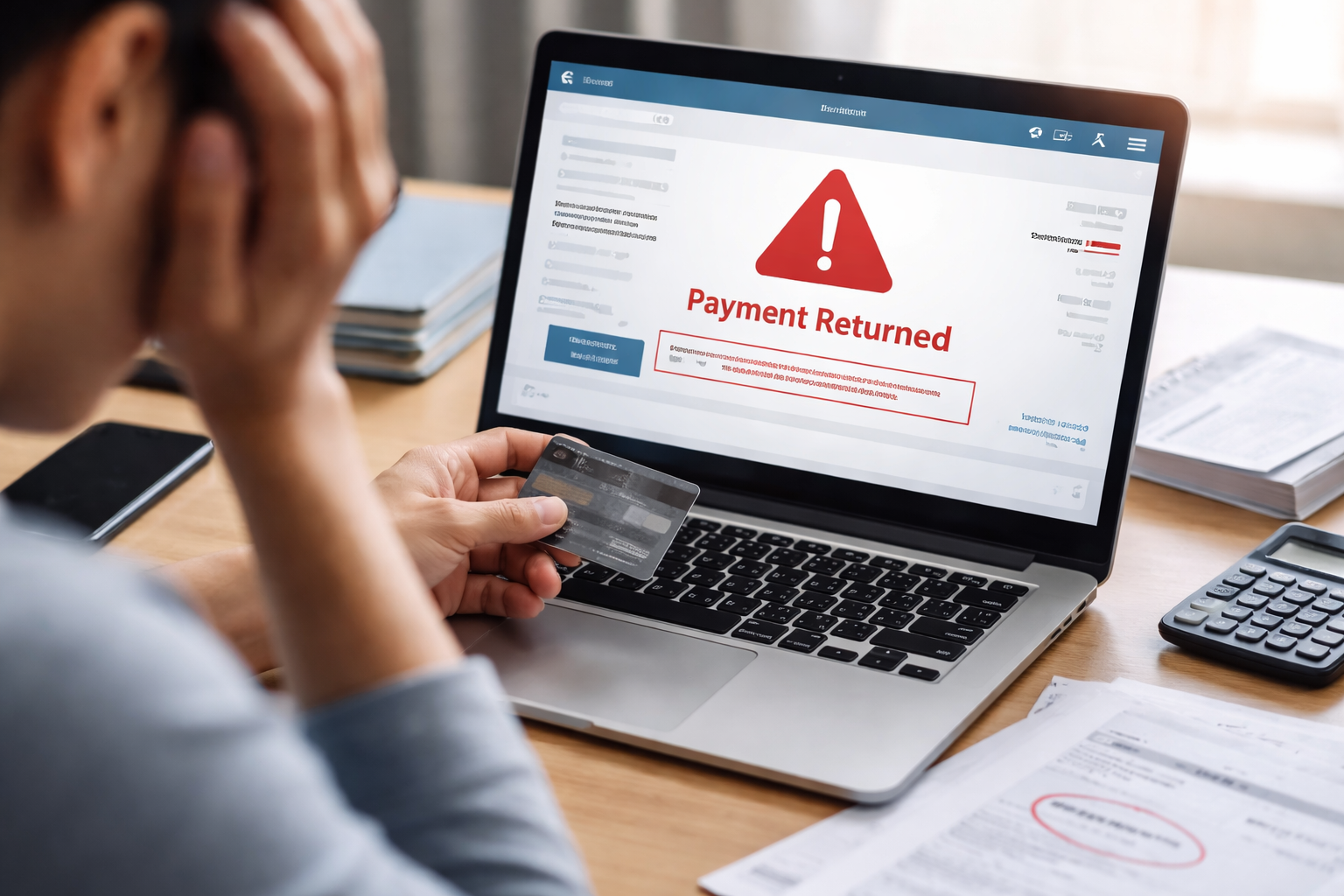
Credit Card Payment Returned for Insufficient Funds After Posting was the phrase that explained what had just happened, but I only found it after staring at the account screen for several minutes. Two days earlier, the payment had already posted. The balance dropped. The available credit went back up. I had moved on mentally because the problem looked over. Then I logged in again and saw the balance rise back up almost to where it had been before. The payment line no longer looked clean and finished. It looked like the system had changed its mind after the fact. That is the exact point when this situation becomes more dangerous than it first appears, because many people assume a posted payment is final when it may still be in bank-clearing review.
Credit Card Payment Returned for Insufficient Funds After Posting is confusing because it feels backward. Most people think insufficient funds should cause an immediate rejection, not a delayed reversal after the payment already seemed complete. But card issuers and banks do not always finalize everything in one instant. The card account may show the payment as posted before the bank transfer fully survives settlement. If the bank later rejects the debit, the issuer reverses the account credit. What looks like a completed payment on the card side can still fail on the bank side a little later.
This usually becomes a bigger problem when it happens close to a due date, during autopay, or after the cardholder already used the restored available credit. If that is the stage you are in, read the risk-pattern guide below first because it helps explain why issuers watch returned payments closely.
Why the Payment Looked Fine First
Credit Card Payment Returned for Insufficient Funds After Posting usually starts with the way payment systems are layered. When you submit a payment, the issuer often records the request immediately. In many cases it will show as pending first, then post to the account ledger before the bank transfer is fully settled. That early posting is operationally convenient because it updates balances faster, but it also creates the exact confusion behind Credit Card Payment Returned for Insufficient Funds After Posting.
A typical timeline looks like this:
- Day 1: Payment is initiated from your bank account
- Day 1 or 2: Card issuer shows the payment as received or posted
- Day 2 to 5: ACH clearing continues behind the scenes
- Later: Bank rejects the debit because available funds were not actually there when settlement completed
- Result: The issuer reverses the payment credit and the balance returns
Credit Card Payment Returned for Insufficient Funds After Posting often surprises people because their account history briefly looked normal in the middle of that timeline. The temporary appearance of success is exactly what makes this situation feel like a system error, even when it is really a late-stage payment failure.
What Usually Causes It
Credit Card Payment Returned for Insufficient Funds After Posting is most often tied to one of a few operational causes, and the exact cause matters because it affects whether the issuer treats this as a one-time payment problem or an early warning sign.
Most common triggers
- The bank balance was high enough when you checked it, but other transactions cleared first
- Autopay ran overnight after other debits reduced the balance
- A paycheck deposit was expected but had not fully settled yet
- The wrong account or routing number was used
- The bank account was restricted, closed, frozen, or overdrawn when ACH settlement completed
- An internal bank block or fraud review interrupted the debit after the card issuer had already posted the payment
Credit Card Payment Returned for Insufficient Funds After Posting can also happen when a user relies on overdraft protection that does not apply to ACH debits the way they expected. Sometimes the money seems available in the banking app, but the bank later determines that certain funds were not usable for that transaction type.
The important practical point is that the issuer normally relies on the bank’s final settlement result, not on the earlier appearance of sufficient funds.
What the Issuer May Do Next
Once Credit Card Payment Returned for Insufficient Funds After Posting hits the account, the issuer’s system may trigger several changes at once. Some are visible immediately, and some appear only after the next cycle or after additional account monitoring.
- The payment amount is removed from the ledger effect
- The statement balance increases again
- Available credit may shrink immediately
- A returned payment fee may be added
- The minimum payment may still show as due or missed
- Future payments may receive more scrutiny
- The account may move into temporary risk review without formal closure
Credit Card Payment Returned for Insufficient Funds After Posting does not automatically mean your card will be shut down. But if the amount was large, if this has happened before, or if you immediately made purchases using the temporary credit, the issuer may view the pattern more seriously. That is especially true when a returned payment happens after the system temporarily restored spending room and the cardholder used it fast.
If the account starts behaving strangely after the reversal, this closely related page may help you compare what you are seeing.
Case Branches That Change the Best Response
Credit Card Payment Returned for Insufficient Funds After Posting is not one single scenario. The right response depends on what happened around the reversal, how close it was to the due date, and whether the issuer changed account behavior afterward.
Case 1: One returned payment, no other warning signs
This is the cleanest version. Credit Card Payment Returned for Insufficient Funds After Posting appears, but the account still works normally. Charges go through, the card is usable, and there are no alerts beyond the restored balance and maybe a fee. In this case, the safest move is simple: replace the payment immediately from confirmed funds and then monitor the next statement for any extra fee or late mark.
Case 2: Returned payment happened right before the due date
This is more dangerous. Credit Card Payment Returned for Insufficient Funds After Posting may make it look like the issuer received your payment on time when, in final settlement terms, it did not. If the due date passed during that gap, the account may still become late. The replacement payment should be made quickly, and the due-date status should be checked directly in the issuer portal.
Case 3: Returned payment after autopay
This creates confusion because many people trust autopay as automatic protection. But autopay is still only as good as the bank funds behind it. Credit Card Payment Returned for Insufficient Funds After Posting after autopay means you should not assume the system will retry in time. Some issuers retry. Some do not. Check manually instead of assuming.
Case 4: Large payment restored credit, then you spent against it
This version can trigger more internal scrutiny. Credit Card Payment Returned for Insufficient Funds After Posting after a large payment may look more serious to the issuer if purchases were made quickly using the temporarily increased available credit. This does not automatically mean misconduct, but it can look riskier in automated systems.
Case 5: Returned payment plus account restriction
If Credit Card Payment Returned for Insufficient Funds After Posting is followed by transaction declines, reduced limit visibility, frozen online functions, or a request to call the issuer, the account may be under review. At that point, the issue is no longer only about the failed payment. It is also about account confidence and payment reliability.
Case 6: Returned payment fee plus interest plus late fee confusion
This is where people often underestimate the cost. Credit Card Payment Returned for Insufficient Funds After Posting can lead to a stack of consequences: the original balance returns, interest keeps running, a returned payment fee appears, and if no valid replacement payment is made in time, a late fee may follow too.
Identifying your exact branch matters because the wrong assumption usually leads to a second problem, not just the first one.
What You Can Realistically Challenge
Credit Card Payment Returned for Insufficient Funds After Posting is usually not a classic billing-error dispute in the same sense as a wrong merchant charge. If the bank really rejected the debit, the issuer is generally allowed to restore the original balance. That means the core reversal itself is often not the part you can challenge successfully.
What you can review carefully includes:
- whether the returned payment fee was permitted under your card terms,
- whether the issuer double-counted the failed payment and another charge,
- whether a late mark was added even though a valid replacement payment arrived in time,
- whether interest or over-limit effects became inaccurate after the reversal.
For general official consumer information on credit cards, use the CFPB page below.
Consumer Financial Protection Bureau – Credit Card Guidance
The reversal itself is often legitimate if the bank rejected the payment, but the surrounding fees, timing, and reporting still deserve close review.
The Exact Fix Sequence That Usually Works Best
When Credit Card Payment Returned for Insufficient Funds After Posting appears, the safest response is fast and orderly. People get into more trouble when they panic and fire off multiple replacement payments from the same weak funding source.
Best action sequence
- Log into the bank account that funded the payment and confirm cleared available funds, not just expected funds
- Check whether the credit card due date has already passed or is about to pass
- Submit one replacement payment from confirmed funds
- Save screenshots of the returned-payment notice and the replacement payment confirmation
- Watch for a returned payment fee, late fee, or account restriction over the next several days
- If the account shows any restriction, call the issuer after the replacement payment is visible
Credit Card Payment Returned for Insufficient Funds After Posting becomes much easier to contain when you replace the failed payment before the account rolls into a genuinely late status. Speed matters more here than perfect paperwork, but documentation still matters once fees or reporting are involved.
Mistakes That Commonly Make It Worse
Credit Card Payment Returned for Insufficient Funds After Posting often turns into a larger account problem because of the reaction, not just the original failed payment.
- Making several rapid payment attempts from the same account
- Assuming the issuer will automatically forgive the timing issue
- Ignoring the restored minimum due
- Using the card heavily while the account is unsettled
- Waiting for the next statement instead of fixing the payment now
- Confusing a returned payment with a merchant refund or a billing error
One especially common mistake is treating Credit Card Payment Returned for Insufficient Funds After Posting as if it were just a temporary display issue. In many cases it is not. It is the system telling you the payment failed in final form.
How This Differs From Other Payment Problems
Credit Card Payment Returned for Insufficient Funds After Posting is different from a payment that is merely processing, and different from a payment that posted late but still ultimately succeeded. That difference matters for SEO and for user intent too, because the person in this situation is not mainly dealing with delay. They are dealing with reversal after apparent success.
If what you are seeing is a status issue rather than a returned-funds issue, this related article may be more accurate for your situation.
Key Takeaways
- Credit Card Payment Returned for Insufficient Funds After Posting means the payment looked complete before final bank settlement failed
- The restored balance is usually legitimate if the funding bank rejected the debit
- The biggest risks are returned payment fees, missed due dates, interest growth, and temporary account review
- The best fix is one valid replacement payment from confirmed funds, made quickly
- Do not assume the original posted payment still protects you from late consequences
FAQ
Why did my payment post before being returned?
Credit Card Payment Returned for Insufficient Funds After Posting happens because issuers may update the card ledger before the bank-side ACH process fully clears. The later rejection causes the reversal.
Can the issuer really put the balance back after it already dropped?
Yes. If the bank rejected the transfer, Credit Card Payment Returned for Insufficient Funds After Posting allows the issuer to reverse the provisional payment effect and restore the balance.
Will I get charged a fee?
Possibly. Credit Card Payment Returned for Insufficient Funds After Posting often leads to a returned payment fee depending on the card agreement and account history.
Can this make me late even though I paid before the due date?
Yes, it can. If Credit Card Payment Returned for Insufficient Funds After Posting occurs and no valid replacement payment settles in time, the issuer may still treat the minimum due as unpaid.
Does this mean my account will be closed?
Not necessarily. One instance of Credit Card Payment Returned for Insufficient Funds After Posting may only cause a reversal and fee. Repeated occurrences or large-risk patterns are more likely to trigger restrictions or review.
Credit Card Payment Returned for Insufficient Funds After Posting feels unfair because the account gave you a short period of reassurance before taking it back. That is what makes the moment so disruptive. The payment looked done, the balance looked lower, and the account looked normal. Then the system rewrote the story a few days later. Once that happens, the important thing is not arguing with the earlier appearance of success. It is responding to the final settlement result before the account gets pushed into fees, delinquency, or risk review.
Credit Card Payment Returned for Insufficient Funds After Posting is usually fixable without long-term damage, but only if you treat it as a real failed payment and not as a cosmetic glitch. Confirm the funding source, replace the payment with cleared funds, check for any fee or due-date issue, and watch the account closely for several days. Then move forward from the corrected balance, not from the brief moment when the payment looked complete.