
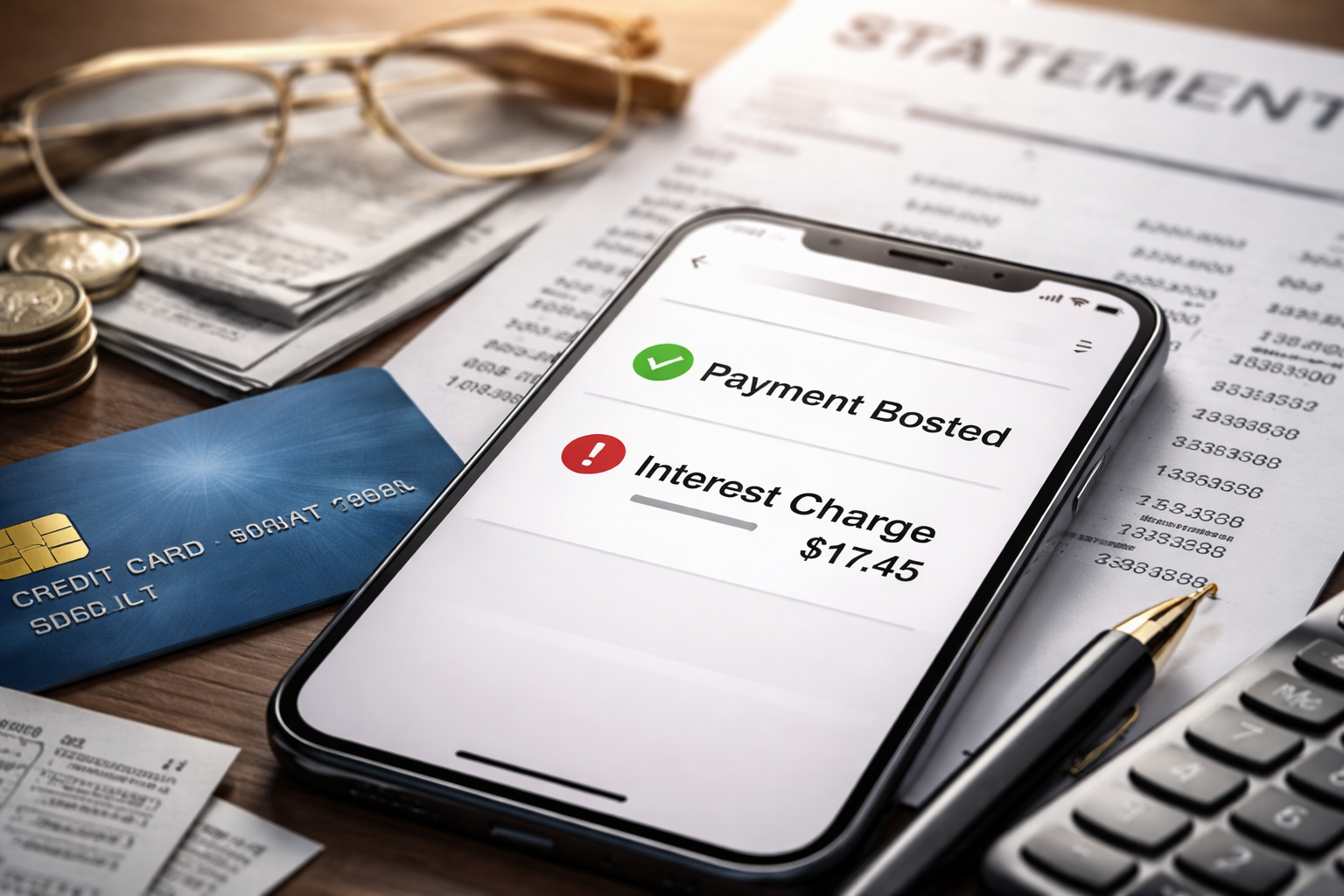
Credit Card Payment Posted but Interest Still Charged was the first thing I saw when I opened the app, and for a few seconds I honestly thought the system had to be wrong. The payment was there. It was no longer pending. The available credit had moved. The balance had changed. Everything looked like the account had recognized the payment. Then I looked a little lower and saw interest added anyway. That is the moment this kind of issue becomes more than a minor annoyance, because once the payment shows as posted, most people assume the account should immediately stop charging anything tied to the old balance.
Credit Card Payment Posted but Interest Still Charged is one of those situations that makes people doubt whether they are reading the statement correctly or whether the issuer is quietly adding charges that should not be there. The problem is that a posted payment and an interest charge can both be accurate at the same time, depending on what happened earlier in the billing cycle. That is why this issue keeps repeating for people who think they solved it once by making a payment, only to see another interest amount appear on the next statement.
If you want the background that helps this make sense quickly, start with the issuer-side flow here. It explains how a payment moves through the system before it affects what you see on the account:
Why this feels wrong even when the system says it is right
Credit Card Payment Posted but Interest Still Charged feels unfair because most cardholders think in simple order: charge appears, payment posts, account clears. But credit card systems do not always work in that order. Interest is often tied to what happened across the entire billing cycle, not just what the account looks like on the day you check it. That gap between what you see today and what the issuer already calculated yesterday is where most confusion begins.
A posted payment changes the balance you see now, but it does not always erase interest that already accrued before that payment was applied. This is the core issue. The payment may be real, properly posted, and fully recognized. The interest may also be real because it was generated from earlier daily balances, from loss of grace period, or from part of the balance that was not paid exactly the way the issuer required.
The most common paths that lead to this problem
Path 1 — Residual interest from the prior cycle
You paid the statement balance, but interest had already been accruing on days before that payment posted. The next statement includes that leftover amount.
Path 2 — Grace period was already lost
At some point earlier, even a small amount was carried. Once that happened, new purchases may begin accruing interest immediately.
Path 3 — Payment posted after the statement cut process
The payment may have posted on the due date or shortly after the internal cutoff for that cycle, even though it still looks timely to you.
Path 4 — Statement balance was not fully paid
You may have paid the current balance, minimum due, or a rounded number instead of the exact statement balance.
Path 5 — Special balance category stayed active
Cash advances, balance transfers, promo balances, or fees may continue accruing interest under different rules.
Path 6 — Payment allocation issue or genuine account error
The payment may have been applied in a way that left part of the interest-bearing balance active, or the issuer may have posted an incorrect finance charge.
Credit Card Payment Posted but Interest Still Charged is most often caused by the first four paths above, not by fraud or random system failure. That matters because the right fix depends on which path you are actually in.
Residual interest is the part most people do not expect
Credit Card Payment Posted but Interest Still Charged is often a residual interest problem, and that is the version people find hardest to accept because it appears after they already did what they thought was required. You look at the account, see a posted payment, and assume the interest should stop right there. But interest is usually not charged based only on the final balance shown on one day. It is based on how much balance existed over time.
Here is what happens in practical terms. You make purchases. Those purchases sit on the account for part of the cycle. The statement closes. Then you make a payment. The payment may fully satisfy the statement balance, but interest may already have built up on the daily balance that existed before the payment arrived. On the next statement, that leftover amount appears. This is why one full payment does not always erase the final bit of interest immediately.
Credit Card Payment Posted but Interest Still Charged can therefore show up once even if you are in the process of getting back to a clean no-interest position. That does not necessarily mean the issuer is wrong. It may mean you are one cycle away from fully restoring the account to normal.
When the grace period quietly disappears
Another reason Credit Card Payment Posted but Interest Still Charged appears is that the grace period was already lost before you realized it. Many people think the only serious mistake is missing the due date. In reality, carrying even a small amount can change how future purchases behave. Once the grace period is gone, interest can begin accruing on new purchases right away instead of waiting until the next statement cycle.
This is where people get stuck. They pay what feels like a large amount, the payment posts, and yet interest still appears. What they do not realize is that the card had already moved into a different interest state. That means the payment reduced balance, but it did not immediately restore grace-period treatment for all activity.
If you ever carried a balance, even briefly, do not assume one payment instantly resets the account to the no-interest pattern you were used to. This is a major reason Credit Card Payment Posted but Interest Still Charged continues for another cycle or two.
What the issuer sees behind the screen
From your perspective, the payment is visible and the charge feels contradictory. From the issuer’s perspective, the account is split into separate events: statement closing, daily accrual, payment posting, payment allocation, and finance charge assessment. These events do not always line up in the simple order consumers expect.
Credit Card Payment Posted but Interest Still Charged may look like the issuer ignored your payment, but many times the issuer sees a different sequence:
- The balance accrued during multiple days in the cycle
- The statement cut at a fixed internal time
- The finance charge was generated from earlier balance history
- The payment posted after part of that calculation was already locked in
- The new displayed balance reflects the payment, but the interest line reflects prior accrual
The system can be slow from a customer perspective but still internally consistent from a billing perspective. That does not mean you should accept every interest charge without checking. It means you should check the right data rather than only the balance shown in the app.
How to tell whether the interest is valid or questionable
Credit Card Payment Posted but Interest Still Charged becomes easier to solve once you stop asking only “Did I pay?” and start asking “What exactly did I pay, and when, relative to the statement cycle?”
More likely valid
- You previously carried part of the balance
- You paid after the statement closed
- You paid the current balance instead of the statement balance
- You had a cash advance or balance transfer
- You resumed spending before the account fully regained grace period treatment
More likely questionable
- You paid the exact full statement balance by the due date
- You had no carried balance in the prior cycle
- No cash advance, no special APR balance, no annual fee issue
- The interest amount looks inconsistent with your APR and balance history
- The issuer gives conflicting explanations about when the finance charge was created
Credit Card Payment Posted but Interest Still Charged deserves a closer look when it appears on an account that was otherwise fully paid and in good standing without special balance types.
If the payment may have landed in the wrong cycle or was treated in a way that distorted the statement math, this related scenario is worth checking:
Detailed self-check before you contact the issuer
Before you call, gather the last two statements and the payment confirmation. Credit Card Payment Posted but Interest Still Charged is much easier to resolve when you speak from documents instead of memory. Many people lose the argument because they say “I paid it off” while the issuer is looking at a statement showing they paid something slightly different.
Check these points carefully:
- The exact statement balance from the prior statement
- The exact payment amount that posted
- The posting date, not only the date you initiated payment
- The due date
- Whether you had new purchases after the statement closed
- Whether your account shows any cash advance, balance transfer, or fee balance
- Whether the interest amount seems tied to one cycle or multiple cycles
The most important comparison is not payment versus current balance. It is payment versus prior statement balance. That is where many account misunderstandings start.
Different real-world versions of the same problem
Version A — You paid on the due date
The payment may show as posted on that date, but internal cutoffs may still place part of the calculation before the payment took effect for finance-charge purposes.
Version B — You paid the app balance, not the statement balance
If the app showed a lower current balance after credits or returns, you may have paid less than the exact statement balance needed to avoid interest consequences.
Version C — You had a previous month with a carried balance
Even if this month’s payment was large, the account may still be moving through a residual interest cycle.
Version D — You used the card again right after paying
If grace period had not been fully restored, new charges may have begun accruing interest immediately.
Version E — A special category remained unpaid
Cash advances and some promotional balances follow different rules and can keep interest active even when ordinary purchases appear covered.
Version F — The issuer actually made an error
Less common, but possible where payment timing, statement math, or allocation history does not match the finance charge assessed.
Credit Card Payment Posted but Interest Still Charged should be diagnosed through one of these patterns, because each one leads to a different conversation with the issuer.
How to talk to the issuer without wasting the call
Do not call and only say the interest looks wrong. Say exactly what you verified. A stronger script is: “I paid the full statement balance of $X, the payment posted on Y date, and I want the finance charge broken down by cycle and balance category.” That forces the representative to move beyond generic explanations.
Ask these questions in order:
- Was my grace period active or already lost before this charge posted?
- Is this residual interest from the prior cycle?
- Was any part of the balance treated as cash advance, promo APR, or another special category?
- What exact balance amount generated this interest?
- On what date did the system assess the finance charge?
- Was the payment applied to the purchase balance the same day it posted?
If the representative cannot explain which balance generated the interest, escalate the call. Credit Card Payment Posted but Interest Still Charged may still be valid, but you should not accept vague answers when the account history should show a concrete calculation path.
When it makes sense to ask for a courtesy reversal
Even when Credit Card Payment Posted but Interest Still Charged is technically valid, you may still be able to get it reversed as an adjustment. This works best when the amount is modest, your payment history is otherwise strong, and the situation clearly resulted from timing confusion rather than repeated delinquency.
Ask for a finance charge adjustment if:
- You usually pay on time and rarely carry a balance
- The payment posted close to the cutoff
- The representative confirms it is residual interest rather than a major delinquency issue
- The charge is small enough to be treated as a courtesy
Do not frame it as an accusation first. Frame it as a documented review request. That gives you a better chance of either getting a true correction or a one-time waiver.
The mistakes that keep this problem alive
Credit Card Payment Posted but Interest Still Charged becomes a recurring problem when people react emotionally and fix the wrong thing. The biggest mistakes are simple:
- Only watching current balance instead of statement balance
- Paying on the due date instead of a few days early
- Ignoring a small finance charge instead of clearing it fully
- Using the card immediately after trying to reset the account
- Assuming one payment restored the grace period without confirming it
If you want the cycle to stop, you need one clean statement-to-payment sequence with no leftover interest-bearing amount.
What to do today so it does not happen again
Right now, pull your last two statements and compare them line by line. Find the exact statement balance, the payment amount, the posting date, and whether any special balance type was present. Then call the issuer and request the finance charge breakdown. If the explanation matches residual interest or lost grace period, pay the full required amount and avoid new charges until the next statement confirms the cycle is clean. If the explanation does not line up with the documents, push for escalation and adjustment.
Credit Card Payment Posted but Interest Still Charged is fixable, but only if you identify whether you are dealing with residual interest, grace-period loss, wrong payment targeting, or a real billing error. The worst move is assuming the posted payment alone proves the interest must be wrong. The best move is using the statement math to force a clear answer.
To understand the broader rule set behind this issue and prevent it from happening again, this guide is the best next step:
FAQ
Why does Credit Card Payment Posted but Interest Still Charged happen after a full payment?
Because the interest may have accrued before the payment posted, especially if this is residual interest from a prior cycle or if the grace period had already been lost.
Does a posted payment mean interest must stop immediately?
No. A posted payment changes the balance now, but it does not always erase finance charges already generated from earlier daily balances.
Can this happen even if I paid on time?
Yes. On-time payment does not always prevent residual interest or correct earlier loss of grace period.
When should I dispute it?
When you paid the exact full statement balance on time, had no prior carried balance, had no special balance type, and the issuer still cannot clearly explain the finance charge.
Should I stop using the card until this is resolved?
If you are trying to restore normal grace-period behavior, that is often the safer move until one clean cycle passes.
Key Takeaways
- Credit Card Payment Posted but Interest Still Charged is often caused by residual interest, not always by error
- Statement balance matters more than current balance when checking whether interest should have appeared
- Loss of grace period can keep interest active even after a payment posts
- Cash advances, promo balances, and timing cutoffs can change the result
- You should request a finance charge breakdown, not a generic explanation
- A documented courtesy reversal may still be possible even when the charge is technically valid
For official consumer guidance on credit card interest and billing questions, review the Consumer Financial Protection Bureau here: CFPB guidance on credit card interest.