
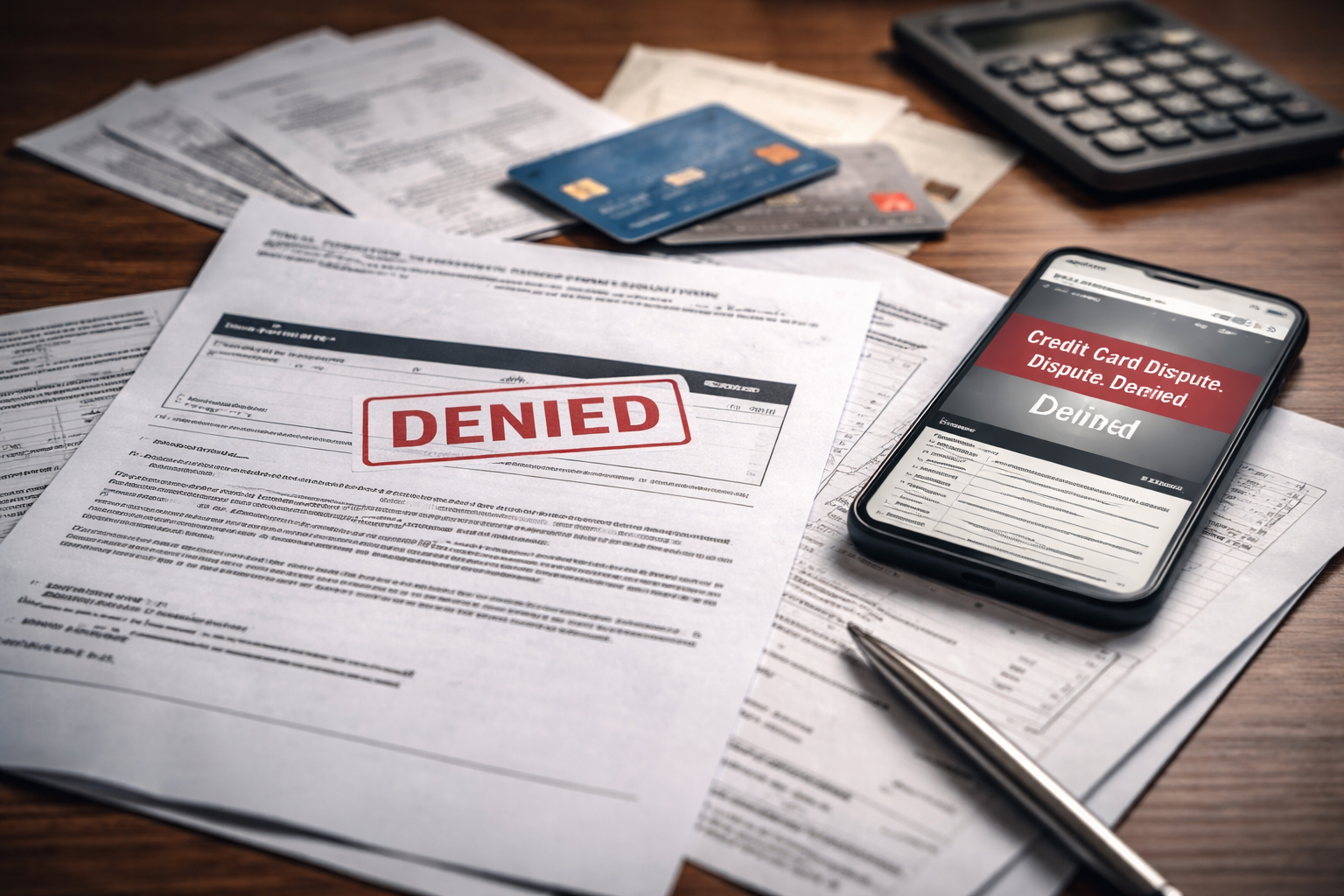
Credit card dispute lost — I noticed it in the most normal, forgettable way: I opened my card app to pay the balance and the “temporary credit” line was gone. The charge I’d been disputing was back like it had never left. No phone call. No “we need more info.” Just a status change and a bigger balance that instantly changed my month.
I didn’t feel dramatic. I felt alert. Because when a credit card dispute flips to lost, the system has already accepted someone else’s paperwork as “good enough.” If you wait, the paperwork hardens into a final-looking outcome. This guide is what I wish I had in that moment: the fastest recovery steps, how to match the dispute category to the facts, and how to escalate without weakening your position.
Before you do anything else, keep this in mind: “Lost” is often a documentation problem, not a truth problem. Your job now is to identify what evidence gap let the merchant win — and close that gap fast.
Also, if your account suddenly started acting “weird” during the investigation (holds, limit changes, extra reviews), read this quickly because it explains why issuers tighten up during disputes.
That page helps you recognize when the issuer is in a heightened-review mode so you don’t misread delays as “no hope.”
First 24 Hours After Credit Card Dispute Lost
When credit card dispute lost hits your account, your first day matters more than your first week. You’re trying to accomplish three things immediately:
- Stop the situation from quietly damaging your credit.
- Find out what evidence the merchant used to win.
- Prepare a stronger, cleaner resubmission that matches the correct billing error category.
Do not start by sending a long angry message. Start by collecting the exact items the system respects.
Do this today:
- Take screenshots of the dispute status and the charge now (date, amount, merchant descriptor).
- Download or screenshot any emails with the merchant: cancellation, refund promises, delivery updates.
- Write a one-page timeline (yes, one page). Dates only. Facts only.
- Call the issuer and ask: “What evidence did the merchant provide that led to the denial?”
If you do nothing else, do the timeline. The timeline is the fastest way to turn your story into evidence.
Why Credit Card Dispute Lost Happens (In Plain Reality)
A credit card dispute lost outcome usually means the merchant responded and the response matched the rules better than your submission did. The bank and card network are not deciding “who seems nicer.” They are checking whether a box was filled with acceptable proof.
The merchant does not have to prove they treated you fairly. They only have to prove they followed their stated process.
That’s why these are common “merchant wins”:
- A delivery scan exists (even if it was wrong or left outside).
- A service log shows “access” (even if you couldn’t use it properly).
- The merchant has a policy page and claims you agreed.
- A partial refund was issued and they claim “resolved.”
Your response must directly attack the specific proof they used — not the vibe of what happened.
Decision Map: Pick the Right Recovery Route
Use this decision map if credit card dispute lost just happened:
- Fraud / Unauthorized charge? → You need a fraud-focused reconsideration with identity and device details.
- Merchandise not received? → You need delivery proof and carrier documentation.
- Service not as described? → You need written promises + proof of deficiency + your attempts to resolve.
- Refund promised but not received? → You need merchant confirmation + expected refund window + posted transaction proof.
- Subscription/cancellation dispute? → You need cancellation confirmation + billing dates + policy mismatch proof.
Do not use the wrong lane. The wrong lane is how people lose twice.
Now we’ll go deeper into each route — because “case splitting” is what makes this a top-tier recovery guide.
Route 1: Credit Card Dispute Lost for an Unauthorized Charge
If credit card dispute lost happened on a charge you truly did not authorize, you must treat this like a fraud-file rebuild — not a general dispute.
What often causes the loss here:
- The issuer thinks it was “card present” or “authenticated” (chip, token, 3DS, Apple Pay).
- The merchant shows matching billing address or device data.
- You reported too late and the system assumes account compromise rather than merchant wrongdoing.
What to submit to reopen:
- Statement: “I did not authorize this charge” (simple, consistent).
- Where you were at the time (work schedule, travel details if relevant).
- Any account takeover signals: password resets, new device alerts.
- Proof you notified the merchant/issuer promptly after discovery.
Keep the story stable. Changing details makes the bank treat it as uncertainty.
If you are dealing with a fraud-related denial, this is the closest supporting article to strengthen your internal structure:
Use it to align your language with what issuers expect in fraud reconsiderations.
Route 2: Credit Card Dispute Lost for “Item Not Received”
When credit card dispute lost happens on “item not received,” it’s almost always because of a tracking scan. Carriers scanning “delivered” is the merchant’s favorite weapon.
Here’s how to fight it effectively:
- Ask the issuer what carrier scan the merchant provided (USPS/UPS/FedEx).
- Contact the carrier and request delivery details (GPS, photo, delivery point, signature status).
- If the carrier admits misdelivery, request a written note or claim summary.
- Provide your attempt to resolve: “I contacted merchant on X date, they refused replacement.”
If you can show the delivery scan did not match your address or unit, your odds improve dramatically.
Also, if your dispute relied on the merchant failing to respond at first and then they suddenly responded later, that scenario is common. This is your internal link that supports it:
This helps readers understand timing games and how responses affect outcomes.
Route 3: Credit Card Dispute Lost for “Service Not As Described”
This is the most misunderstood category. A credit card dispute lost here is usually caused by one of two problems:
- You described dissatisfaction, not misrepresentation.
- You didn’t show your attempt to fix the problem directly with the merchant.
What works:
- Copy/paste the claim the merchant made (website line, email promise, invoice terms).
- Show what you received (photos, screenshots, work product, error messages).
- Show you asked for a fix and they refused or failed (email thread).
- Use a simple comparison statement: “Promised X. Delivered Y.”
Don’t argue about fairness. Argue about mismatch.
Route 4: Credit Card Dispute Lost on a Promised Refund
This one is painful because you often did everything “right.” Yet credit card dispute lost can still happen if the merchant shows a refund receipt that never actually posted, or claims a longer timeline.
To rebuild your claim:
- Provide the merchant message promising a refund and the date.
- Provide your statement screenshot showing no credit posted.
- Provide a clear “reasonable wait” timeline (example: 7–14 business days, unless merchant policy says longer).
- Ask issuer: “What refund evidence did merchant provide?”
Your key move is to prove the absence of the credit on your statement, not your frustration.
How to Ask the Bank the “Right Way” (Exact Phrases)
When credit card dispute lost happens, people often call and say: “You need to fix this.” That usually goes nowhere.
Use these instead:
- “Can you tell me what documentation the merchant submitted that resulted in the decision?”
- “Is there a reconsideration process if I submit new material evidence?”
- “Which dispute reason code was used, and which evidence gap caused the denial?”
- “Can you reopen the investigation or escalate to a supervisor review?”
You’re asking them to explain the framework, not argue the conclusion.
What If the Dispute Was Closed Without a Real Resolution?
Sometimes credit card dispute lost is what the screen shows, but the real issue is that the dispute was closed early, marked resolved incorrectly, or you never got a clean explanation.
If that sounds like you, read this in the middle of your process — it helps you recognize administrative closures and what to do next.
That page is helpful when the bank’s “final” status is more procedural than factual.
Escalation Outside the Issuer (When It’s Time)
If you’ve tried a reconsideration and credit card dispute lost still stands, escalation becomes a strategy decision. For large charges, repeated failures, or poor bank explanations, a formal consumer complaint can trigger an internal second look.
In the U.S., the most practical official channel is the CFPB complaint process.
Do not file a complaint with a messy story. File it with a timeline, the key evidence, and a clear ask:
- “Please conduct a reconsideration based on new documentation.”
- “Please explain the evidence used to deny the claim.”
- “Please correct any errors in dispute handling.”
Protect Your Credit While This Is Happening
A credit card dispute lost decision can hurt you indirectly, even if you plan to keep fighting. The charge returns, your utilization rises, and your score can dip.
Do this while disputing:
- Pay the undisputed portion of your balance.
- If the disputed amount is large, call and ask about hardship or payment plan options.
- Set alerts so you don’t miss due dates during the back-and-forth.
Also, if your issuer reduced your limit after the dispute — that can make utilization worse. This internal guide explains that pattern and what to do.
The “Never Do This” List After Credit Card Dispute Lost
After credit card dispute lost, these mistakes lock people into losing:
- Reopening with the same evidence (nothing changes, nothing changes).
- Switching your explanation each call (creates doubt).
- Threatening lawsuits immediately (front-line reps shut down).
- Ignoring due dates while “waiting for justice.”
- Closing the card before you stabilize the account (can complicate access and communication).
Your goal is to look credible, consistent, and document-heavy.
Key Takeaways
- Credit card dispute lost is often reversible with new evidence and the right dispute category.
- Ask for the merchant’s evidence and attack the exact gap that lost your claim.
- Use a one-page timeline to turn your story into evidence the system respects.
- Escalate to a supervisor review and consider formal complaints for large charges.
- Protect your credit: utilization and due dates matter during disputes.
FAQ
Can I reopen a case after credit card dispute lost?
Often yes, especially if you can submit new material evidence or show the dispute category was mismatched.
How fast should I act after credit card dispute lost?
As soon as you can strengthen your documentation. Days matter more than weeks because escalation windows and internal review cycles move quickly.
What if the merchant lied in their documentation?
Focus on disproving a specific claim (delivery, cancellation, terms). Broad accusations are weaker than a direct contradiction supported by proof.
Will this hurt my credit score?
It can if the charge returns and raises utilization. Pay what you can and avoid late payments while you escalate.
Your Next Move (Do This Now)
Credit card dispute lost — if you’re staring at that status today, don’t treat it like a verdict. Treat it like a signal that your evidence package needs upgrading.
The fastest recoveries happen when you stop arguing “fairness” and start delivering “documentation.”
Right now, do these four actions:
- Call and ask what evidence the merchant used to win.
- Write your one-page timeline with dates, amounts, and outcomes.
- Collect new proof (carrier details, cancellation confirmation, refund promises, screenshots).
- Submit a reconsideration request that directly addresses the missing piece.
I’m not going to tell you “it’s your fault” or “you should have known.” You’re here because the system felt one-sided. But you still have leverage — if you move like someone who understands the rules.
And if your case is time-sensitive (large amount, rent/medical/travel, or you’re on the edge of missing a payment), act today. Waiting is what turns a fixable dispute into a permanent loss.