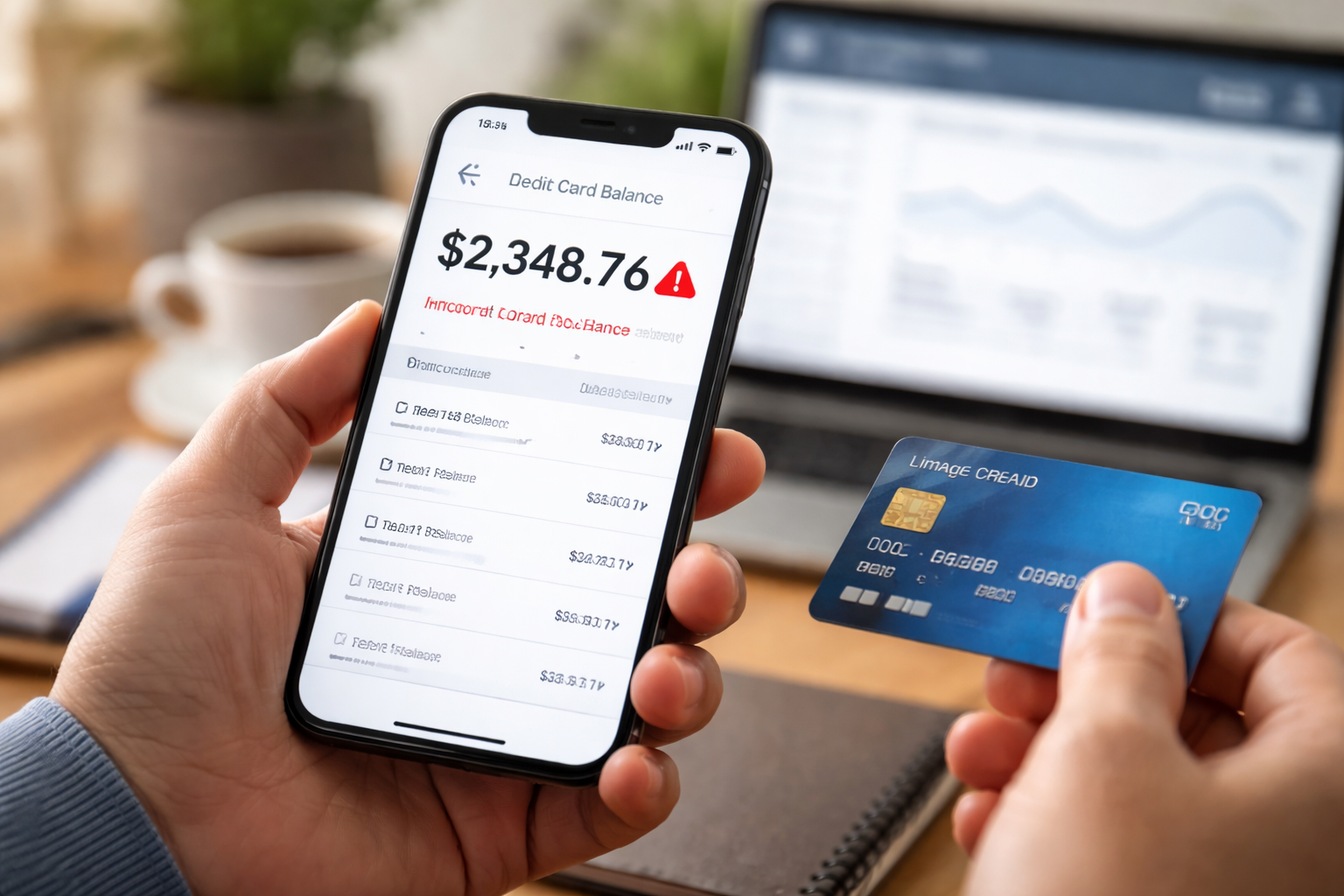
Credit card balance incorrect — I saw it in the most ordinary moment: coffee in one hand, phone in the other, checking the app like I always do after a payment. The number didn’t drop. It looked higher than yesterday, like my payment never existed.
I didn’t feel “panic.” It was more like a cold pause. I refreshed, closed the app, opened it again. Same number. When the balance is wrong, it’s not just a number — it changes what you’ll pay, what you’ll be charged, and what your credit report may reflect.
If you’re here because credit card balance incorrect describes your screen right now, this guide is built to help you identify the cause quickly, choose the right fix, and protect your credit while the system catches up.
First, if your mismatch feels like the statement math is off (not just the app view), start with this quick diagnostic. It helps you separate “display confusion” from true billing errors so you don’t waste a call.
Stop Guessing: A 2-Minute Snapshot That Protects You
When credit card balance incorrect happens, your first job is to freeze the evidence before anything updates again.
Do This Now (2 minutes)
- Screenshot the balance page (include date/time if your phone shows it).
- Screenshot the “Recent Activity” list showing the newest transactions.
- Screenshot the payment confirmation screen (or email receipt).
- Write down: Current Balance, Statement Balance, Available Credit.
Most successful fixes start with proof captured before the system “corrects” in a way you can’t explain later.
This matters because many “wrong balance” problems are actually timing or posting issues that change quickly. If you wait until it flips again, it becomes harder to show what was wrong.
The Fastest Way to Identify the Cause (Decision Tree)
A credit card balance incorrect situation usually falls into one of these branches. Pick the one that matches your screen; don’t try to solve all of them at once.
Case Branch Box
- A) Payment posted but balance didn’t drop (or dropped then jumped back)
- B) Pending charge looks wrong (higher than expected, duplicated, or never drops)
- C) Refund/credit missing (merchant says refunded, but balance stays high)
- D) Interest/fees appeared unexpectedly (even after “paying in full”)
- E) Dispute/chargeback credit reversed (temporary credit removed)
- F) Unauthorized/unknown activity (transactions you don’t recognize)
Your fix depends on the branch. The same script does not work for every case.
We’ll walk each branch with a “what to check” and “what to do today” approach.
Branch A: Payment Posted but the Balance Didn’t Drop
If credit card balance incorrect started right after you paid, do not assume the payment “failed.” Many payments show as received before full reconciliation.
What to Check
- Does the payment show as Posted or Pending?
- Did your Available Credit change even if Current Balance didn’t?
- Did you pay from a new bank account or after changing bank details?
- Is there a “Returned Payment” or “Reversed Payment” line item?
If available credit improved but the balance didn’t, it’s often a display lag or processing split.
What to do today:
- Send the issuer a secure message (better than phone-only) stating: date/time, payment amount, and the mismatch you captured.
- If your due date is close, ask for a note on the account: “payment submitted, balance mismatch under review.”
- Do not submit multiple duplicate payments “just in case” unless you’re sure the original failed. Duplicate payments create new problems.
Key idea: When credit card balance incorrect follows a payment, your leverage comes from being precise, not loud.
Branch B: Pending Charges That Inflate the Balance
If credit card balance incorrect is driven by pending items, you need to know one thing: pending is not final, but it can still affect available credit and trigger fear.
Common Triggers
- Hotel deposits + final checkout amount
- Gas station authorizations
- Tips added after dining
- Subscription renewals that reauthorize
A pending item can look “wrong” even when it’s technically allowed — the question is whether it clears correctly.
What to do today:
- Check the merchant receipt and compare it to the authorization amount.
- Set a personal timer: if it doesn’t drop within the issuer’s typical window, escalate with documentation.
If your specific frustration is “it never drops,” don’t duplicate that content here — use the targeted guide below. It’s a better fit for that exact scenario and avoids you mixing two different fixes.
When the authorization just sits there and keeps your balance looking wrong, follow this focused walkthrough. It’s built for the “pending charge never dropped” pattern.
Branch C: Merchant Says “Refunded” But Your Balance Didn’t Change
One of the most frustrating credit card balance incorrect causes is the “refund ghost” — the merchant insists it’s done, but your account doesn’t reflect it.
What to Check (Don’t Skip)
- Did the merchant refund to the same card used originally?
- Is it a partial refund (multiple credits)?
- Did you return an item and the refund is “processing” on their side?
- Is the refund posted but applied to a different part of the ledger (statement vs current)?
Refunds often post as credits on a statement cycle, not always as an immediate “balance drop” in the app view.
What to do today:
- Ask the merchant for the refund confirmation including date and reference number.
- Send that reference number to your issuer via secure message.
- Ask the issuer to confirm whether the credit is pending, posted, or rejected.
If you suspect the refund exists but isn’t crediting the card account correctly, keep your message simple: “Here is the reference number; please confirm whether it’s received on your side.”
Branch D: Interest or Fees Appeared After You “Paid in Full”
Many people search credit card balance incorrect when they did pay in full — yet interest appears anyway. This is often “trailing interest” or a timing mismatch between statement close and payment posting.
Quick Test
- Did you carry a balance last cycle, even briefly?
- Did you pay after the statement closed but before the due date?
- Did a refund or adjustment post after your payoff?
“Paid in full” and “no interest” are not always the same thing if the balance was carried earlier in the cycle.
What to do today:
- Compare the statement close date and your payment date.
- Ask the issuer: “Is this residual/trailing interest? If so, what exact date range is it for?”
- Request a one-time courtesy adjustment if the interest was triggered by processing timing and you have a strong payment history.
Sometimes the balance looks wrong because the fee is real — but it was triggered by something you didn’t see. The fix is to force clarity and minimize repeats.
Branch E: Dispute Credit Reversed (Balance Jumps Back Up)
If credit card balance incorrect started after you disputed a charge, a common cause is the reversal of a provisional credit. The issuer may have credited you temporarily, then removed it when the case went against you.
What to Check
- Do you see a line like “Temporary Credit Reversal”?
- Did you receive a message saying the dispute was denied or decided?
- Did the merchant respond with documentation?
If a dispute credit was reversed, the “wrong balance” feeling is real — but the next move is a stronger case file, not a repeat complaint.
What to do today:
- Request the dispute outcome details and what evidence was used.
- Clarify whether you can appeal/reopen or file a different type of claim (chargeback vs billing error).
- Ask for the exact deadline for any reconsideration.
If you’re stuck in that limbo where nothing feels resolved, this next guide is the cleanest “what now” playbook.
Branch F: Unknown Transactions (Treat This as Time-Sensitive)
Sometimes credit card balance incorrect is the first sign of something you didn’t authorize. In that case, your priority shifts: contain first, then investigate.
Containment Steps
- Lock/freeze the card in the app (if available).
- Call the fraud line and report the exact transactions.
- Change your login password and enable 2FA.
When transactions are truly unauthorized, speed protects you more than perfect paperwork.
Even here, keep your record: screenshots, timestamps, and the representative’s name/ID if they provide it.
What NOT to Do (These Mistakes Make Fixes Slower)
When credit card balance incorrect shows up, these are the mistakes that quietly turn a fixable mismatch into a months-long mess:
- Sending vague claims: “My balance is wrong” without listing amounts and dates.
- Making multiple “just in case” payments: this can trigger returns, overpayments, or holds.
- Closing the card immediately: closures complicate dispute timelines and access to records.
- Arguing before documenting: anger isn’t evidence.
The system responds to clarity. The system ignores noise.
The One Official Rule Set Worth Bookmarking (U.S.)
If your issue involves a billing error or dispute rights, the cleanest official overview is the FTC’s consumer guidance. This is not “legal advice,” but it is the baseline reference used across U.S. consumer education.
Use the official framework to support your message — not to start a fight.
Key Takeaways
- credit card balance incorrect is usually traceable to one ledger event: payment, pending, refund, fee/interest, dispute reversal, or fraud.
- Capture screenshots first. Proof before changes is your advantage.
- Choose the branch that matches your screen and act in order.
- Secure message + precise numbers often beats a long phone call.
- Protect your credit by staying current on undisputed amounts while an investigation happens.
FAQ
Why does it say credit card balance incorrect right after I pay?
Because payment processing and ledger reconciliation can occur in separate steps. If the payment is pending, the app view may lag or update in phases.
Should I pay the full “wrong” number to be safe?
Not automatically. First verify which portion is undisputed. Paying an incorrect balance can create overpayment issues or remove urgency from corrections.
Can a pending charge make the balance look wrong?
Yes. A pending authorization can temporarily reduce available credit and distort what feels like the “real” balance until settlement completes.
How long should I wait before contacting the issuer?
If the mismatch affects a due date, credit limit, or appears tied to fees or unknown transactions, contact them the same day.
What if the issuer says everything is correct?
Ask for the ledger explanation in writing (secure message). Request dates, amounts, and what posting event caused the change. credit card balance incorrect cases usually resolve once the cause is named precisely.
Act Today: A Simple Script That Works
When you contact support, keep it short and structured. You want them to do one thing: identify the posting event and correct it.
Copy-Paste Message (Secure Message / Chat)
Hello — my credit card balance incorrect as of [DATE/TIME]. Current Balance shows [$X], but based on my records it should be [$Y]. I have screenshots of the balance page and the relevant transactions/payments. Please confirm what posting event caused the difference and whether any pending items, reversals, interest, or dispute credits are affecting the ledger.
Ask them to respond with the reason in writing.
That script avoids accusations and forces the system to name the cause.
Now the last piece: if you can’t reconcile it today, still protect your credit. Pay the undisputed portion by the due date, document everything, and keep the conversation in writing where possible.
When credit card balance incorrect shows up, you don’t need drama — you need structure. Take the snapshot, pick the right branch, and push for a written explanation.
And here’s the good news: most balance mismatches are fixable once the issuer identifies the exact ledger event. Your job is to make that identification unavoidable — quickly, calmly, and with proof.