
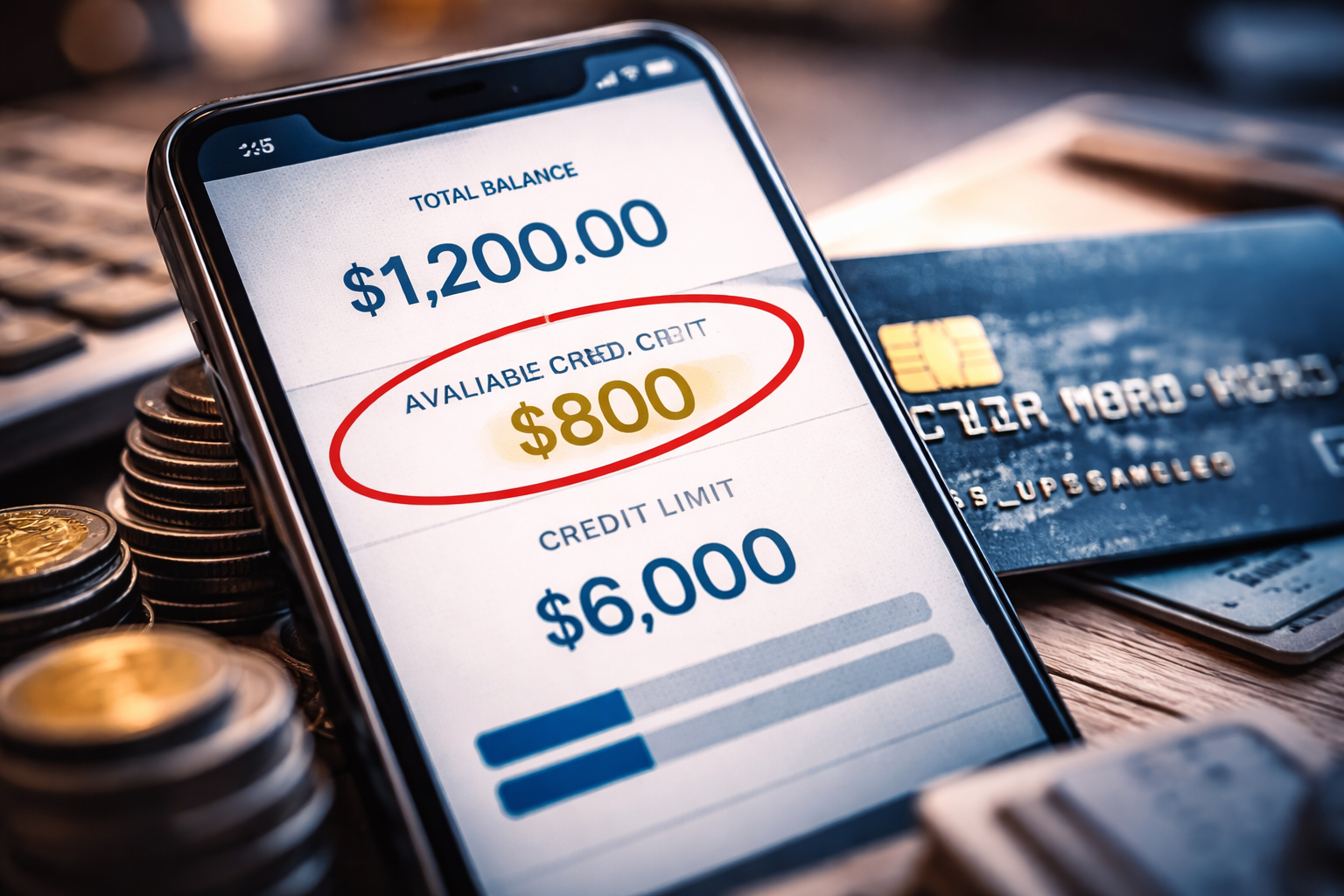
Credit Card Available Credit Reduced Without Balance Change was the phrase that matched what I was staring at after my card unexpectedly came up short during a normal purchase. I was not over the limit. I had not missed a payment. I had not seen a fraud alert. The balance on the account looked basically the same as it had the day before, but the amount I could actually use had quietly dropped.
At first I assumed it was a refresh issue. Then I assumed maybe a gas station preauthorization had not cleared. Then I started checking recent purchases one by one, because this kind of change feels small until it suddenly affects something you were planning to pay for that same day. When Credit Card Available Credit Reduced Without Balance Change happens, the confusing part is not just the lower number. It is the lack of a clear explanation. Nothing obvious appears broken, yet something inside the account has clearly shifted.
That is why this issue causes so much second-guessing. People start wondering whether the bank quietly lowered the limit, whether a payment is not fully recognized, whether a merchant hold is still sitting in the background, or whether the account has been pushed into some kind of internal review. In many situations, Credit Card Available Credit Reduced Without Balance Change is not a normal statement error at all. It is a system-level restriction, temporary exposure adjustment, or hidden hold that sits underneath the number you see on the screen.
If you want the wider background on how statement-side issues and visible billing problems appear before focusing on this more specific situation, start here first:
Why this feels different from a normal billing problem
Credit Card Available Credit Reduced Without Balance Change usually does not begin with a fee, a posted charge, or a late payment entry. That is exactly why so many people misread it. A normal billing issue gives you something concrete to point to. This issue often does not. The balance looks stable. The limit may still display the same number. The statement may show nothing unusual. Yet your spending room is smaller.
That disconnect usually means the system is applying logic that has not fully surfaced in the account view you are seeing.
There are several reasons this happens:
- A pending authorization is reducing usable credit even though it has not posted as a final charge
- A recent payment is showing as received, but not fully cleared in the issuer’s internal risk system
- The account has been pushed into a soft review or internal monitoring status
- An internal exposure cap is temporarily replacing the spending room you thought you had
- A merchant reversal, refund, or adjustment is incomplete, leaving credit temporarily tied up
So when Credit Card Available Credit Reduced Without Balance Change appears, the real question is not simply, “Did the app glitch?” The real question is, “Which hidden layer is controlling my usable credit right now?”
The most common hidden paths behind the drop
Not every version of Credit Card Available Credit Reduced Without Balance Change is the same. This matters because the right next step depends on what kind of hidden reduction you are dealing with.
Branch 1: Temporary authorization pressure
This often happens with gas stations, hotels, rentals, subscription renewals, or merchants that place estimated holds before final settlement. Your balance may not look dramatically different, but usable credit drops because the hold is still reserving space.
Branch 2: Payment not fully trusted yet
You made a payment, the app acknowledges it, but the issuer has not fully released equivalent spending capacity. This is especially common after large payments, payments from newly linked bank accounts, or unusual payment timing.
Branch 3: Quiet internal risk throttling
The issuer has not formally closed or frozen the account, but it reduces practical spending room while it evaluates account behavior. This can happen after rapid spending, unusual merchant mix, repeated cash-equivalent activity, or a sudden pattern shift.
Branch 4: Merchant-side reversal not fully cleaned up
A void, refund, or cancellation happened, but the hold or offset did not disappear when you expected. That can leave a gap where the balance looks normal enough, but available credit stays artificially compressed.
Once you understand which branch you are in, the confusion drops fast, because you stop treating every version of this issue as the same problem.
What issuers may be seeing that you are not
One reason Credit Card Available Credit Reduced Without Balance Change feels unfair is that the issuer is often acting on signals you cannot see from the consumer side. Banks do not rely only on the statement balance. They watch payment source quality, transaction pace, merchant categories, spending bursts, prior disputes, recent account changes, and whether the behavior on the card still matches the account’s normal pattern.
That means your account can look calm from your point of view while appearing elevated-risk from theirs.
Examples that can trigger this kind of quiet compression include:
- A large payment followed by immediate high utilization again
- Several transactions in a short period after weeks of low activity
- Spending that resembles cash-like behavior or high-risk merchant activity
- New bank account funding a payment that has not seasoned yet
- Recent dispute activity combined with fresh account usage
- External credit report changes affecting the issuer’s risk score for the account
In those moments, Credit Card Available Credit Reduced Without Balance Change can function like a quiet buffer. The issuer is not always telling you, “We cut your line.” Sometimes it is closer to, “We are reducing how much of that line you can use right now until more things settle.”
How to tell whether this is a hold, a payment issue, or a soft restriction
This is the part where most readers need a practical self-check, because the wrong diagnosis leads to the wrong reaction.
Look at recent merchant activity first.
If you recently used the card at a hotel, gas station, rental counter, or a merchant known for estimated authorizations, Credit Card Available Credit Reduced Without Balance Change may be tied to a temporary hold. In that version, the number often corrects itself once the final amount settles or the hold expires.
Then look at recent payments.
If you made a payment in the last 1 to 3 days, especially a larger-than-usual one, the issuer may be showing the payment on the front end while still limiting how much credit it truly releases. That is different from a regular posting delay because the balance may already look fine.
Then examine whether the card still works normally for smaller purchases.
If small transactions work but larger ones fail unexpectedly, you may be looking at soft throttling rather than a hard block. Credit Card Available Credit Reduced Without Balance Change often behaves this way before a formal restriction message appears.
Finally, check whether any refunds, voids, or reversals are incomplete.
If a merchant canceled something recently, the transaction history may look corrected while the credit space tied to it is not fully restored yet.
If your situation seems connected to clearing problems after you already made a payment, this related article may fill in the payment-side mechanics:
What to do in the first 24 to 72 hours
When Credit Card Available Credit Reduced Without Balance Change appears, the first move should be controlled, not emotional. People often create extra signals by reacting too aggressively.
Start with this order:
- Review pending transactions separately from posted transactions
- List every payment made in the last 7 days and note whether it came from a usual funding account
- Check for any recent merchant voids, refunds, or canceled orders
- Stop making rapid back-to-back transactions while you evaluate the account
- Take screenshots of the current balance, available credit, and any pending items
The first goal is not to “force” the account back to normal. The first goal is to find out whether the issue is naturally self-resolving or hardening into a real restriction.
In many temporary versions of Credit Card Available Credit Reduced Without Balance Change, the usable amount restores itself once pending items settle or payment confidence improves. But that does not happen instantly. A wait-and-watch period of 24 to 72 hours is often reasonable unless the account is clearly worsening.
What usually makes the problem worse
There are several reactions that feel logical in the moment but can deepen the issue.
- Making repeated large payments in a short window to try to “unlock” the account
- Running multiple test transactions across several merchants
- Pushing the remaining available credit to the edge immediately
- Opening several disputes or fraud complaints without confirming what actually happened
- Ignoring the possibility that a recent payment itself triggered added caution
These steps can turn Credit Card Available Credit Reduced Without Balance Change from a temporary control into a broader review event. What looks like persistence from the customer side can look like elevated instability from the bank side.
When this points to a bigger account review
Sometimes the issue does not reset. Sometimes Credit Card Available Credit Reduced Without Balance Change is the visible edge of a deeper internal decision. That is more likely when:
- The lower usable credit remains for several days with no meaningful change
- Transactions start declining despite a still-open account
- Customer service gives vague wording about security, review, or internal verification
- You recently had dispute activity, unusual payments, or suspicious-activity alerts
- The available amount continues shrinking rather than stabilizing
At that stage, you may no longer be dealing with a simple hold. You may be inside a risk-based review, soft block, or internal exposure reduction path. This article is the most relevant follow-up if the pattern starts looking broader than a temporary adjustment:
Your rights and the practical limit of those rights
Credit Card Available Credit Reduced Without Balance Change is frustrating because consumers often expect every meaningful account change to come with a clear notice. In practice, not every temporary internal control arrives that way. Some actions are visible only through the effect they have on spending capacity.
That does not mean you should stay passive. It means you should approach the issue in a way that produces a usable record.
- Document the timing of the drop
- Document what the visible balance showed at that moment
- Document all pending items and recent payments
- Ask customer service specific questions, not broad ones
Examples of better questions include:
- Is there an active authorization hold affecting usable credit?
- Has any recent payment been recognized but not fully released for spending?
- Is the account under internal review or temporary restriction?
- Has any merchant reversal failed to restore available credit completely?
Specific questions force clearer answers than asking, “Why is my number lower?”
Key Takeaways
- Credit Card Available Credit Reduced Without Balance Change is usually caused by hidden controls, not obvious statement errors
- The main branches are pending holds, payment-confidence limits, merchant cleanup delays, and soft internal risk throttling
- The visible credit limit can stay the same while actual usable credit drops
- The first 24 to 72 hours should focus on diagnosis, screenshots, and controlled account behavior
- Repeated payments, repeated test swipes, and aggressive reactions can make the account look riskier
- If the issue persists, it may be part of a broader internal review rather than a temporary hold
FAQ
Why did my available credit go down if my balance did not?
The most common reasons are temporary authorization holds, recent payments not fully released for use, incomplete merchant reversals, or internal issuer risk controls.
Can Credit Card Available Credit Reduced Without Balance Change fix itself?
Yes. Many temporary versions correct themselves after pending transactions settle or payments clear more fully through internal systems.
Does this mean my credit limit was lowered?
Not always. The displayed limit can remain unchanged while usable credit is reduced underneath it.
How long should I wait before calling?
If the issue looks tied to a hold or very recent payment, monitoring for 24 to 72 hours can make sense. If transactions are declining or the number keeps falling, contact the issuer sooner.
Can this hurt my credit score?
It can indirectly affect utilization if your available credit remains constrained, especially if balances stay the same while usable room shrinks.
Credit Card Available Credit Reduced Without Balance Change catches people off guard because it looks like a number problem when it is often really a systems problem. It sits in the gap between what the issuer shows you and what the issuer is actually willing to let you use at that moment.
That is why the smartest response is not panic and not guesswork. Check pending activity, review recent payments, stop behavior that can look unstable, and build a clean record of what changed and when. If the usable credit does not normalize, move from observation to deliberate escalation with precise questions and documentation.
For official consumer information about credit card billing disputes and related account issues, see the Federal Trade Commission guidance here: Disputing Credit Card Charges.