
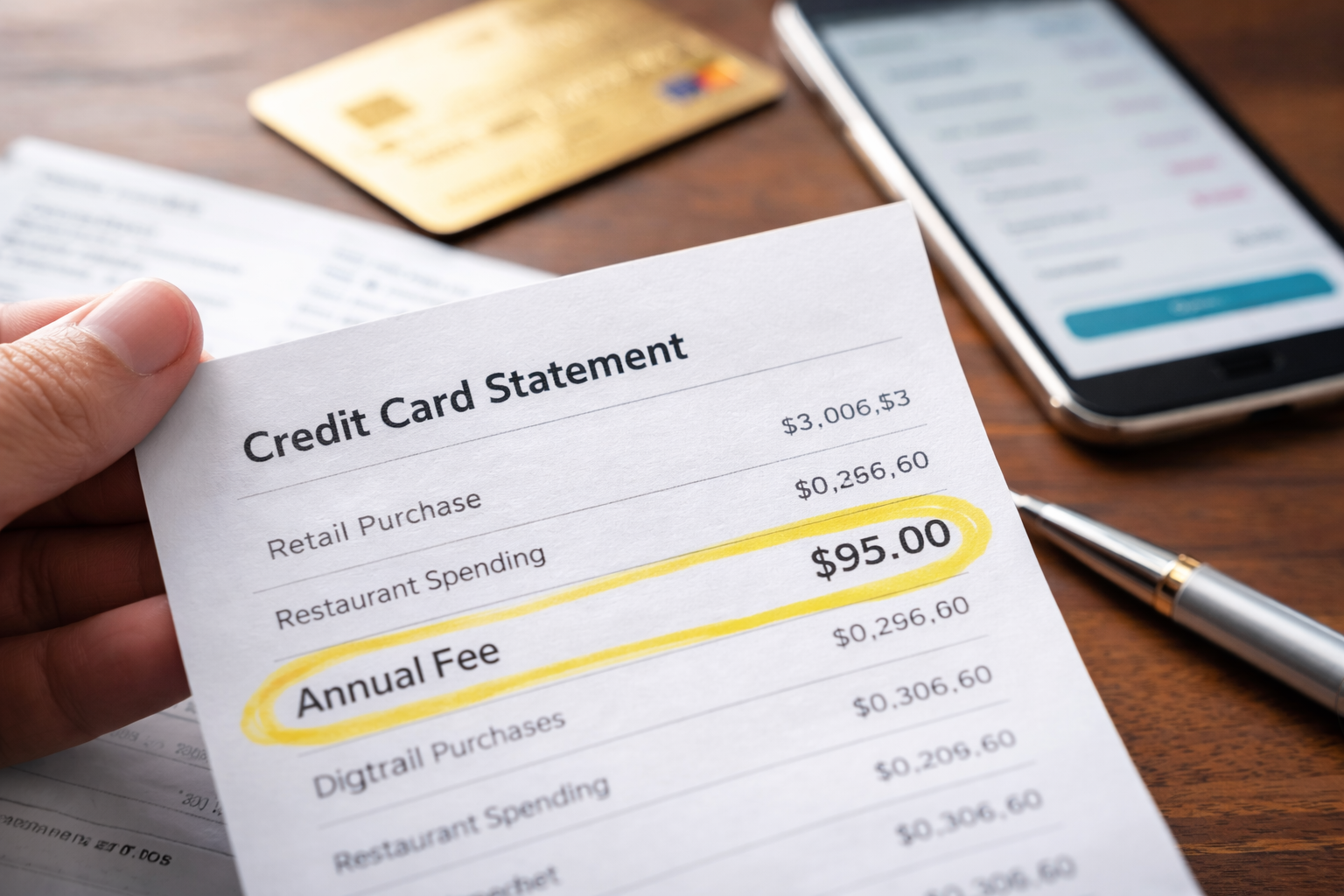
Credit card annual fee charged unexpectedly. You see it while doing something normal—checking the statement before autopay runs, or looking for a subscription you meant to cancel. The line item is clean and simple, like it has every right to be there. But it doesn’t match what you remember signing up for.
You don’t feel dramatic. You feel practical. If you do nothing, you lose money for a product you didn’t mean to buy. So you start doing the mental math: Is it refundable? Is it waiveable? If you close the card, do you lose points? If you keep it, are you rewarding a bait-and-switch?
Read this first (so you don’t take the one action that kills your leverage)
When credit card annual fee charged unexpectedly appears, many people do the fastest thing: they hit “dispute” in the app. That is often the wrong first move.
Annual fees are usually treated as disclosed, automated fees—not merchant errors. Banks often resolve these through waivers, retention credits, downgrades, or prorated refunds, and those options can shrink if you trigger the wrong internal workflow.
Your goal is not to “prove the charge is fake.” Your goal is to get the bank to remove it.
This article is educational and not legal, tax, or financial advice.
Why this happens (without the textbook lecture)
credit card annual fee charged unexpectedly is usually caused by timing rules that feel invisible in real life. Common reasons include:
• A “first year waived” promo ended, and the fee posted on the next statement cycle
• The card changed tiers (upgrade, product conversion, or benefits change)
• A retention waiver was promised but not applied correctly
• The account was reopened or reissued, resetting the annual-fee clock
• The card is in a family of products where similar names have different fee rules
The bank’s system is consistent. The communication you received may not have been.
Fast self-check: which of these matches your exact moment?
Pick the line that feels most true. This determines what you do next.
A. The fee posted today or this week and you noticed immediately.
B. The fee posted within the last 30 days and you haven’t called yet.
C. The fee posted more than 30–60 days ago and you just found it.
D. You were told it would be waived (by chat or phone).
E. The card was upgraded/converted recently.
F. You were planning to close the card anyway.
If you’re in A or B, you typically have the best odds. If you’re in C, you may still succeed, but the path changes.
Decision tree: the right first move based on timing
If the fee is pending or just posted (0–7 days):
Call first, politely. Ask for options before discussing closure or disputes. Speed signals good faith.
If it posted within 8–30 days:
Call and request a waiver or credit. If denied, ask about downgrade + credit, or retention offers.
If it’s older than 30–60 days:
Call anyway, but your strongest leverage becomes: prior promises, product change confusion, or “I didn’t realize this card carried a fee.” You may end up with a partial credit rather than a full reversal.
For most people, the best first move is still a conversation, not a dispute.
Case breakdowns so you can “drop yourself into” the right path
Case 1: “First year no annual fee” ended and you missed the exact timing
credit card annual fee charged unexpectedly often means the promo ended on a schedule you didn’t track. The fee can post right after a statement closes—not on the day you opened the card.
Best play: Ask for a one-time courtesy waiver. If you have good payment history and low disputes, you’re asking for a normal exception.
What to say: “I signed up expecting the first year waiver. I see the fee posted now. Is there a courtesy waiver or statement credit available?”
Case 2: You barely use the card (high closure risk for the bank)
If the card isn’t part of your daily spending, you can calmly signal that the fee changes your decision to keep it. Banks don’t like losing accounts. This is where retention teams exist.
Best play: Ask about a retention offer or waiver. If denied, ask about downgrading to a no-fee version with the fee credited.
What to say: “I wasn’t expecting this fee. I’m deciding whether to keep the card. Are there retention options or a downgrade path that removes the fee?”
Case 3: You were promised a waiver (but the fee still posted)
When credit card annual fee charged unexpectedly happens after a promise, you should ask the agent to review account notes. Many issuers log chat transcripts or call notes.
Best play: Request a supervisor review and reference the approximate date/time of your prior conversation.
What to say: “I was told this fee would be waived. Could you check the account notes or the prior chat/call record and apply the credit?”
Case 4: Your card was upgraded/converted (sometimes quietly)
Some issuers convert products after benefits changes, targeted offers, or customer “upgrades.” The fee can follow the product, even if you didn’t notice the exact moment the product changed.
Best play: Ask what product you are currently on, the effective date, and whether a downgrade restores the prior terms and triggers a credit.
What to say: “Can you confirm the product name and when it changed? If this is a conversion, I’d like to revert or downgrade and have the fee removed.”
Case 5: You closed/reopened the card or replaced it after loss/fraud
Reopenings and reissues can reset internal clocks. The system might treat the account as active in a way that triggers a fee.
Best play: Request an explanation of why the fee posted and ask for a courtesy credit due to the unusual lifecycle event.
Case 6: You actually use the benefits (but the fee still feels wrong)
Sometimes the best resolution isn’t a waiver—it’s making sure you’re getting value. If you keep the card, you may negotiate a retention credit that offsets the fee.
Best play: Ask for retention options before threatening closure. If you travel or use perks, mention one perk you value. Be real, not theatrical.
Exactly what to do on the call (a calm script that works)
When credit card annual fee charged unexpectedly appears, your tone matters. You want “reasonable customer” energy, not “legal threat.” Use this structure:
1) Confirm the charge and timing
“I’m calling about an annual fee that posted on my statement. Can you confirm when it posted and why?”
2) Ask for the most direct remedy first
“Is there a waiver or statement credit available to remove it?”
3) If denied, ask the second-best remedy
“If a waiver isn’t available, can we downgrade to a no-fee version and have the fee credited?”
4) If you’re willing to close, state it as a decision point
“I’m deciding whether to keep the card with this fee. What options do I have?”
Don’t start by demanding. Start by inviting them to solve it.
If you prefer chat or secure message (what to write)
Some issuers handle fee credits faster via secure messaging. Copy/paste-friendly:
“I noticed an annual fee on my statement that I wasn’t expecting. Please confirm the reason and let me know if a waiver, statement credit, or downgrade option is available to remove the fee.”
This keeps it factual and gives them three ways to help you.
Refund vs waiver vs proration (what each one really means)
Waiver: The fee is removed entirely (often as a courtesy). Best odds early.
Statement credit: The fee stays, but they credit the same amount. Functionally identical to you.
Prorated refund: If you cancel soon after the fee posts, some issuers refund part or all of it. Not universal, but common enough to ask.
When credit card annual fee charged unexpectedly happens, your best outcome is usually a credit or waiver.
Mistakes that quietly ruin your chances
• Hitting “dispute” immediately inside the app
• Closing the account before asking about proration
• Waiting multiple statement cycles
• Using threats (“I’ll sue”) instead of decision language
• Assuming the first agent’s “no” is final
Most successful outcomes happen because the customer stayed calm and asked the right second question.
One official resource (U.S.) you can reference if needed
If you feel stuck, it helps to understand the general framework for credit-card billing issues in the U.S. This is an official starting point:
Use it for context—not as a weapon. The goal is resolution, not a fight.
Internal guide that helps if your account has multiple confusing charges
If this fee appeared alongside other charges that don’t look right, this internal guide helps you separate “billing error” problems from “fee policy” problems.
This is useful because annual-fee situations can look like billing errors, but they are often handled through waivers and credits instead.
FAQ
Can I get my annual fee back if I close the card?
Sometimes. Ask specifically if the issuer offers a prorated refund or a full reversal if you close within a certain window after the fee posts.
Should I dispute the fee as fraud?
Usually no. Annual fees are typically fee-policy items, not unauthorized merchant transactions. Start with waiver/credit requests first.
Does calling about the fee hurt my credit score?
No. Calling does not affect your credit. Closing a card can affect utilization, but the call itself doesn’t.
What if they say “it’s in the terms”?
Acknowledge it and pivot: “Understood. Are there any courtesy waivers, retention credits, or downgrade options available?”
How many times should I call?
If you get a quick “no” with no options offered, it’s reasonable to call again or ask for a supervisor review—especially if you’re within 30 days of the fee posting.
Key Takeaways
• credit card annual fee charged unexpectedly is often fixable, especially when caught early
• Don’t start with a fraud dispute—start with a waiver/credit request
• If denied, ask about downgrade + fee credit or retention offers
• Timing windows (0–7 days, 8–30 days, 30–60+ days) change your best strategy
• Calm, decision-based language usually gets better outcomes than threats
credit card annual fee charged unexpectedly doesn’t mean you were careless. It means the system posted a fee automatically in a way that didn’t match your mental model of the card.
Here’s what to do right now: open your statement, confirm the posting date, then call the number on the back of the card and ask for a waiver or credit. If the first answer is no, ask about downgrade and proration. Your next 10 minutes can decide whether you keep or recover that money.