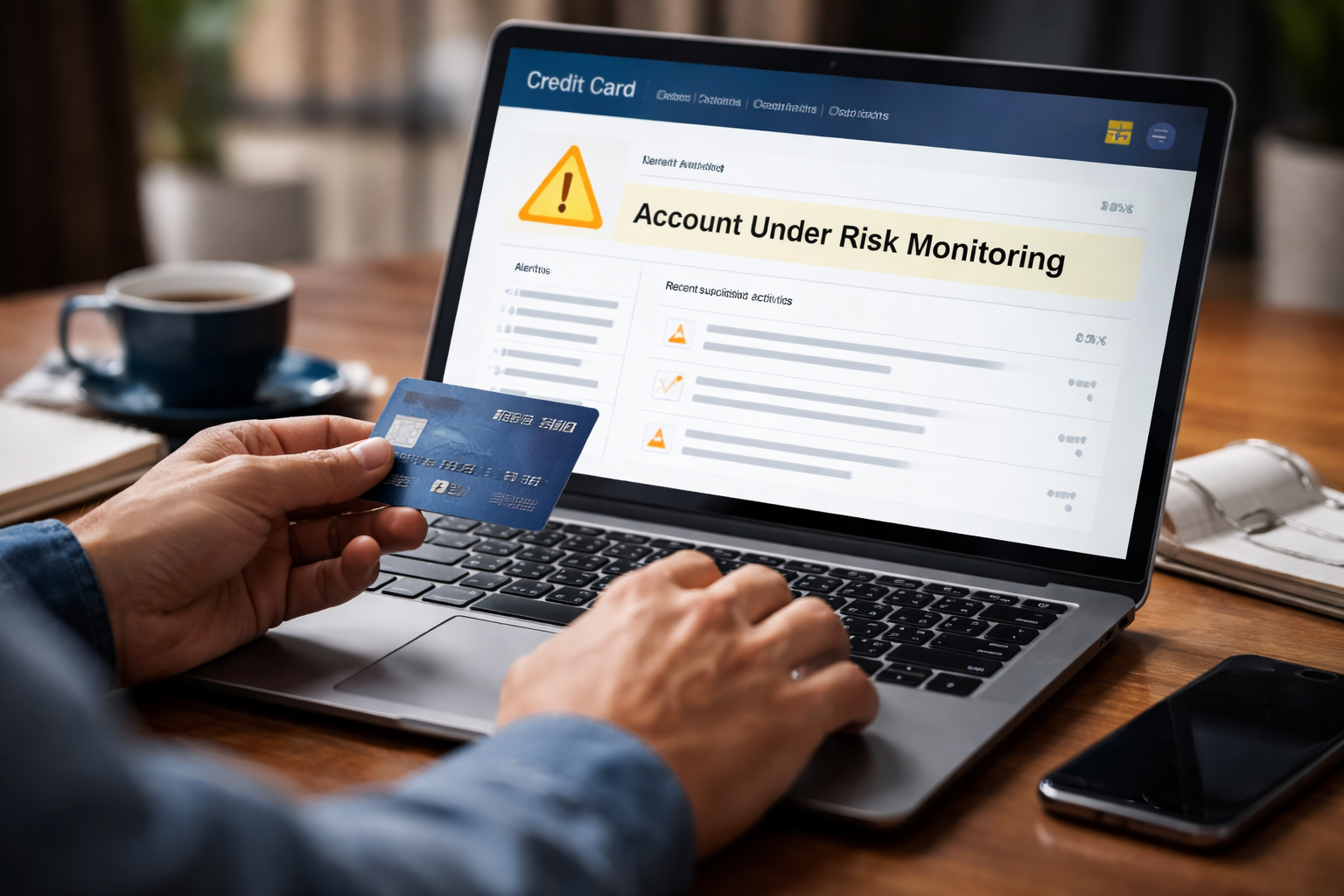
Credit Card Account Placed on “Internal Risk Monitoring” Status — I noticed it in the most normal moment: logging in to confirm a payment posted. No warning email. No fraud text. No “action required.” Just a new line in the account area that wasn’t there the week before.
I refreshed, thinking it was a temporary banner. It stayed. My balance looked the same, my due date hadn’t changed, and my card still worked. But the language was too specific to ignore. That was the moment I realized the issuer’s system had moved me into a different lane—one where everyday activity gets watched for “pattern risk,” not just missed payments.
If your Credit Card Account Placed on “Internal Risk Monitoring” Status message popped up and you don’t know what you did “wrong,” you’re not alone. This guide is built to help you map your exact situation, prevent escalation, and protect your credit reporting—without guessing, panicking, or accidentally triggering stricter controls.
If you want the bigger framework first, read this quick hub and come back:
This explains how “review” states differ from hard restrictions and why issuers use layered status codes.
What This Status Usually Signals
When a Credit Card Account Placed on “Internal Risk Monitoring” Status appears, it’s usually an internal risk flag—not a public credit bureau event. The issuer is watching account behavior more closely because an internal score, rule, or threshold changed.
In plain terms: the issuer’s system decided your account now needs extra observation before it grants the same level of “automatic trust” it used to.
- It can happen even if you’ve never missed a payment.
- It can happen even if you have no fraud claims.
- It can happen after a single “odd” event that is normal to you.
Most people get stuck because they look for one obvious cause. Monitoring statuses are often triggered by combinations of small signals that are harmless individually but “loud” when bundled.
Why It Happens (System Logic)
The fastest way to understand Credit Card Account Placed on “Internal Risk Monitoring” Status is to think in “rules + scoring + queues.” Issuers rarely rely on one reason. Instead, they use:
- Rules: If-then triggers (payment size jump, dispute cluster, multiple device logins).
- Scores: Risk scoring models (portfolio risk, fraud risk, credit risk).
- Queues: Accounts routed to monitoring lanes, then to review lanes, then to restriction lanes if needed.
Monitoring is a middle lane: the system doesn’t want to shut you down, but it’s not comfortable letting everything run fully automated either.
The Triggers That Commonly Flip the Switch
Any of these can contribute to Credit Card Account Placed on “Internal Risk Monitoring” Status—especially when they happen close together:
- Large payment after months of smaller payments
- Paying from a new bank account or new funding source
- Rapid spend increase (same income, new spending pattern)
- High utilization spike (even if you pay in full later)
- Returned payment (NSF), even once
- Multiple disputes in a short window
- Merchant credits/refunds that look like “reversal patterns”
- Travel or cross-state spending pattern changes
- Login/device/IP changes (new phone + new location)
- External credit report movement (score drop, new collections, new inquiries)
Monitoring often starts after a “perfectly reasonable” life event: moving, switching banks, changing jobs, travel, medical bills, or a disputed charge that wasn’t your fault.
What The Issuer Is Trying to Prevent
Issuers use Credit Card Account Placed on “Internal Risk Monitoring” Status to reduce losses from events that usually happen fast:
- Account takeover (fraudster gains access and drains available credit)
- Bust-out risk (spend spike followed by nonpayment)
- Dispute abuse signals (high dispute rate relative to spend)
- Payment risk (large payments that later return)
This doesn’t mean you did any of those things. It means the system saw a pattern that resembles one of them.
Self-Check: Identify Your Lane in 5 Minutes
Use this checklist to map your situation (this is where “instant self-application” happens):
- Did your payment amount jump by 2x or more vs your typical month?
- Did you switch the bank account used for payments?
- Did you file 2+ disputes in the last 60 days?
- Did your balance move from low to near-limit recently?
- Did you travel, move, or log in from a new device/location?
- Did you get any “returned payment” or “payment reversal” in the last 90 days?
- Did your employer or income change recently (even if you didn’t tell the issuer)?
If you answered “yes” to two or more, monitoring makes sense from a system standpoint—even if it feels unfair.
What You Should Do Next (Pick One Path)
Path A — Your card still works and payments are posting normally
- Make your next 1–2 payments from the same bank account you used most recently (avoid switching again).
- Keep utilization stable for one full billing cycle (avoid rapid spend spikes).
- Do not open new disputes unless necessary; document issues first.
- Call and ask: “Is there any verification step I can complete to remove monitoring?”
Path B — You notice a limit reduction, declined transactions, or “restricted” language
- Stop nonessential spending immediately to prevent cascading declines.
- Pay down to a low utilization target (many people use <30% as a practical threshold).
- Ask for the exact restriction type: “Is this a soft block, hard block, or risk-based restriction?”
- Request the escalation team that handles risk holds (not general customer service).
Path C — You recently disputed charges and the timing matches
- Collect your dispute timeline: dates filed, amounts, merchant names, and any temporary credits.
- Ask whether monitoring is “dispute-linked” or “portfolio risk-linked.”
- Request confirmation that your account will not be reported late while the dispute is active (get it in writing if possible).
Path D — You had a returned payment or bank issue
- Fix the bank-side issue first (NSF or account mismatch).
- Make the next payment with a stable, verified method (avoid multiple small “test” payments).
- Ask if you can complete identity or bank verification to shorten monitoring time.
The Exact Script to Use When You Call
When you call about Credit Card Account Placed on “Internal Risk Monitoring” Status, avoid emotional explanations. Use short, trackable questions:
- “Can you confirm whether monitoring is credit-risk, fraud-risk, or dispute-risk related?”
- “Is my account eligible to be moved out of monitoring if I complete verification?”
- “Are there any active restrictions right now, or is it monitoring only?”
- “Is any credit line decrease pending, or already decided?”
- “Will any payments be held for additional days while monitoring is active?”
Your goal is to learn the lane type, the gating step, and whether an escalation is already queued.
What Not to Do (These Mistakes Escalate Monitoring)
These are the moves that often turn Credit Card Account Placed on “Internal Risk Monitoring” Status into something worse:
- Making many small “test” payments in the same week
- Switching banks repeatedly to “prove” you can pay
- Maxing the card because “it still works right now”
- Opening multiple new cards immediately (can amplify issuer risk scoring)
- Filing extra disputes as leverage instead of last resort
- Ignoring the due date because you assume monitoring pauses reporting
Even if monitoring feels passive, late reporting can still happen if you miss your payment.
Your Rights and Where to Verify Officially
If monitoring turns into an adverse decision (like a credit limit decrease, account restriction, or closure), issuers may provide notices depending on what action occurred and why. You can also file complaints if you believe your account was mishandled.
Official consumer resource (one link only): CFPB Credit Cards Consumer Tools
If Disputes Triggered This
If the timing matches a recent dispute, this guide helps you keep the dispute from quietly expanding into account-wide review:
It explains how dispute activity can route accounts into wider financial review lanes.
Key Takeaways
- Credit Card Account Placed on “Internal Risk Monitoring” Status is an internal lane change, not necessarily a public credit event.
- Monitoring often follows pattern changes (payments, disputes, utilization, location/device shifts) rather than a single “bad” action.
- Your best protection is stability: consistent payment method, stable utilization, and clean documentation.
- Ask the issuer what lane type you’re in (fraud/credit/dispute) and whether verification can clear monitoring faster.
FAQ
Will Credit Card Account Placed on “Internal Risk Monitoring” Status hurt my credit score by itself?
Not by itself. But if monitoring leads to a limit reduction, higher utilization, or missed/late reporting, your score can be affected indirectly.
How long does Credit Card Account Placed on “Internal Risk Monitoring” Status last?
It varies. Some accounts clear after one or two stable billing cycles; others escalate quickly if additional triggers occur. The key is to ask if there is a specific verification step or gating rule you can complete.
Should I stop using the card entirely?
If your account is monitoring-only and still functioning, you often want stable, predictable behavior—not sudden zero activity and not a spend spike. Small, normal purchases and on-time payment can be safer than dramatic changes.
Can I get the status removed faster?
Sometimes. Ask whether identity verification, bank verification, or a risk team review can clear it. If the issuer says “no timeline,” ask what behavior would move it out of monitoring.
What if a purchase gets declined while I’m monitored?
That’s a sign you may have shifted from monitoring into restriction. Confirm whether it’s a soft block, hard block, or merchant-category restriction and request the risk/verification team.
Before You Scroll Away: Do These 5 Actions Today
Credit Card Account Placed on “Internal Risk Monitoring” Status is easiest to manage before it escalates. Here’s the immediate plan:
- Take screenshots of the status message and your current available credit.
- Write down your last 60 days: disputes, big payments, travel, bank changes, and utilization spikes.
- Call using the script above and get the lane type (fraud/credit/dispute) on record.
- Keep your payment method consistent for the next cycle and avoid “test payment” behavior.
- If you have a due date soon, pay early enough to avoid posting delays while monitoring is active.
Do not wait for a decline, limit cut, or closure notice to start documenting. Monitoring is the warning light that appears before the dashboard goes dark.
If you want the clearest “what happens next” map, read this next:
This shows the common escalation path from monitoring to soft restriction states—and how to respond without making it worse.
When Credit Card Account Placed on “Internal Risk Monitoring” Status first appears, it’s tempting to treat it like a glitch. I did. But the better move is to treat it like a system state: a lane change that can either normalize with stable behavior or escalate if the system sees more “noise.”
Your job today is not to argue with the label—it’s to prevent the next label. Document what changed, keep your activity steady, and get the issuer to tell you which lane you’re in and what clears it. Then you can move forward without guessing, without panic, and without waking up to a sudden hold.