
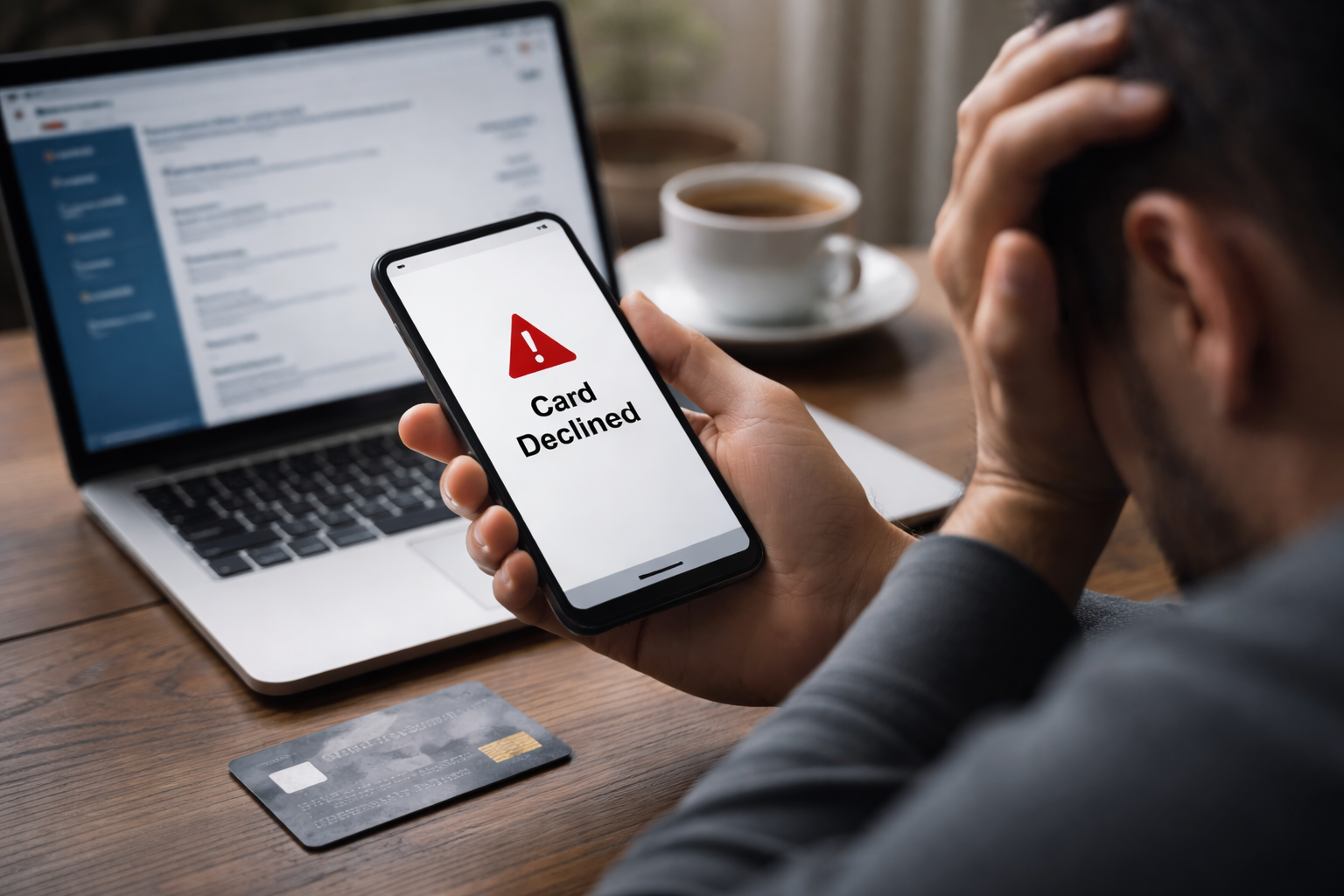
Credit Card Account Placed in “Soft Block” Without Formal Closure was the only clue I found after my card declined for a normal purchase. Not a luxury charge. Not a sketchy website. Just an everyday transaction—and then the checkout screen flashed “declined,” like the card was dead.
I opened the app expecting a clean “account closed” message. Instead, the account still existed. Balance still existed. Minimum payment still existed. But purchases were blocked. No big email. No letter. No formal closure notice. That’s the part that messes with your head: it looks open, but it behaves closed.
If you’re reading this, your Credit Card Account Placed in “Soft Block” Without Formal Closure moment probably started the same way—something small that instantly turned into a bigger logistical problem (rent, groceries, a recurring bill, a hotel hold, a work expense).
Quick context: If your account shows “review,” “restriction,” or “temporary hold,” this hub explains how issuers route accounts into internal queues and what usually happens next.
What “Soft Block” Usually Means (Without the Textbook Talk)
Credit Card Account Placed in “Soft Block” Without Formal Closure generally means the issuer didn’t end the account relationship—but it temporarily removed one or more permissions. Think of it like a “partial freeze” state used by risk systems while the issuer confirms something behind the scenes.
In practice, a soft block often looks like this:
- Purchases decline even though the account shows available credit
- Cash advances may be blocked, sometimes even if purchases are not
- Online payments may still be accepted (and must still be made)
- Recurring charges might behave inconsistently (some post, some fail)
- New card requests, balance transfers, or credit line increases are paused
The most important thing to understand: “soft block” is an internal control state, not a consumer-facing “decision” like a closure.
Why Issuers Choose a Soft Block Instead of Closing the Account
Credit Card Account Placed in “Soft Block” Without Formal Closure exists because it’s reversible. Closing is final and creates a formal trail. A soft block buys the issuer time: verify identity, confirm payment validity, audit dispute activity, or re-score risk—without committing to closure.
These are the common system categories that trigger it:
- Identity verification flags: mismatch in device, address, phone, or login pattern
- Payment integrity flags: returned payment risk, unusual payment timing, sudden paydown then spend
- Dispute intensity flags: multiple disputes, high-dollar disputes, merchant responses pending
- Fraud-network signals: card number exposure or compromised merchant alerts
- Compliance and audit routing: a dispute or transaction routed into a higher-review workflow
Sometimes, the bank will never say “soft block.” You may hear: “restriction,” “security hold,” “account limitation,” “temporary lock,” or “activity paused.” But if the account isn’t formally closed, you’re usually living inside the same bucket.
Find Your Exact Trigger Pattern
Use this to identify why your Credit Card Account Placed in “Soft Block” Without Formal Closure happened. Pick the closest match and follow the action set under it.
Case A — It happened right after a dispute
Common tells: your dispute is still “pending,” you recently uploaded documents, or you received temporary credit and then activity got restricted.
Issuer goal: reduce exposure while the merchant response window is open.
What to do: ask the issuer to confirm whether the restriction is tied to a dispute queue, and request the exact verification step needed for restoration (sometimes it’s just phone verification; sometimes it’s proof-of-identity).
Case B — It happened after a large payment (or multiple payments)
Common tells: you paid a big chunk, used a new bank account, paid from a different name account, or made several payments close together.
Issuer goal: confirm funds stability and reduce “payment reversal” risk.
What to do: confirm whether the payment is under “hold for clearing,” ask the earliest date the payment is considered final, and avoid stacking additional rapid payments unless the issuer tells you to.
Case C — It happened after travel, device changes, or digital wallet updates
Common tells: new phone, new browser, new SIM, login from a different area, new Apple Pay/Google Pay token, or a sudden run of online purchases.
Issuer goal: confirm it’s you, not a replay attack or account takeover.
What to do: complete the issuer’s verification channel (SMS, voice call, secure message) and ask for a “note” on the account that identity was confirmed.
Case D — It happened after a merchant issue or chargeback escalation
Common tells: you had a merchant conflict, a reversal, pre-arbitration talk, or an escalated complaint.
Issuer goal: contain network exposure, especially if the merchant category is high-risk.
What to do: confirm whether purchases are blocked globally or only for specific merchant categories, and request a timeline for review completion.
Case E — It happened “randomly” with no obvious event
Common tells: no recent dispute, no large payment, no travel—just a normal life pattern.
Issuer goal: automated risk re-score based on external signals or internal model updates.
What to do: ask if the account is in a “risk-based review,” whether a supervisor can remove it after verification, and whether any adverse action notice is pending.
The Hidden Danger: Your Account Still Has Obligations
Here’s what makes Credit Card Account Placed in “Soft Block” Without Formal Closure uniquely dangerous: people assume “blocked” means “paused.” It doesn’t. Minimum payments still matter. Interest still accrues. Fees can still appear. Autopay can still fail if your payment method is linked to the same blocked card.
Treat the account as active for payment purposes even if it is unusable for spending.
One official reference for consumer rights around billing errors and dispute handling is the CFPB’s Regulation Z section for billing error resolution:
CFPB Regulation Z — Billing Error Resolution (Official Reference)
How the Issuer’s System “Thinks” During a Soft Block
Credit Card Account Placed in “Soft Block” Without Formal Closure usually sits inside a workflow the agent can see but cannot fully override. The system logic often runs like this:
- Trigger: event hits a rule (payment anomaly, dispute intensity, identity mismatch, fraud-network alert)
- State change: account permission set is reduced (purchases, cash advance, balance transfer, digital wallet tokenization)
- Queue routing: the case is assigned to a team (fraud ops, risk ops, disputes, compliance)
- Verification gate: the system waits for a “pass” event (ID verified, phone confirmed, bank account validated)
- Outcome options: restore access, partial restore, credit line decrease, or formal closure
That’s why you can call twice and get two different-sounding answers. One agent sees the “restriction” label but not the reason code. Another can see the queue but not the timeline. A supervisor might see the timeline but can’t bypass the verification gate.
The “Long Block” Box: When It Doesn’t Clear Quickly
If your Credit Card Account Placed in “Soft Block” Without Formal Closure lasts longer than 7 business days:
- Ask for the department name currently holding the case (fraud, risk, disputes, compliance)
- Ask for the required action that releases the block (ID upload, phone verification, bank validation, dispute documentation)
- Ask whether there is a pending adverse action notice or whether it’s strictly a temporary restriction
- Request that the issuer documents the call and notes that you are ready to comply with verification
- Keep paying at least the minimum due while the block exists
A long block is often a missing step, not a permanent “no.” The step has to be identified clearly.
If your restriction started right after a dispute, this specific scenario is the closest match and can help you frame the call correctly:
A Self-Check Checklist That Forces “Instant Situation Mapping”
Use this checklist to turn your Credit Card Account Placed in “Soft Block” Without Formal Closure into a clean, explainable timeline. You want the issuer to hear a structured story, not a stressed one.
- Timing: Exactly when did the first decline occur?
- Last normal transaction: What was the last purchase that worked?
- Recent changes: New device, travel, address, phone number, digital wallet, or bank account?
- Payments: Any large payment, multiple payments, or payment from a new bank?
- Disputes: Any dispute opened in the last 60 days?
- Recurring charges: Which subscriptions are tied to this card and might fail next?
- Access impact: Is it purchases only, or also cash advance / balance transfer / online payments?
When you call, read this list like a script. It increases the chance the agent routes you to the correct queue on the first call.
Exact Call Script: The Questions That Unlock Useful Answers
Say this (short, direct):
- “My account shows open, but transactions are blocked. Is this a soft block / restriction state?”
- “Which department queue is holding the restriction: fraud, risk, disputes, or compliance?”
- “What is the one verification step required to restore spending?”
- “Is there a timeline or review window I should expect?”
- “Please document that I called today and that I’m ready to complete verification.”
Then ask one more thing that matters a lot:
“While the restriction exists, are my payments posting normally, and will autopay still run?”
Mistakes That Turn a Temporary Block Into a Permanent Problem
Credit Card Account Placed in “Soft Block” Without Formal Closure is often reversible—until someone reacts in a way that escalates risk scoring.
- Stacking rapid payments: multiple payments in a day can look like “managing around holds”
- Opening multiple new accounts immediately: can worsen risk models and trigger more restrictions
- Ignoring the minimum due: late reporting causes long-term damage unrelated to the original block
- Arguing about “fairness” before verification: verification is a gate; it must be cleared first
- Changing contact info mid-review: can extend verification timelines
Your goal is to clear the verification gate first, then deal with the bigger dispute or complaint.
FAQ
Is Credit Card Account Placed in “Soft Block” Without Formal Closure the same as being closed?
No. The account can remain open while permissions are restricted. It’s a control state, not necessarily a final decision.
Will this show on my credit report immediately?
Usually the block itself doesn’t. What can affect credit is missed payments, later closure, or credit line changes.
Can I still pay the card while restricted?
In most cases, yes—and you should. Payment obligations typically continue even when spending does not.
How long should I wait before escalating internally?
If you complete verification and nothing changes within about 7 business days, ask for the department holding the case and request escalation to a supervisor or executive resolution path.
Does a soft block mean the bank thinks I committed fraud?
Not necessarily. Many flags are automated and are about uncertainty, not accusation.
Key Takeaways
- Credit Card Account Placed in “Soft Block” Without Formal Closure usually means “restricted but open,” not “closed.”
- Most soft blocks are verification gates tied to risk, payments, disputes, or fraud-network signals.
- Keep making at least the minimum payment while the restriction exists.
- The fastest path is identifying the holding department and completing the specific verification step.
If the issuer later claims a “decision” was made (limit cut, closure, denial), this explains what a formal notice can mean and what it usually contains.
When my Credit Card Account Placed in “Soft Block” Without Formal Closure happened, the worst part wasn’t the decline. It was the silence. An account that looks open makes you second-guess your next move. You keep checking the app like it’ll explain itself.
Here’s the move that actually works: call today, identify the holding department, ask for the single verification gate, and get the account notes documented. Then keep payments current while the restriction clears. Do those steps in that order and you give yourself the best chance of restoring access before the system escalates the restriction into something permanent.