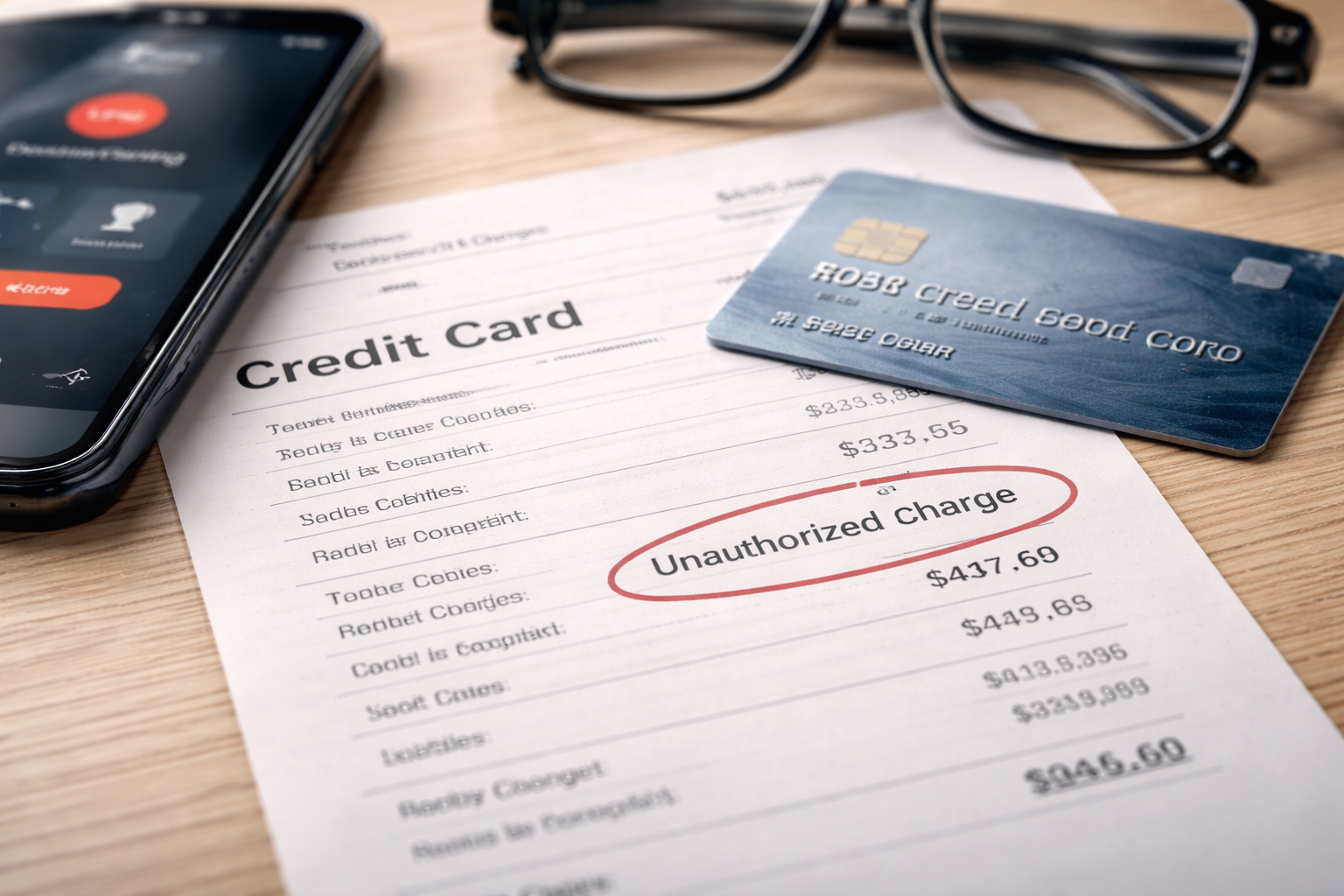
Unauthorized credit card charge — I spotted it in the most boring moment imaginable: waiting for a page to load, half-scrolling my statement, not expecting anything. Then I saw a merchant name that didn’t ring a bell. The amount wasn’t enormous, but it was clean and final-looking, like it belonged there.
I didn’t feel rage first. I felt that practical kind of stress—quiet, controlled, but heavy. I started bargaining with myself. Maybe it’s a hotel hold. Maybe it’s a weird merchant name. Maybe I forgot. That “maybe” is exactly how a real problem gets a head start. If you’re reading this, you’re probably trying to decide whether you’re about to overreact—or underreact.
Fast self-check (30 seconds)
Don’t guess. Don’t spiral. Just answer these:
- Do you recognize the merchant without Googling it?
- Is the charge posted (not pending)?
- Did you receive a matching email receipt you trust?
- Is the amount small enough to be a “test charge”?
- Did the charge appear right after you used your card on a new website or device?
If even one answer makes you hesitate, treat it seriously. That hesitation is the early stage of an unauthorized credit card charge story.
One quick internal guide
If you want the broader “billing error vs fraud vs duplicate” framework before you act, this hub guide helps you label your situation correctly in under two minutes.
Use it only to label the issue—then come right back here and act.
Why this happens (without the lecture)
Most people imagine fraud as a stolen wallet situation. In real life, the first sign is often smaller and quieter: card details reused somewhere, a compromised online checkout, a data breach you never hear about, or stored card info on an account you forgot existed.
Sometimes the first move is deliberate: a small charge used to confirm the card works. If it goes through, larger attempts may follow. That’s why “it’s only $3.19” isn’t comforting. It can be the warm-up.
And sometimes it’s messy rather than malicious: a merchant descriptor looks unfamiliar, a subscription renews under a parent company name, or a previous authorization reappears. The key is this: you don’t have to solve the mystery before you protect yourself.
How the issuer will handle it (and how to get the right track)
When you contact your card issuer, the path your case takes depends on the language you use. “I’m confused” invites explanation. “I’m reporting fraud” triggers security steps. If you believe you did not authorize the transaction, say it plainly.
Use this script:
“I’m reporting an unauthorized transaction. I did not authorize this merchant or amount, and I want a dispute opened with a case number.”
This is the difference between a slow conversation and a process that moves. In other words: call it what it is—an unauthorized credit card charge.
What to do immediately (the “stop the bleed” sequence)
Keep this simple. You’re trying to stop additional damage first, then clean up the disputed amount.
- Capture proof: Screenshot the transaction line item (merchant, date, amount, status).
- Check for more: Search your statement/app for similar merchants or repeating patterns.
- Contact issuer via official channel: Number on the back of your card or in-app support.
- Open the dispute: Ask for the case number and what happens next.
- Secure the account: Ask whether a replacement card is recommended and whether the account can be temporarily locked.
Do not start by emailing a random merchant support address you found online. Secure the account with the issuer first.
Evidence checklist (tiny but powerful)
You don’t need a file folder. You need a clean set of facts you can repeat without drifting into emotions.
- Transaction screenshot (posted/pending status visible)
- Your location and activity at the time (simple note is enough)
- Whether your card is in your possession
- Whether your phone number/email were recently changed on the account
- Any recent legitimate purchase that might be related (same day, same category)
The goal is to make the review easy for the issuer, not to convince them with a story.
Case branching (pick your path and follow it)
Read these like a decision tree. Your results depend on choosing the right first move. Most people lose time because they treat every charge the same. That’s why an unauthorized credit card charge guide has to be case-based.
Case A: Small “test charge” you don’t recognize
This is often the early probe before bigger attempts.
- Say to issuer: “I’m reporting an unauthorized transaction and I’m concerned this is a test charge.”
- Ask: “Are there other attempted transactions that were blocked?”
- Action: Request a replacement card and confirm whether any digital wallet tokens are active.
Best practice: Treat it as urgent even if the amount is tiny.
Case B: A larger charge from a merchant you’ve never used
This is containment first, details second.
- Say: “I did not authorize this merchant or amount. Please open a dispute and provide a case number.”
- Ask: “Will I receive provisional credit? If yes, when?”
- Action: Ask if the card should be replaced immediately to prevent repeats.
Best practice: Don’t negotiate. Open the dispute and lock down risk.
Case C: A charge that looks like a subscription renewal
This is the most confusing scenario because it can be fraud, a forgotten sign-up, or a descriptor mismatch.
- First step: Check your email for receipts and search the merchant name plus your common subscription services.
- If no match: Report it as an unauthorized transaction.
- Say: “I have no record of authorizing a recurring charge to this merchant.”
- Action: Ask the issuer whether the charge is coded as recurring and whether a “stop payment for merchant” option exists.
Best practice: Don’t cancel through the merchant first if you can’t verify they’re legitimate.
Case D: Multiple charges in a short window
This suggests active misuse.
- Say: “There are multiple unauthorized transactions. I need my card temporarily locked and a dispute opened for each one.”
- Ask: “Are additional charges pending that can be blocked?”
- Action: Replace the card and confirm alerts are enabled for all transactions.
Best practice: Your job is to stop the chain, not to analyze each link.
Case E: You recognize the merchant category, but not the amount
Sometimes this is an error. Sometimes it’s fraud disguised as a familiar category.
- First step: Check whether the merchant is a marketplace platform (descriptors can differ).
- If still wrong: Use a dispute path focused on amount mismatch and authorization scope.
- Say: “I did not authorize this amount for this merchant.”
- Action: Keep receipts of any legitimate purchase that might be confused with this charge.
Best practice: Don’t talk yourself into accepting an amount that doesn’t make sense.
Case F: The card is still in your wallet (and you’re wondering how it’s possible)
Card-not-present fraud is common. Physical possession doesn’t rule it out.
- Say: “My card is in my possession, and I did not authorize this transaction. Please treat this as fraud.”
- Ask: “Was this an online transaction? Was a digital wallet token used?”
- Action: Replace the card and update passwords for the email tied to the account.
Best practice: Possession is not proof of authorization.
Across all cases, the goal is the same: secure the account, document the dispute, and force a clear timeline. That’s how an unauthorized credit card charge becomes solvable instead of draining.
One mid-article helper
If your “unauthorized” situation turns out to be a weird duplicate pattern (it happens more than people expect), this guide helps you confirm it fast without losing time.
Use it as a cross-check, not as a delay.
What not to do (these mistakes cost real money)
- Don’t wait for “next statement”: time reduces options.
- Don’t assume small = harmless: small can be a probe.
- Don’t keep it verbal: always ask for a case number and written confirmation when possible.
- Don’t chase the merchant first if you can’t verify them: secure the card with the issuer first.
The biggest mistake is treating uncertainty as permission to do nothing.
Official escalation
If your issuer does not respond clearly, delays without explanation, or you cannot get a coherent timeline, you can submit an official complaint through the Consumer Financial Protection Bureau (CFPB). This is a legitimate channel for unresolved credit card dispute problems.
Use this after you have your issuer case number and a record of what happened.
FAQ
Should I pay the charge while disputing?
Follow your issuer’s instructions. If you must pay to avoid fees, ask how they record “paid under dispute” and keep a note of the answer.
Will I automatically get my money back?
Outcomes vary by issuer and facts. What improves results is reporting quickly, documenting the dispute, and securing the account.
What if the merchant name is unfamiliar but it’s actually legitimate?
That happens. The key is to verify without delaying. If you can’t verify quickly and confidently, dispute first.
What if it keeps happening after I dispute?
Ask for a replacement card, confirm recurring tokens are addressed, and enable transaction alerts.
Key Takeaways
- Act fast. Delay helps the problem grow.
- Secure first, investigate second. Stop additional damage before you analyze.
- Use the right language. “Unauthorized” triggers a defined process.
- Keep proof simple. Timeline + screenshot beats long explanations.
One final internal step
If you later discover your dispute is complicated by a payment posting issue or confusing account balance changes, this guide helps you handle that follow-up without losing your place.
It’s the cleanest “next step” article when the account story gets messy after the dispute is opened.
I remember the moment my mindset changed. It wasn’t when I fully understood what happened. It was when I stopped trying to prove I wasn’t forgetful and started treating it like a process: case number, dispute opened, card secured, alerts on. That’s when the situation stopped feeling personal.
If you’re staring at that line item right now, do not wait. Call your issuer through the official number, report it clearly, open the dispute, and secure the account today. You are not asking for sympathy—you are asking for a correction process you’re entitled to. That’s how an unauthorized credit card charge ends with resolution instead of regret.