
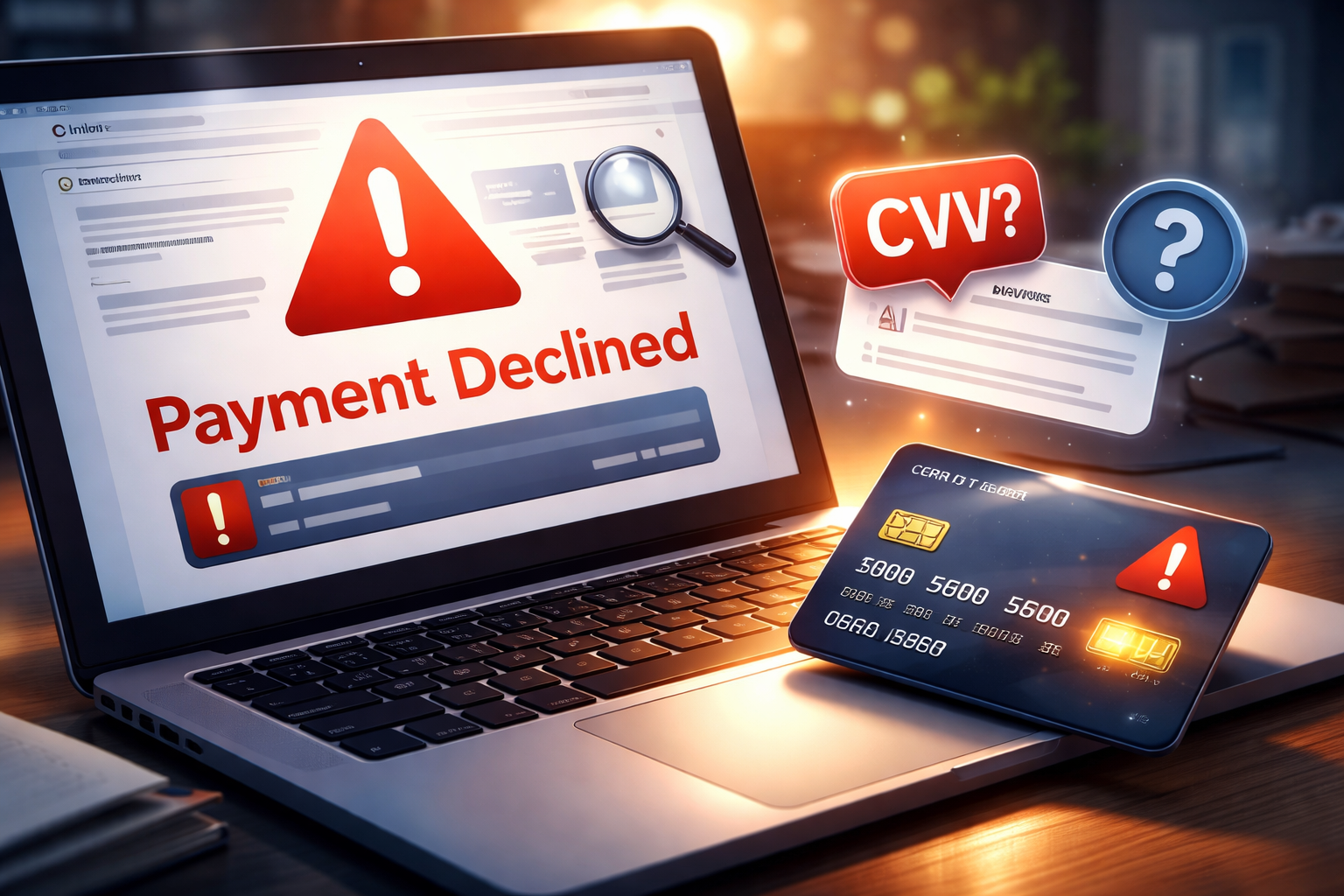
Credit Card Payment Declined Due to CVV or Address Verification Mismatch was not the kind of message you expect to see when everything else looks fine. The card is active. The balance looks manageable. The purchase is normal. Then the screen refreshes, the order stalls, and the payment fails anyway. That first moment is usually confusing more than dramatic. You look back at the numbers, check the card name, re-read the billing line, and still nothing looks obviously wrong.
What makes Credit Card Payment Declined Due to CVV or Address Verification Mismatch so frustrating is that it often happens during a routine purchase. It is not always a giant charge, an overseas purchase, or something that obviously looks suspicious. Sometimes it happens on an ordinary online order, a subscription renewal, or a payment you have made before. That is why people lose time on the wrong explanation. They assume the account is broken, when the real problem is usually hidden inside how the payment system compares the details you entered to the details already on file.
If you want the broader system background before diagnosing this specific type of decline, start here first:
Why this kind of decline happens even when the card looks fine
Credit Card Payment Declined Due to CVV or Address Verification Mismatch usually happens before the transaction ever feels “real” to the cardholder. The merchant site sends the payment request through a gateway. The gateway or processor checks the card data format. Then the issuer, or sometimes the merchant’s own fraud rules, compares what was entered against what is expected.
That comparison is stricter than most people realize. The system may compare the three- or four-digit security code, the numeric portion of the billing address, the ZIP code, and the general risk pattern of the transaction. If those checks do not line up cleanly, Credit Card Payment Declined Due to CVV or Address Verification Mismatch can happen even though the card is open, the account is current, and the available credit is more than enough.
This is the part many people miss: the system is not asking whether you have money or whether your account is in good standing. It is asking whether the transaction data is trustworthy enough to approve right now.
That is why a person can have one failed checkout on a laptop, then have the same card work later in person or on a different merchant website. The account itself may not be broken at all. The specific authorization request is what failed.
Where the mismatch usually starts
Credit Card Payment Declined Due to CVV or Address Verification Mismatch often starts with details that seem too small to matter. In real life, these are the common patterns:
Most common mismatch points
• The billing address on file changed after a move, but the issuer profile was never fully updated
• The cardholder enters the shipping address instead of the billing address
• The address is technically correct, but formatted differently enough to fail the merchant’s filter
• A saved card has old expiration or stale token data even though the physical card was replaced
• The CVV is entered manually once, then auto-fill inserts outdated address information
• The merchant checks ZIP or house number aggressively and rejects anything incomplete
Credit Card Payment Declined Due to CVV or Address Verification Mismatch becomes especially common after reissued cards, moves, name changes, apartment-number mistakes, and rushed mobile checkouts. The user feels certain the information was correct because most of it was correct. But these systems do not grade on a curve.
One field being “close enough” for a human does not mean it is close enough for the authorization system.
Merchant decline vs issuer decline
Not every failure is rejected in the same place. Credit Card Payment Declined Due to CVV or Address Verification Mismatch can be stopped by the merchant before the issuer fully approves it, or it can be rejected by the issuer after the authorization request reaches them.
That distinction matters because it changes what you should do next.
If the merchant side rejects it
• The merchant may use strict AVS or CVV filters
• The issuer may never give a full approval response
• The same card might work elsewhere right away
If the issuer side rejects it
• The issuer may see a mismatch plus added risk signals
• Repeated attempts can make the account look riskier
• You may start seeing declines across multiple merchants, not just one
Credit Card Payment Declined Due to CVV or Address Verification Mismatch is often treated like one single event by the customer, but the next step depends on which layer rejected it. If it works at one merchant and not another, the merchant filter may be stricter. If it suddenly fails across several merchants, the issuer may be scoring the activity as suspicious.
For the account-level side of that problem, this related page is the closest supporting read:
Detailed situation breakdowns
Credit Card Payment Declined Due to CVV or Address Verification Mismatch does not look the same in every situation. If you want to solve it quickly, it helps to identify which version you are dealing with.
Situation 1: You recently moved
If the issuer still holds an old billing address, or if the change is incomplete across systems, a perfectly normal online purchase can fail. This is especially common when the online account profile looks updated but the card authorization profile is still catching up. In that version, Credit Card Payment Declined Due to CVV or Address Verification Mismatch may continue until you use the exact billing address currently recognized by the issuer.
Situation 2: The card was reissued
If the old card expired, was replaced after fraud, or was reissued after damage, a stored payment method can fail even when the visible last four digits look familiar. A stale token or old security-code expectation may trigger Credit Card Payment Declined Due to CVV or Address Verification Mismatch even though the replacement card is otherwise fine.
Situation 3: The order is larger than usual
A bigger-than-normal purchase can push the transaction into a stricter review path. Once that happens, the system may treat a small address inconsistency as enough reason to reject it. In this version, Credit Card Payment Declined Due to CVV or Address Verification Mismatch is not just about the address or CVV. It is about the mismatch plus the higher-risk transaction profile.
Situation 4: It only fails online
If the card works in-store but not online, that strongly suggests verification logic instead of a pure account problem. Card-present transactions and card-not-present transactions are not screened the same way. Credit Card Payment Declined Due to CVV or Address Verification Mismatch is much more likely in online checkouts because address verification and security-code checks matter more there.
Situation 5: It failed once, then everything started failing
This is the version where repeated retries made the pattern look worse. One decline turned into several. Several turned into a risk signal. At that point, Credit Card Payment Declined Due to CVV or Address Verification Mismatch may stop being a one-checkout problem and start becoming an account-review problem.
What to do immediately in the right order
The fastest fix is usually not “try again until it works.” The fastest fix is a controlled reset of your information and behavior.
Immediate action sequence
1. Stop retrying for a few minutes
2. Pull up the exact billing address from your card statement or issuer profile
3. Re-enter the address manually instead of trusting saved checkout data
4. Re-enter the CVV manually
5. Make sure you are not mixing billing and shipping addresses
6. Retry once, not repeatedly
7. If it fails again, contact the issuer before making more attempts
Credit Card Payment Declined Due to CVV or Address Verification Mismatch often gets fixed at step two or step three. The issue is that many people skip those steps and go straight to five more attempts, which can make the system less willing to approve the next request.
A clean single retry after correcting the data is usually safer than three panicked retries with slightly different address entries.
Mistakes that make it worse
There are a few reactions that repeatedly turn a temporary mismatch problem into a broader restriction problem.
Credit Card Payment Declined Due to CVV or Address Verification Mismatch can get worse when you:
• retry too many times in a short window
• switch between multiple merchants within minutes
• use different versions of the address on each attempt
• keep the same browser auto-fill even after one failure
• try a VPN, different location, or multiple devices too quickly
To a risk engine, frantic human behavior can look very similar to fraudulent testing behavior.
That is one reason people sometimes say, “It started as one simple decline and then suddenly the whole account felt blocked.” The mismatch itself may have been minor. The pattern afterward is what raised concern.
How to tell whether this is really a mismatch issue
Sometimes Credit Card Payment Declined Due to CVV or Address Verification Mismatch is the real cause. Sometimes it overlaps with another card problem and only looks like a mismatch from the front end.
Look at the surrounding clues:
Signs it is mostly a mismatch issue
• The card works elsewhere
• The failure happens only online
• You recently changed address or received a replacement card
• A manual re-entry works after a failed saved-card attempt
Signs something deeper may be happening
• Multiple merchants start declining the card
• The account shows unusual warnings or restrictions
• A large payment or unusual transaction happened just before the decline
• The card is in good standing, but authorizations keep failing anyway
If it starts looking broader than a single mismatch, this is the best mid-article supporting read:
Consumer rights if the failed payment turns into a billing problem
Credit Card Payment Declined Due to CVV or Address Verification Mismatch is not automatically a billing dispute by itself. A decline alone is usually just a failed authorization attempt. But if the failed attempt turns into an incorrect charge, duplicate posting, unresolved pending item, or a payment not properly reflected on the account, consumer protections can matter.
If a charge posts incorrectly, or if a payment-related error appears on the statement, that is when you stop treating it as just a checkout inconvenience and start treating it as a billing issue.
Official source:
Consumer Financial Protection Bureau – How to fix mistakes in your credit card bill
Key Takeaways
• Credit Card Payment Declined Due to CVV or Address Verification Mismatch usually means the authorization details failed a trust check, not necessarily that the account is bad
• Small address differences, stale saved-card data, and reissued cards are common causes
• Merchant filters and issuer risk rules can both trigger the decline
• Repeated retries can make the problem worse
• The best fix is to verify the exact billing details, retry once, then contact the issuer if it still fails
FAQ
Why does my card work in person but not online?
Because Credit Card Payment Declined Due to CVV or Address Verification Mismatch is tied to card-not-present verification checks. In-store purchases do not rely on the same address verification logic.
Can one wrong ZIP code really cause a decline?
Yes. Credit Card Payment Declined Due to CVV or Address Verification Mismatch can be triggered by a small mismatch if the merchant or issuer uses strict filters.
Should I keep trying until it goes through?
No. Repeated attempts can increase risk scoring. Correct the details first, then make one controlled retry.
Does this mean my account is under review?
Not always. But if Credit Card Payment Declined Due to CVV or Address Verification Mismatch starts happening across several merchants, account-level review becomes more likely.
What if a pending charge appears after the decline?
That can happen when an authorization attempt is placed but never completes cleanly. Watch whether it falls off or posts incorrectly before treating it as a dispute.
What to read next before the problem grows
If your decline is starting to look less like a simple checkout problem and more like a broader posting or authorization problem, read this next before making more retries:
Credit Card Payment Declined Due to CVV or Address Verification Mismatch usually feels bigger than it is during the first few minutes. But the real damage often happens after that first decline, when people start guessing, changing details, and hammering the checkout screen. The right move is simple: stop, verify the exact billing information, retry once, and escalate to the issuer before the system decides your behavior itself is the risk.
If the transaction is important, do not let the problem drift. Pull the statement, match the address exactly, and handle it now while it is still a verification problem instead of a larger account problem.