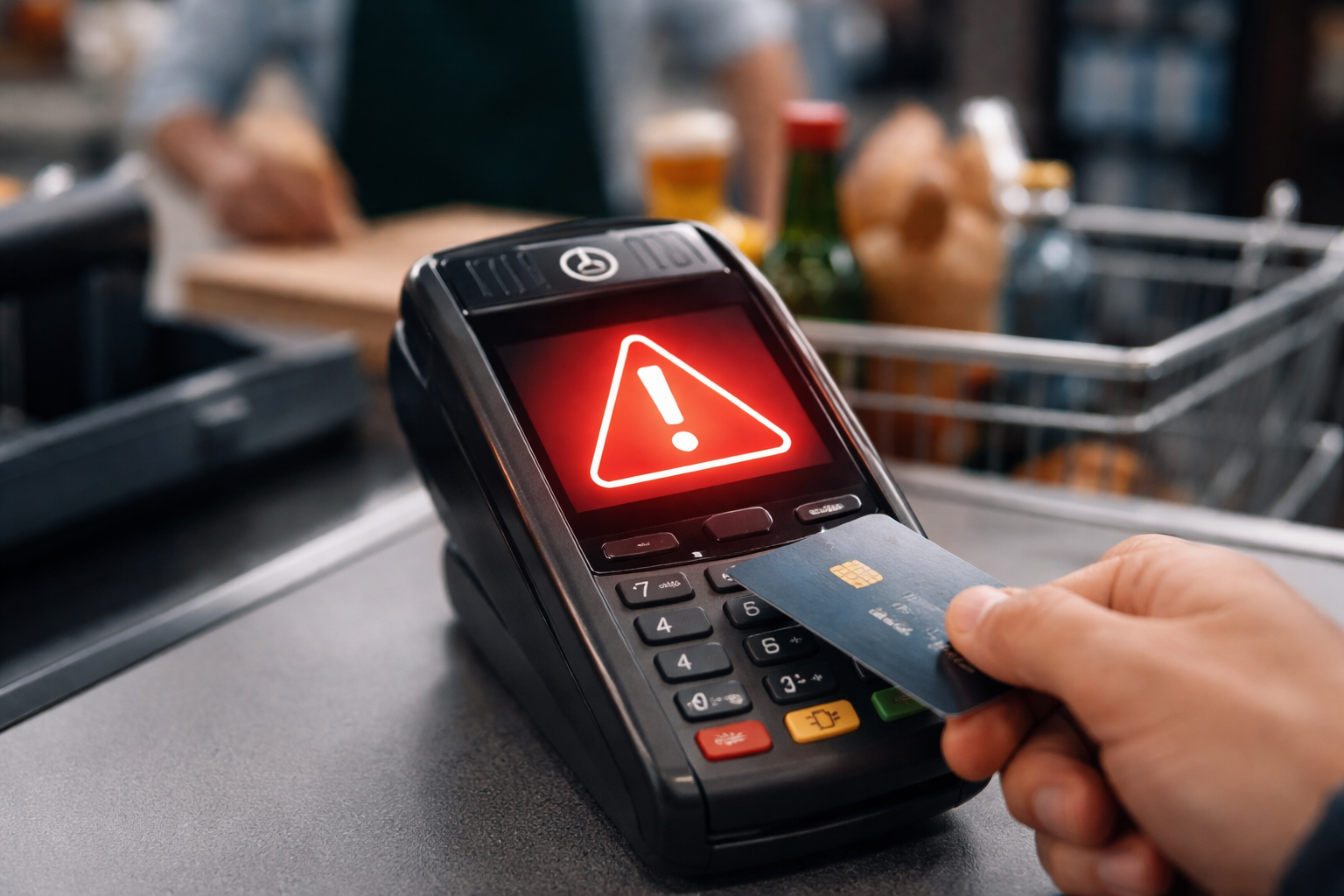
Credit Card Payment Flagged as Suspicious and Temporarily Blocked After Large Transaction was the exact problem the moment the payment should have gone through and didn’t. You tap once, wait, and get a decline. Not an over-limit message. Not an expired card message. Just a stop. For most people, that is the first sign this is not a normal merchant issue. It feels abrupt because it is abrupt. The system is built to interrupt first and explain later.
You try to make sense of it in real time. The card worked last week. The account looked fine this morning. There was enough available credit. Nothing seemed wrong until this one large purchase hit the screen and everything stalled. That is why Credit Card Payment Flagged as Suspicious and Temporarily Blocked After Large Transaction is so frustrating: it usually appears at the worst possible moment, when you are already committed to the purchase, already at checkout, and already assuming the transaction is routine.
Before you get deeper into this specific issue, it helps to understand the broader payment flow that happens before a charge becomes final:
Why this happens without any warning
Credit Card Payment Flagged as Suspicious and Temporarily Blocked After Large Transaction usually happens because the issuer’s fraud system sees a pattern shift, not because it has already proven fraud. That distinction matters. A lot of consumers assume a blocked payment means the bank believes the card was stolen. In many situations, that is not what happened. The system may simply believe the transaction does not fit your recent behavior closely enough to approve it instantly.
That decision can be triggered by a mix of signals:
- The purchase amount is much larger than your usual spend.
- The merchant category has elevated fraud history.
- The location of the purchase does not fit your normal pattern.
- The purchase is online when most of your large purchases are in person.
- The card was just used elsewhere, and the timing looks unusual.
- You retried after a first decline, which raised the risk score even more.
The bank is not only evaluating the card. It is evaluating the behavior around the card. That is why Credit Card Payment Flagged as Suspicious and Temporarily Blocked After Large Transaction can happen even when your account is current, your balance is manageable, and the merchant is legitimate.
What the issuer is seeing in that moment
From your side, it looks like one declined purchase. From the issuer’s side, the system may be seeing an event cluster: unusual amount, unusual merchant, unusual channel, unusual timing. Credit Card Payment Flagged as Suspicious and Temporarily Blocked After Large Transaction is often the result of those signals landing together inside a real-time fraud engine.
These systems do not work like a person reading your account line by line. They score transactions in seconds. They compare the attempted purchase to prior card usage, account age, payment behavior, known merchant risk signals, location data, device patterns, and timing patterns. If that combination crosses an internal threshold, approval may be interrupted.
That is why one cardholder can make a $2,500 purchase with no issue while another gets blocked at $800. Credit Card Payment Flagged as Suspicious and Temporarily Blocked After Large Transaction depends less on the raw number itself and more on how unusual that number looks for that particular account.
If you want the account-side background for how these flags can widen into broader monitoring, this related guide fits well:
The most common real-world patterns
Large purchase at a merchant you rarely use
This is one of the most common setups. The system sees a high-dollar transaction at a seller with no recent pattern match.
Travel, relocation, or cross-border spending
The card may be active and valid, but the location pattern suddenly shifted. That alone may not block a payment, but paired with a large amount, it often does.
Online checkout after mostly in-store activity
If your history suggests one spending style and the transaction appears in a different environment, the system may treat it as a deviation.
Repeated checkout attempts in minutes
The first decline is bad enough. Repeating the same amount several times can make Credit Card Payment Flagged as Suspicious and Temporarily Blocked After Large Transaction look even more serious.
High-risk merchant type or digital goods
Certain categories draw more internal scrutiny because fraud losses are historically higher there.
These patterns matter because they explain why consumers often say, “But I had the credit available.” Available credit is not the only approval factor. Credit Card Payment Flagged as Suspicious and Temporarily Blocked After Large Transaction is not mainly a limit issue. It is a trust-in-the-moment issue.
How to tell whether it is a merchant issue or an issuer block
One of the fastest ways to lose time is to assume the wrong source of the problem. Sometimes a merchant terminal fails. Sometimes a payment gateway glitches. But Credit Card Payment Flagged as Suspicious and Temporarily Blocked After Large Transaction has its own clues.
- The same card is declined at one large checkout but works for a smaller test purchase.
- You receive a fraud text, email, or app alert immediately after the decline.
- The merchant says the issuer did not approve the transaction.
- You try again and get the same stop even though the account looks normal.
If you see those signs, the odds are higher that Credit Card Payment Flagged as Suspicious and Temporarily Blocked After Large Transaction is being driven by the issuer, not the seller.
What to do in the first 10 minutes
When Credit Card Payment Flagged as Suspicious and Temporarily Blocked After Large Transaction happens, the first response matters. The goal is to confirm identity and stabilize the transaction path, not to overpower the system with repeated attempts.
- Open your banking app and look for any fraud confirmation prompt.
- Check text messages and email tied to the card account.
- Call the number on the back of the card if no alert appears.
- Confirm that you attempted the charge.
- Ask whether the block is transaction-specific or account-level.
- Retry only after you get a clear confirmation to do so.
In many cases, Credit Card Payment Flagged as Suspicious and Temporarily Blocked After Large Transaction is resolved by a quick identity check. But the fix is usually not passive. Waiting without confirming often just leaves the block in place.
Detailed self-check before you retry
If the purchase is in person:
Ask the cashier whether the decline came back as issuer decline, security decline, or technical error. That helps you separate a true suspicious-activity block from a terminal problem.
If the purchase is online:
Check whether billing ZIP, address, CVV, or device verification failed. A mismatch can combine with a high-dollar charge and strengthen the block.
If you are traveling:
Verify that your app still shows the correct contact information. A fraud alert is useless if it went to an old number you no longer control.
If the charge is urgent:
Do not keep clicking submit. Pause, confirm with the issuer, then retry once. Multiple fast retries can deepen the block.
Credit Card Payment Flagged as Suspicious and Temporarily Blocked After Large Transaction often feels like something you should “test” repeatedly. That instinct is understandable, but it is usually the wrong move.
When the problem is bigger than one transaction
Sometimes Credit Card Payment Flagged as Suspicious and Temporarily Blocked After Large Transaction is only the first visible symptom. If the issuer sees a pattern it does not like, the block can widen. What started as one interrupted payment can become a temporary account restriction, broader transaction review, or manual verification hold.
Warning signs that the issue may be expanding:
- Different merchants start declining the card.
- Cash advance access changes unexpectedly.
- Your app shows an account alert, review, or restriction notice.
- You are told to wait for a specialist team rather than just verify the purchase.
At that point, the issue is moving beyond Credit Card Payment Flagged as Suspicious and Temporarily Blocked After Large Transaction and into account-level control. That is not the same topic as this article, but it is the natural place the problem can go if handled badly or if the risk signals are unusually strong.
Mistakes that often turn a temporary block into a longer problem
There are a few common reactions that make this worse:
- Retrying the same high-dollar transaction over and over.
- Trying smaller split charges immediately after a suspicious decline.
- Using another digital wallet path to force approval.
- Calling the wrong number found through a search result instead of the number on the card.
- Ignoring the fraud prompt and assuming the merchant will “fix it.”
What looks like persistence to you can look like escalating risk to the issuer. That is why Credit Card Payment Flagged as Suspicious and Temporarily Blocked After Large Transaction should be treated as a verification problem first, not a checkout problem first.
Your rights and your practical position
You do have the right to ask the issuer what happened in plain language, but in real life, fraud systems are not always explained in detail. A representative may not tell you the exact scoring logic. That does not mean you are stuck. When Credit Card Payment Flagged as Suspicious and Temporarily Blocked After Large Transaction happens, your practical goal is narrower and more useful: confirm identity, confirm the attempted charge, confirm whether the block has been lifted, and confirm whether another attempt is safe right now.
If a representative tells you the transaction cannot be approved immediately, ask whether the account itself is restricted, whether travel or location verification is needed, and whether a note has been added for a retry. Those questions are more productive than demanding the exact fraud rule used.
If your card keeps getting declined and you’re not sure why, this official guidance explains what to do next: Federal Trade Commission – When a Company Declines Your Credit or Debit Card
How to reduce the chance of this happening again
No one can guarantee that Credit Card Payment Flagged as Suspicious and Temporarily Blocked After Large Transaction will never happen again. But you can reduce the odds.
- Use issuer travel notices or app alerts when available.
- Keep your phone number and email current.
- Respond quickly to fraud prompts instead of waiting.
- For very large purchases, consider notifying the issuer in advance.
- Avoid repeated rapid attempts if a large purchase fails once.
The system learns more from confirmed behavior than from repeated failed behavior. That is why confirmation habits matter more than frustration-driven retries.
If your decline later turns into a larger freeze or payment-access issue, this related article gives the next step context:
FAQ
Does Credit Card Payment Flagged as Suspicious and Temporarily Blocked After Large Transaction mean my card was stolen?
Not necessarily. It often means the purchase pattern looked unusual enough to interrupt approval until you verify it.
Can I just try the charge again later?
Sometimes, but not as your first move. Confirm the transaction with the issuer first. Otherwise the same block may repeat.
Will this affect my credit score?
A single suspicious-activity block usually does not directly affect your score. The risk is indirect if it leads to missed payments, broader account restriction, or confusion that delays payment management.
Why did a smaller purchase work but the large one failed?
Because Credit Card Payment Flagged as Suspicious and Temporarily Blocked After Large Transaction is usually about risk scoring tied to that specific transaction profile, not your general ability to use the card.
Should I split the purchase into smaller amounts?
Not immediately after a suspicious decline. That can look worse. Confirm with the issuer first.
Key Takeaways
- Credit Card Payment Flagged as Suspicious and Temporarily Blocked After Large Transaction is usually a real-time fraud scoring issue, not a normal billing issue.
- The block is often triggered by pattern mismatch, not proven fraud.
- Large amount, unfamiliar merchant, location shift, and repeated retries commonly combine to cause the interruption.
- The fastest path is to verify the transaction through the issuer, then retry once you are told the block is cleared.
- Repeated attempts without confirmation can push the problem toward broader account review.
Credit Card Payment Flagged as Suspicious and Temporarily Blocked After Large Transaction feels personal because it happens in a public, inconvenient, and often expensive moment. But the underlying logic is usually mechanical. The system saw something outside your normal pattern and chose interruption over risk.
That is why the best next step is not guessing, blaming the merchant, or hammering the payment button again. The right move is to verify the charge through your issuer immediately, confirm whether the block is transaction-only or account-wide, and only then retry. Do that first, and you give yourself the best chance of turning a stressful checkout problem into a short-lived interruption instead of a larger account mess.