
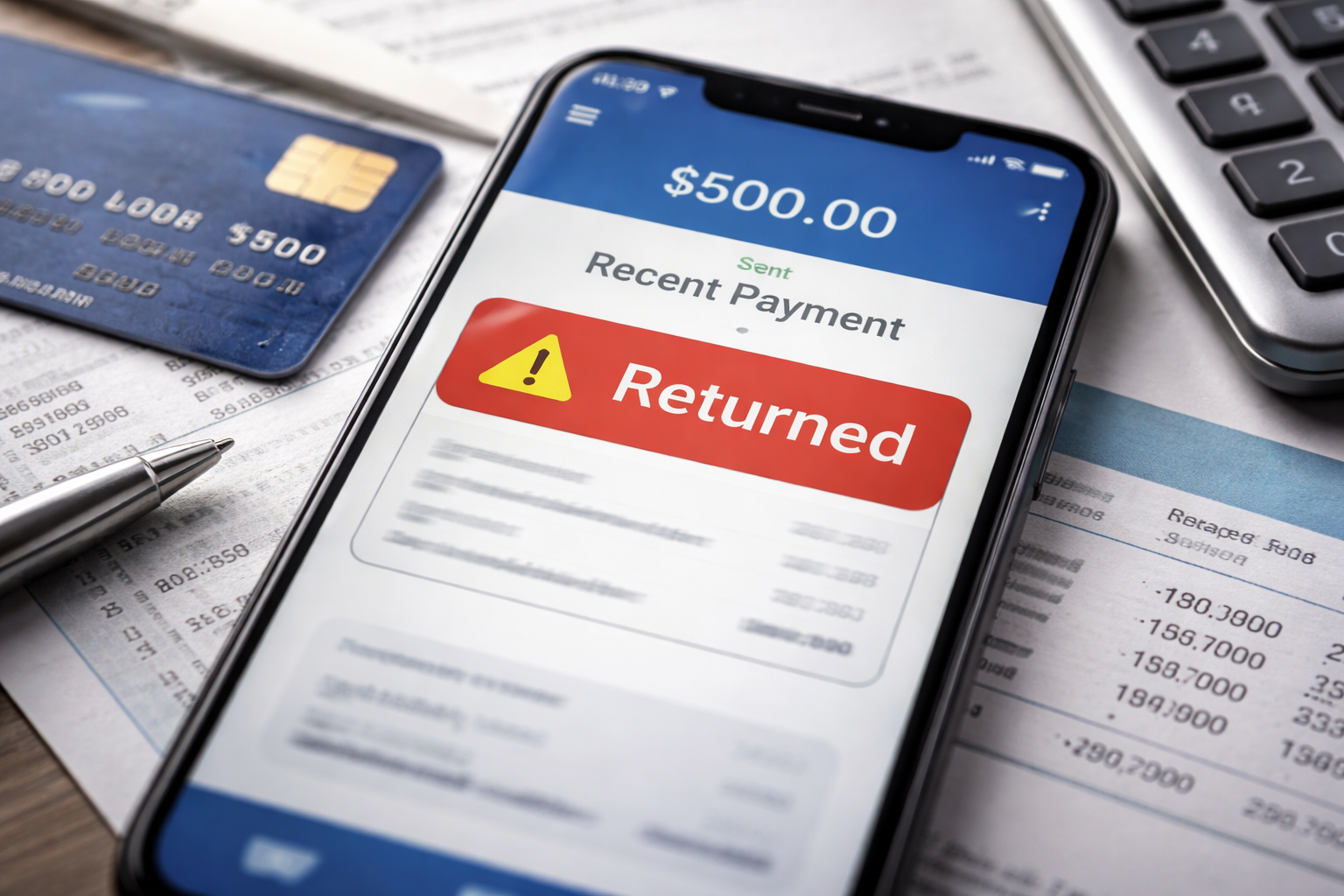
Credit Card Payment Marked as Returned but Money Already Deducted was the exact phrase I ended up staring at after checking two screens that should have matched but didn’t. My bank balance was lower. The money had already left. But on the credit card side, the payment was not showing as successful, not even pending in a normal way. It was marked as returned, like the whole thing had bounced backward after my account had already been hit.
That kind of mismatch is what makes this situation so unsettling. It does not feel like a normal late payment problem or a normal banking delay. It feels like the money disappeared into a gap between systems. And when Credit Card Payment Marked as Returned but Money Already Deducted shows up, the biggest danger is not confusion itself — it is what the card issuer may do while you are still trying to understand what happened.
If you want the closest hub-level explanation first, this guide helps show how these mismatches appear across billing systems and statements:
Why this feels worse than a normal failed payment
When a regular payment fails, the usual pattern is simple. You try to pay, the payment does not go through, and the money stays in your bank account. That is frustrating, but it is easy to identify. Credit Card Payment Marked as Returned but Money Already Deducted is different because both systems appear to be telling a different story at the same time.
Your bank may show the transfer as completed, posted, or withdrawn. Your card issuer may show the payment as returned, reversed, or removed from the account ledger. So from your side, the money is gone. From their side, the bill may still look unpaid.
That is why this problem can turn into a late fee, extra interest, a temporary account restriction, or even an internal risk review before you realize the payment was not credited the way you expected.
Credit Card Payment Marked as Returned but Money Already Deducted usually happens because payment movement and payment validation do not happen in one single step. The money can move out before the receiving side fully accepts the transfer. That delay is where things split.
What is happening behind the scenes
Most card payments made from a bank account move through ACH processing or an equivalent electronic transfer flow. That sounds simple from the outside, but there are separate checkpoints involved. One system authorizes the outgoing payment. Another system receives the payment file. Another system verifies account data, timing, duplicate activity, and settlement conditions. Another part of the issuer ledger decides whether the payment should actually stay applied.
So Credit Card Payment Marked as Returned but Money Already Deducted can happen when the outgoing side releases funds first, but the receiving side later rejects, reverses, or removes the payment entry. Sometimes the rejection happens because of a technical mismatch. Sometimes it happens because of cutoff timing. Sometimes a risk filter catches it after it initially looks fine.
This is why people get confused by the wording. “Returned” sounds final, but it does not tell you where the money is at that exact moment. It only tells you how the card issuer currently classified the incoming payment on its side.
A returned label is an issuer-side status, not proof that your money is already back in your bank account.
The most common versions of this problem
Version 1: Temporary routing gap
You see Credit Card Payment Marked as Returned but Money Already Deducted for one to three business days, then the money reappears in your bank account. This is often a timing mismatch between outgoing transfer and reversal posting.
Version 2: Issuer removed the payment after initial acceptance
The payment may have briefly reduced your balance, then vanished from the card account. The bank money is still gone. This usually means the issuer ledger reversed the credit before your bank completed the refund leg.
Version 3: Payment was returned and fees started immediately
This is the most urgent pattern. The issuer treats the payment as failed and begins charging late fees or continuing interest as if no valid payment was made.
Version 4: Multiple payments were involved
You made one manual payment, one autopay payment, or two close-together payments. Credit Card Payment Marked as Returned but Money Already Deducted may be tied to a duplicate-detection rule or sequencing error.
Version 5: Account enters review status
If the payment was large, unusual, or part of a rapid series of transfers, the returned status may be tied to internal risk screening rather than a simple bank data problem.
Detailed case splits that change what you should do next
If your due date is today or tomorrow
Treat Credit Card Payment Marked as Returned but Money Already Deducted as unresolved until confirmed otherwise. Do not assume the original payment will save you from fees. Protect the due date first. That often means making a backup payment from a different confirmed method if you can safely do so.
If your bank shows the transfer as pending, not posted
The money may still release back automatically. In that version, the returned status may resolve faster. But you still need to ask the issuer whether the account is currently treated as unpaid.
If your bank shows posted and final
This is the version that needs the most attention. At that point, Credit Card Payment Marked as Returned but Money Already Deducted may mean the funds are sitting in a return path, waiting for reconciliation between institutions.
If the payment was made through your issuer’s website
Ask whether the issuer can see the internal payment trace, the return reason, and the exact timestamp of reversal. That usually gives better answers than simply asking whether it “went through.”
If the payment was made through bill pay from your bank
The bank may need to investigate the transmission record separately. In that version, the issuer may not have enough information to explain where the money is until the bank traces it.
If autopay was involved
Check whether a manual payment was entered too close to the autopay date. Credit Card Payment Marked as Returned but Money Already Deducted can show up when one payment disrupts the expected posting sequence of another.
If the issuer added a late fee or raised concern about returned payments
Do not wait for the money to come back before disputing the fee. Ask them to document that the funds had already left your bank when the payment was marked returned.
What the issuer may be doing while you wait
One reason Credit Card Payment Marked as Returned but Money Already Deducted is so dangerous is that your card issuer may keep applying normal account logic while you are stuck in the middle of a payment mismatch.
That means the account may continue accumulating interest. It may lose any benefit associated with timely payment. It may generate a late fee. If there were recent large transactions or unusual activity, the issuer may even put the account into review because returned payments are often treated as risk signals by automated systems.
The issuer is not necessarily looking at your bank screen. It is looking at its own ledger. If that ledger says the payment was returned, your account can be treated as unpaid unless you intervene.
Never assume both institutions can see the same status in real time. They usually cannot.
If you need more context on payment-stage problems that remain unresolved longer than expected, this related guide helps fill in the middle of the story:
What you should say when you call
Do not call and simply ask, “Where is my money?” That often gets you a generic answer. Instead, describe the mismatch clearly.
Tell the bank: “My credit card issuer shows the payment as returned, but the funds were already deducted from my bank account. I need the payment trace, current status, and whether a reversal is pending or completed.”
Tell the issuer: “My bank confirms the funds left my account, but you marked the payment as returned. I need the return reason, timestamp, and whether the account is being treated as unpaid for fee or reporting purposes.”
Credit Card Payment Marked as Returned but Money Already Deducted becomes easier to solve once both sides confirm whether the transfer failed before settlement, after settlement, or during reversal routing.
The mistakes that create bigger damage
The first mistake is passively waiting. Sometimes the money does return on its own, but that does not pause due dates, interest logic, or account reviews. The second mistake is sending repeated replacement payments without understanding whether the first payment is still floating through the system. The third mistake is failing to document the dates and status language used by both sides.
Credit Card Payment Marked as Returned but Money Already Deducted can also turn messy when people focus only on recovering the missing funds and ignore the credit card consequences. Even if the money comes back later, the account may still show a late fee or interest charge that needs separate correction.
The problem is not solved just because one side eventually fixes itself. You have to check the account aftermath too.
What your rights look like in practice
If the issuer applies charges or negative consequences based on a payment error that was still being reconciled, you may have grounds to challenge those charges. In the United States, billing disputes and account errors can be raised formally, especially when the issue involves misapplied or incorrectly treated payments.
Official consumer guidance is here:
Consumer Financial Protection Bureau — Credit card billing error guidance
Credit Card Payment Marked as Returned but Money Already Deducted does not automatically mean the issuer acted wrong, but it does mean you should not accept downstream fees without checking whether they were triggered by a system mismatch rather than a true failure to pay.
Key Takeaways
Credit Card Payment Marked as Returned but Money Already Deducted usually means the bank and the card issuer are out of sync, not that the issue is already resolved.
The payment can leave your bank before the issuer fully accepts it.
The returned status may expose you to late fees, interest, or review flags if you do nothing.
The right response is to protect the due date, confirm the return reason, and document both sides immediately.
The fastest way to limit damage is to treat the situation as unresolved until both institutions confirm the final path of the funds.
FAQ
How long does Credit Card Payment Marked as Returned but Money Already Deducted usually last?
It can clear in a few business days, but some payment reversals take longer if the funds already moved into settlement or return routing.
Should I make another payment right away?
If the due date is close, often yes. But confirm first whether doing so could create an accidental duplicate. The priority is preventing avoidable penalties.
Can this hurt my credit?
It can if the account ends up treated as unpaid long enough for a missed payment consequence to attach. That is why timing matters.
Is this the same as a bounced payment?
Not always. Credit Card Payment Marked as Returned but Money Already Deducted can happen even when the funds left your bank first, which makes it more complicated than a simple insufficient-funds rejection.
What to read next
If this payment issue leads to a deeper dispute, restricted account behavior, or unresolved corrections, this next guide is the most useful follow-up:
Credit Card Payment Marked as Returned but Money Already Deducted is the kind of issue that feels small for a few hours and then suddenly becomes expensive. That is why the safest move is not to wait for one screen to catch up with the other. It is to force clarity while the account is still recoverable.
So do this now: confirm whether the funds are pending return, confirm whether your card account is being treated as unpaid, and protect the due date before anything else. That is the step that prevents a temporary payment mismatch from becoming a real billing problem.