
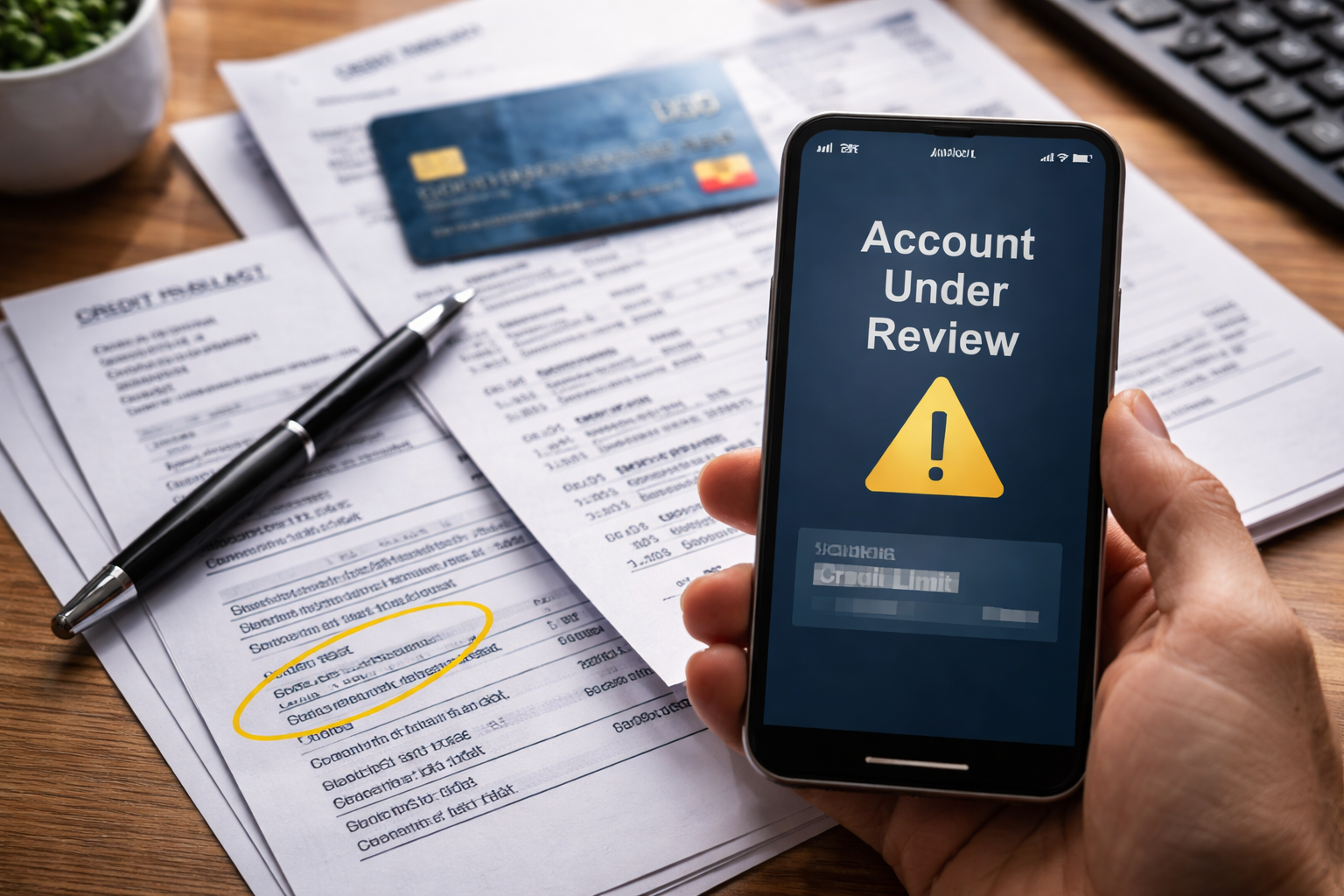
Credit Card Dispute Triggered Financial Review of Entire Account – That line showed up the first time I realized something had changed — not because the merchant replied, but because my card started declining for a small, normal purchase that should have been boring. When I opened my account, the dispute status looked “in progress,” but the rest of my account looked… different. Lower available credit. A vague “review” message. Pending transactions stuck longer than usual.
I had filed one dispute. One. I wasn’t trying to “game” anything. I just wanted a charge corrected. Yet Credit Card Dispute Triggered Financial Review of Entire Account, and suddenly the conversation wasn’t about the merchant. It was about me, my spending pattern, my payments, and whether the issuer still wanted the risk of keeping the account open.
If you’re here because Credit Card Dispute Triggered Financial Review of Entire Account on your card, this guide is built to help you make the next 7–30 days go your way: protect access, protect your credit, and keep the dispute on track without accidentally triggering more “risk” decisions.
Start with the system path so you understand the sequence (this is the closest hub-style overview):
Why a Single Dispute Can Expand Into a Full Account Review
When Credit Card Dispute Triggered Financial Review of Entire Account, it’s usually because dispute events feed into a separate risk engine. A dispute creates uncertainty: the issuer may issue provisional credit, the merchant may fight back, and the network rules might extend the timeline. Uncertainty is what risk systems are designed to reduce.
What shocks most people is that dispute teams and risk teams often run different playbooks. The dispute may be valid and still cause risk tightening.
How the “full review” typically happens
- Event: You file a dispute → the account receives a dispute flag.
- System: Risk engine re-scores the account using recent payment + spend + dispute signals.
- Routing: If score crosses a threshold, the account gets routed to an “under review” queue.
- Controls: Limit reduction, temporary restriction, or hold states can be applied automatically.
- Human step (sometimes): A manual analyst verifies identity, pattern consistency, and exposure.
This is why Credit Card Dispute Triggered Financial Review of Entire Account can show up even when the dispute is totally legitimate. The review is about “exposure,” not about whether you’re right.
The Most Common Triggers That Push the Review Button
In practice, Credit Card Dispute Triggered Financial Review of Entire Account often happens when the dispute lands on top of other risk-sensitive signals. Some are obvious; some feel unfair.
High-frequency triggers (seen again and again)
- Large purchase followed quickly by a dispute
- Multiple disputes across a short window (even small amounts)
- Recent credit limit increase + new dispute
- High utilization (balance close to limit) during the dispute
- Large payment that “doesn’t match history” (especially from a new bank)
- Returned payment / reversed payment history
- Merchant category that commonly produces disputes (travel, digital goods, high-ticket services)
What matters is the combination. One dispute alone might not do it. One dispute plus a high balance plus a recent large payment might. That’s where Credit Card Dispute Triggered Financial Review of Entire Account becomes more likely.
If you want the deeper scoring logic (the “why does a payment look risky?” angle), this is the best complement mid-article:
What You Might See on Your Account (And What It Usually Means)
When Credit Card Dispute Triggered Financial Review of Entire Account, the visible symptoms vary. The key is to interpret what you see without making it worse.
Symptom map
- Available credit suddenly drops: often a limit reduction or a hold on available credit while review is active.
- Purchases decline but payments still post: restriction state (spend blocked) without full closure.
- Provisional credit disappears: merchant response received, documentation gap, or issuer policy to retract until final outcome.
- “Account under review” message: queue routing; could be automated with optional manual follow-up.
- Autopay fails or gets canceled: sometimes a control to prevent new exposure while verification is pending.
Credit Card Dispute Triggered Financial Review of Entire Account can feel personal because it affects your daily life — gas, groceries, subscriptions — but the best results come from treating it like an operational process.
Your Consumer Rights (And the One Detail That Matters Most)
Even if Credit Card Dispute Triggered Financial Review of Entire Account, the billing error process rules still apply. Under U.S. law, issuers must generally acknowledge billing error notices within 30 days and resolve within two billing cycles (not more than 90 days). The review doesn’t cancel the dispute timeline.
Official reference (one source): Regulation Z — Billing Error Resolution (12 CFR §1026.13)
The detail that matters: if the issuer requests documentation and you delay, the dispute can stall while the risk review keeps running. That’s how people end up stuck in “review limbo.”
Find Your Exact Situation
Below are the most common “paths” after Credit Card Dispute Triggered Financial Review of Entire Account. Read the one that matches what you’re seeing. Then do only the actions listed for that path for the next 72 hours.
Path 1 — Limit Reduced (but account still open)
- What’s happening: the issuer is lowering exposure while keeping the relationship.
- What to do: pay down enough to keep utilization stable; avoid new large charges; save screenshots of the old/new limit.
- What to ask: “Is this a temporary risk action during review, or a permanent line adjustment?”
- What not to do: don’t request a limit increase now; don’t move large balances onto the card.
Path 2 — Spending Restricted (declines), payments still accepted
- What’s happening: a control state is blocking new authorizations until review clears.
- What to do: shift essentials to another card; keep making at least minimum payments on time; document declines (date/time/merchant).
- What to ask: “Is my account restricted pending identity or risk verification? What exact item do you need from me?”
- What not to do: don’t keep retrying the same purchase repeatedly; it can look like suspicious activity.
Path 3 — Provisional Credit Reversed
- What’s happening: the issuer received merchant evidence or determined the temporary credit can’t remain during review.
- What to do: request the reason code or summary of merchant response; submit your strongest proof quickly (not a long story).
- What to ask: “What documentation would change the dispute outcome at this point?”
- What not to do: don’t file a second dispute for the same charge unless the issuer instructs you.
Path 4 — Account Closure Threat / “May be closed” language
- What’s happening: risk team is considering ending the relationship; sometimes tied to adverse action requirements.
- What to do: keep payments current; download statements; move subscriptions; avoid balance transfers; prepare for a letter.
- What to ask: “Is an adverse action notice being generated? If yes, when will it be sent?”
- What not to do: don’t stop paying because you’re angry — that creates real credit damage fast.
Credit Card Dispute Triggered Financial Review of Entire Account doesn’t guarantee closure. But your next moves can influence whether the issuer sees stability or sees escalation risk.
The Call Script That Keeps You Out of Trouble
When people call, they often accidentally say the wrong thing. The goal is not to argue. The goal is to (1) confirm status, (2) learn the missing requirement, (3) create a paper trail.
Simple script
- “I’m calling because Credit Card Dispute Triggered Financial Review of Entire Account and I need to understand the current restrictions on my account.”
- “Is the review automated, manual, or both?”
- “What specific documents do you need, and where do I upload them?”
- “Will my autopay and minimum payment processing remain active during review?”
- “Can you send a secure message summarizing today’s status and the next required action?”
Ask for a summary in writing. If the issuer later reports something incorrectly, your secure message history becomes important.
What to Do in the Next 24 Hours (Exact Steps)
If Credit Card Dispute Triggered Financial Review of Entire Account is active right now, do this in order:
- Step 1: Screenshot your current limit, available credit, balance, and the dispute status page.
- Step 2: Download the last 2 statements and the transaction detail for the disputed charge.
- Step 3: Create a one-page proof bundle: receipt, cancellation, shipping/tracking, chat logs, or service failure evidence.
- Step 4: Make at least the minimum payment on time (even if you disagree with the charge) unless the issuer explicitly confirms otherwise in writing.
- Step 5: Move essential bills to a backup payment method to avoid cascading late fees and service interruptions.
This is not about “being nice.” This is about preventing the review from turning into secondary damage.
Mistakes That Make Reviews Last Longer
These are the moves that repeatedly worsen the situation when Credit Card Dispute Triggered Financial Review of Entire Account appears:
- Opening multiple new disputes at once because you feel “if they’re reviewing me anyway, I’ll dispute everything.” That often increases risk flags.
- Making a huge payoff payment from a brand-new bank account during review. It can look inconsistent and trigger additional verification.
- Maxing out the card “before they close it.” That’s the fastest path to exposure actions.
- Missing minimum payments because “the charge is wrong.” Late payments create real credit harm, separate from dispute outcomes.
- Calling repeatedly and giving conflicting explanations. Keep your story simple and consistent.
Credit Card Dispute Triggered Financial Review of Entire Account is one of those moments where calm behavior is strategy.
Does This Topic Overlap With Your Existing Posts?
Some overlap is natural in a niche site, but this article is structured to avoid “same-page, different title” repetition.
- This is broader than “dispute escalated to compliance” because it focuses on portfolio-level account review (limits, restrictions, closures) triggered by a dispute event.
- This is different from “account under review” posts because it specifically anchors to Credit Card Dispute Triggered Financial Review of Entire Account and builds action steps around the dispute + risk interaction.
- This is different from “adverse action notice” because the notice is only one possible outcome, not the main frame.
If you already have a post narrowly about “account under review,” the safest SEO separation is to keep that one about general review states, and keep this one explicitly about the dispute-triggered review mechanism and branching outcomes.
Recommended Reading
Next, read the one that matches how your situation is evolving. These are placed intentionally: mid-journey and next-action focused.
If you suspect payment pattern flags are involved, use this.
If you see letter language, closure hints, or account changes, use this.
If you feel the dispute is being reopened, delayed, or looped internally, use this.
FAQ
Does Credit Card Dispute Triggered Financial Review of Entire Account mean the issuer thinks I committed fraud?
Not automatically. It often means the risk engine detected higher exposure while the dispute is active. Fraud is only one possible branch, not the default.
Can they reduce my limit while the dispute is open?
Yes. Limit decisions can be separate from dispute resolution. That’s why your best protection is stable utilization and on-time payments during review.
Should I keep paying the disputed amount?
You should keep paying at least the minimum payment by the due date unless the issuer provides a different instruction in writing. Dispute rights and payment obligations can run in parallel.
How long does the “full review” last?
Many reviews resolve in 7–30 days, but the dispute timeline can extend up to the legal maximum depending on the cycle and the network process.
What’s the fastest way to calm the account down?
Submit clean documentation fast, avoid new high-dollar charges, keep the balance from spiking, and maintain consistent payment behavior.
Key Takeaways
- Credit Card Dispute Triggered Financial Review of Entire Account is usually a risk-engine response to uncertainty, not a judgment of “right or wrong.”
- Most negative outcomes come from secondary reactions: multiple new disputes, unstable balances, missed minimum payments, or frantic transaction behavior.
- Your leverage is documentation, stability, and written status confirmation.
- Limit reductions and restrictions can happen even while dispute rights remain active.
- Following the correct path for your symptom set protects your credit and improves the odds of review clearance.
I remember the moment it clicked: the dispute didn’t just create a ticket. It created a signal. And once Credit Card Dispute Triggered Financial Review of Entire Account, every action I took became part of the same risk picture.
So do this now: screenshot your account state, download your statements, submit your clean proof bundle, keep your payment on time, and move essential bills to a backup method. Those five steps prevent the review from turning into a chain reaction. If you need the next layer, use the reading buttons above based on what you’re seeing — and keep your behavior steady until the review clears.