
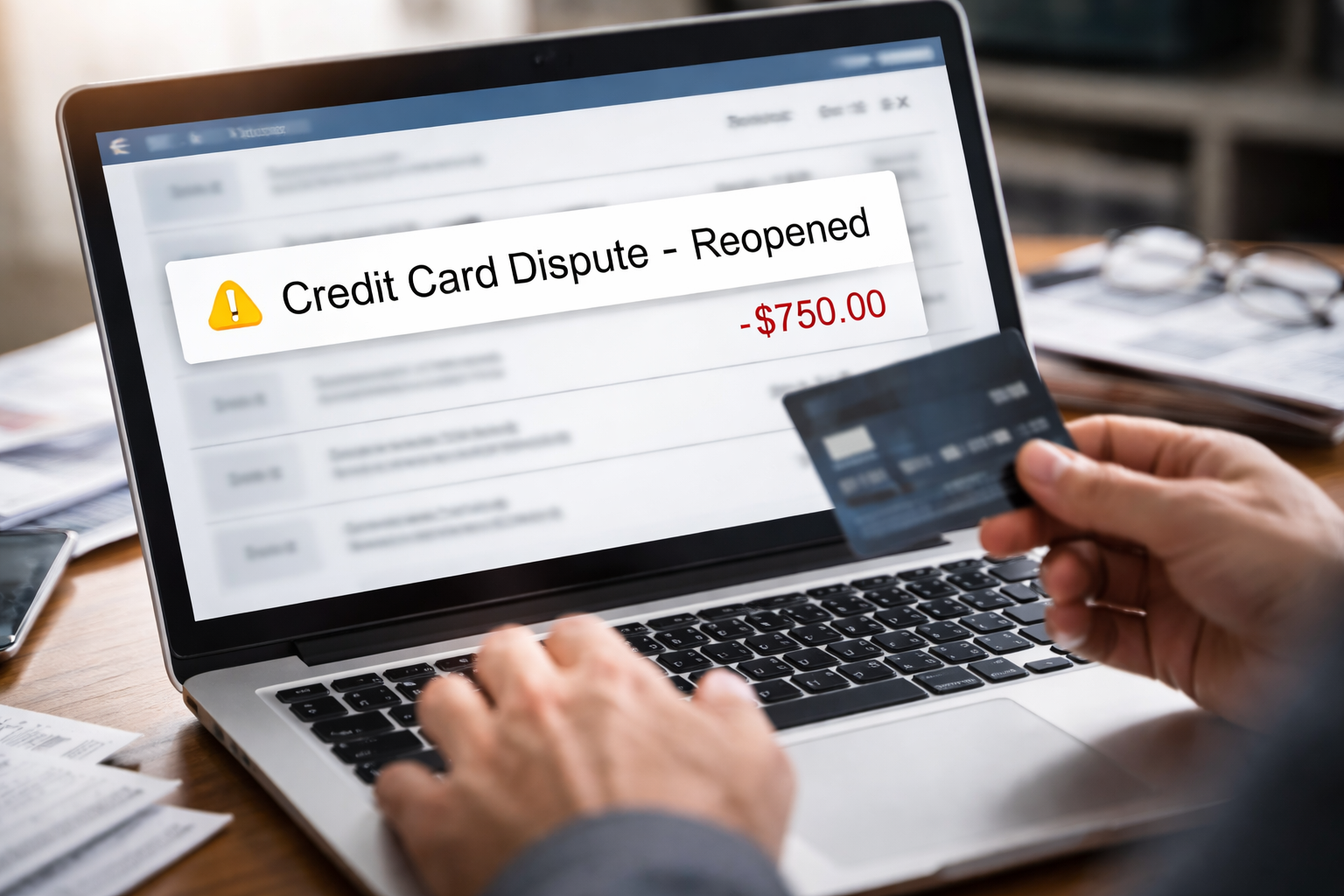
Credit Card Dispute Reopened After Being Closed — that was the exact line I saw when I logged in to check my balance. The case had been marked “closed” two weeks earlier. I had already moved on. Then the status changed, the ledger shifted, and the transaction I thought was settled was suddenly active again.
There was no dramatic notification. No clear explanation. Just a reopened case and a new pending adjustment. If you’re seeing Credit Card Dispute Reopened After Being Closed in your account, the important thing is to treat it as a workflow event, not a personal verdict.
A reopened dispute is not automatically “you lost.” It usually means the system received new information, triggered a timing rule, or detected a mismatch that required the case to be reprocessed.
To ground yourself quickly, here’s the most relevant hub-style system guide for how disputes move end-to-end. It will make every step below easier to follow:
This walkthrough explains the normal dispute timeline and where a reopened case usually re-enters the workflow.
What “Reopened” Usually Means in the Back-End Workflow
When Credit Card Dispute Reopened After Being Closed shows up, it often reflects a downstream action that happened after the “closure” you saw on screen. Many disputes are closed provisionally: the issuer’s system marks an internal step complete, while the network/acquirer side still has windows for response, representment, or correction.
In plain terms: your portal status is a user-facing label, but the dispute itself is a chain of messages and deadlines. A case can look closed while a later message (merchant evidence, corrected transaction data, late response acceptance, or an adjustment) arrives and forces the issuer to reopen the file.
If the dispute was closed quickly, reopening is more likely to be a timing + evidence event than a sudden “change of heart.”
The Most Common Triggers (So You Can Identify Yours Fast)
Below are the triggers that most often cause Credit Card Dispute Reopened After Being Closed to appear:
- Merchant evidence arrived late but was accepted: sometimes the network allows late evidence under specific conditions.
- Representment posted: the merchant contested and the issuer must review.
- Refund/credit mismatch: the merchant issued a partial refund, refund to another card, or a credit posted under a different descriptor.
- Duplicate or split transactions: the dispute was filed on one posting, but settlement occurred on a related posting.
- Chargeback reversed / second presentment: a prior outcome was reversed procedurally.
- Account lifecycle events: card replaced, account restricted, or tokenized wallet transaction updated metadata.
- Compliance review: internal QA flags a missing required document or timeline conflict.
Your first job is to identify which trigger fits your ledger right now.
Pick the Box That Matches What You See
Box A — You see a temporary credit removed or reduced
- Clue: Your statement shows the dispute credit disappearing, or the balance increases again.
- What it usually means: representment or adjustment posted and the issuer is re-reviewing.
- What you do today: capture proof (screenshots + statement PDF), then request the representment packet or summary.
Box B — The dispute reopened but the credit is still there
- Clue: Status says reopened, but your credit remains.
- What it usually means: administrative reopen, data correction, or a pending merchant response review.
- What you do today: confirm the “next deadline” and what additional documents (if any) are required.
Box C — You received a merchant refund, but the dispute still reopened
- Clue: The merchant claims refunded, but your card doesn’t show it clearly.
- What it usually means: refund posted elsewhere, partial refund, or delayed batch processing.
- What you do today: ask for the refund transaction reference (ARN / trace) and confirm it posted to your exact account.
Box D — You see a new document request or “more info needed”
- Clue: portal asks for “proof of return,” “cancellation,” “written communication,” or “invoice.”
- What it usually means: the issuer’s compliance checklist wasn’t satisfied for your reason code.
- What you do today: upload a clean, minimal packet (only what proves the key point) and confirm receipt.
Credit Card Dispute Reopened After Being Closed feels ambiguous because the portal usually doesn’t tell you which box you’re in. But your ledger almost always does.
What the Issuer and Merchant Are Doing While You See “Reopened”
When Credit Card Dispute Reopened After Being Closed appears, there are usually two parallel tracks:
- Issuer track (your bank): verifying that the dispute file has the required documents, that the timeline is consistent, and that the transaction details match the claim.
- Merchant/acquirer track: submitting evidence, clarifying delivery/return terms, or asserting that the charge is valid under the network’s dispute category.
Most reopen events happen because the system must reconcile new evidence with the original dispute category — not because the story changed.
Your Rights (U.S. Focus) Without Turning This Into a Law Lecture
You do not need to memorize statutes to handle Credit Card Dispute Reopened After Being Closed safely. You need two practical ideas:
- Billing error disputes have timing rules: deadlines exist for you and for the issuer’s investigation steps.
- You can demand clarity on the reason for a change: if a case outcome or credit changed, you can ask what evidence or rule triggered it.
Official reference (one external source): The Consumer Financial Protection Bureau explains credit card dispute / billing error rights under U.S. federal rules in its guidance on disputing credit card charges. See the CFPB’s consumer guidance here: CFPB guidance on disputing credit card charges.
If the portal changed your balance, you are allowed to ask for the specific reason and the evidence category that triggered it.
The Step-by-Step Fix That Works for Most Reopened Cases
This is the approach I used once I realized Credit Card Dispute Reopened After Being Closed wasn’t going to resolve itself just because I waited.
- Step 1 — Capture the record: screenshot the “reopened” status, download the statement PDF showing the credit/balance, and save the transaction details (date, amount, descriptor).
- Step 2 — Ask one targeted question: “What event triggered the reopen — representment, adjustment, new evidence, or compliance review?” (You want a category, not a speech.)
- Step 3 — Request the evidence summary: ask for the merchant’s evidence summary or what they claim proves their side (delivery proof, cancellation policy, return window, communication logs).
- Step 4 — Match your response to the claim: respond only to the key dispute element. Don’t flood them with unrelated screenshots.
- Step 5 — Confirm deadlines: ask: “What is my deadline to submit additional documents, and when will the next decision post?”
- Step 6 — Protect payment status: if the charge is now due while reopened, ask how minimum payments are handled so you avoid late reporting while the review is active.
Credit Card Dispute Reopened After Being Closed is easiest to manage when your response is narrow: you are not re-arguing everything, you are addressing the exact claim that reopened the file.
Self-Check Checklist (So You Can Instantly Map This to Your Situation)
- Is your temporary credit still present, partially present, or removed?
- Did a merchant email arrive after the case “closed” (even if you didn’t respond)?
- Did you return an item, cancel a service, or dispute a subscription renewal?
- Do you have one clear document that proves the key point (return receipt, cancellation confirmation, written promise, delivery mismatch)?
- Did the transaction descriptor change between authorization and posting?
- Did your card get replaced (new number) during the dispute timeline?
If you can answer those six items, you can usually predict why the case reopened before the bank even explains it.
Do Not Make These Mistakes (They Backfire in Reopened Cases)
- Do not ignore the reopen: reopened cases often come with a new response window.
- Do not send a “document dump”: too much noise can bury the one proof that matters.
- Do not assume a portal label is final: “closed” and “reopened” can be administrative states, not final outcomes.
- Do not stop monitoring statements: reopening can change balance calculations and due amounts.
- Do not contact the merchant in a way that contradicts your claim: keep messages consistent and factual.
When Credit Card Dispute Reopened After Being Closed happens, the fastest path to resolution is clean evidence + correct category alignment.
What to Do If Your Credit or Account Status Looks Affected
Sometimes Credit Card Dispute Reopened After Being Closed is paired with account restrictions, a past-due label, or confusing status codes. If you see any “past due,” “restricted,” or “delinquent” markers while the dispute is active, treat it as a parallel issue that needs its own documentation trail.
Here’s a system-structure guide that helps interpret issuer-side statuses without guessing:
This explains how issuers label accounts internally, which helps you ask better questions during a reopened dispute.
Key Takeaways
- Credit Card Dispute Reopened After Being Closed usually means a workflow event (evidence, adjustment, timing rule), not an instant loss.
- Your ledger (credit removed vs still present) is the fastest clue for what kind of reopen you’re dealing with.
- Respond to the specific claim that triggered the reopen; don’t re-argue the entire story.
- Get deadlines in writing (or at least documented notes) and submit a minimal, targeted proof packet.
- Monitor payment status during reopen so you don’t get hit with avoidable late issues.
FAQ
Why did my dispute close and then reopen?
Credit Card Dispute Reopened After Being Closed commonly happens when new merchant evidence arrives, a representment posts, a refund mismatch is detected, or the issuer’s compliance review flags a missing requirement.
Does “reopened” mean the merchant won?
No. Credit Card Dispute Reopened After Being Closed is often a neutral status. It means the file is active again and needs review, not that the final decision is already made.
My temporary credit disappeared after it reopened. What now?
Treat it as a representment/adjustment scenario. Capture your statement evidence, request the reason category that triggered the reopen, and submit a targeted response tied to the merchant’s specific claim. Credit Card Dispute Reopened After Being Closed with credit removal is time-sensitive because you may have a new response window.
Can the bank reopen a dispute without telling me?
Yes, portals often update first. If Credit Card Dispute Reopened After Being Closed appears, ask for the trigger event and whether any document deadline applies to you.
Should I keep paying the card while it’s reopened?
If the amount is due and your issuer says it can be treated as due during review, you may need to pay at least the required minimum to avoid late issues. Ask the issuer how they handle due amounts during a reopened dispute.
Recommended Reading
If you want the “why this is happening” mechanics (not guesswork), read this next. It’s the best bridge from reopened status to what the system is doing behind the scenes:
This helps you understand what the issuer reviews when a dispute reopens and what evidence usually matters.
What I’d Do Right Now (So You Don’t Lose Time)
When I saw Credit Card Dispute Reopened After Being Closed, I stopped trying to interpret the label and focused on the workflow trigger. I saved the statements, asked for the exact event category that reopened the file, and submitted one tight proof packet that answered the merchant’s specific claim.
Your next move is simple and immediate: log in, capture screenshots + statement PDF, then contact the issuer and ask: “What triggered the reopen, what is my deadline, and what single document would most directly resolve this?” If they mention evidence or representment, request a summary and respond only to that point. That’s how you keep Credit Card Dispute Reopened After Being Closed from drifting into a slow, messy back-and-forth.