
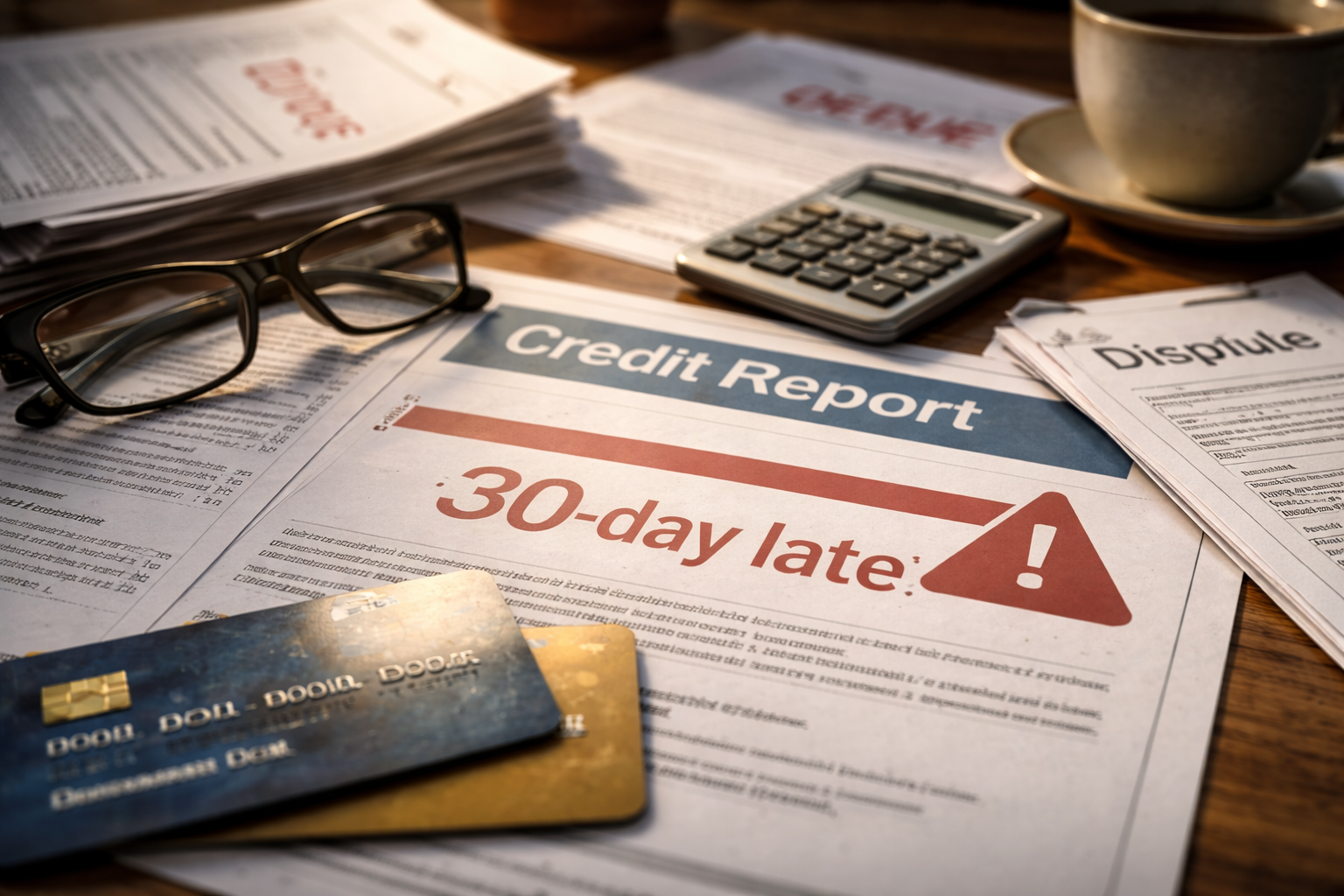
Credit card reported late during dispute — I caught it by accident. I opened a credit app the way you check the weather: quick, mindless, expecting nothing. Then I saw the new 30-day late mark and the score drop beside it. The dispute was still open. I hadn’t “given up.” I hadn’t ignored the account. But that late mark was already there, and it felt like the system decided I was wrong before the case even finished.
I didn’t start by yelling at customer service. I started by building a clean file: statement due date, payment proof, dispute confirmation, and a timeline. If credit card reported late during dispute is happening to you, the good news is that late reporting is usually a process and documentation problem — which means it can be corrected, limited, or stopped from getting worse if you move fast.
YMYL note: I’m not a lawyer and this isn’t legal advice. This guide is educational and U.S.-focused. If you’re facing identity theft, a lawsuit, or a large-dollar loss, consider professional help.
Start with the big map: If you want to understand where this fits in the broader billing error/dispute process, use this as your hub so you don’t miss key steps.
Key Takeaways
- A dispute does not automatically pause payment requirements. Many “reported late” cases start with confusion about the minimum payment.
- If credit card reported late during dispute, you must identify whether it’s (1) nonpayment, (2) payment timing, (3) payment allocation, or (4) pure reporting error.
- The fastest goal is to prevent the late mark from aging into 60 or 90 days. That’s where damage gets worse.
- Phone calls can help you understand, but written documentation fixes reports.
- Keep one story, one timeline, and one evidence set. Consistency wins investigations.
Quick Self-Check (Do This Before You Take Action)
When credit card reported late during dispute, you need to answer these in 10 minutes. If you can’t, pause and gather documents first.
- What is the exact due date shown on the statement?
- What date did your payment leave your bank?
- What date did the card issuer post the payment?
- What amount did you pay vs the required minimum?
- Is the late mark on one bureau or all three?
- Did the account have temporary/provisional credit that later changed the minimum?
Your goal is to prove what happened, not guess what happened.
Why This Happens During an Active Dispute
People think a dispute is a pause button. In practice, disputes are often treated like a separate track from billing and credit reporting. That separation is why credit card reported late during dispute shows up so often.
- Minimum payment confusion: you disputed a charge and assumed you could skip payment until the investigation ended.
- Payment timing: payment was initiated on time but posted after the due date because of processing delays (weekends, holidays, transfer holds).
- Payment allocation: payment applied to fees/interest first, leaving the account short of the required minimum.
- Balance shift: provisional credit reversed, minimum increased, and you didn’t see the change before the due date.
- Account review actions: restriction or “under review” status can create messy system updates and incorrect reporting.
Reality check: Even if your dispute is valid, the system can still report late if your account shows past due. Your job is to prove whether the past-due status is accurate.
Pick the Lane That Matches Your File
Lane A — You did not pay the minimum (or paid far below it)
If credit card reported late during dispute and you didn’t pay the required minimum, the late mark may be technically accurate. Your focus becomes damage control and prevention of 60/90-day escalation.
Lane B — You paid on time, but the issuer posted it late
This is often correctable with documentation. Your focus is proving the payment date and challenging inaccurate reporting.
Lane C — You paid, but the payment was “applied wrong”
The account can show short even when money left your bank. Your focus is payment allocation proof and statement math.
Lane D — Provisional credit changed the minimum at the worst time
Your focus is showing the minimum changed due to a dispute-related adjustment and that reporting should reflect accurate status.
Lane E — Autopay failed or was set to the wrong option
Your focus is proving system failure and preventing a second late mark while fixing the first.
Lane F — Pure reporting error (you were current, but they reported late)
Your focus is bureau disputes + furnisher correction with a clean evidence packet.
The 48-Hour Plan (Stop It From Getting Worse)
If credit card reported late during dispute, treat this as a timed event. You’re working against the mark aging and against future statement cycles.
- Get your statement PDF covering the due date. Highlight due date, minimum due, and account status line.
- Get bank proof (transaction confirmation + date posted at your bank).
- Get issuer proof (payment confirmation number, online payment history screenshot, and posted date).
- Save dispute proof (case ID, date opened, and any provisional credit notices).
- Build a one-page timeline: Date you disputed, date statement cut, due date, payment date initiated, payment posted date.
Do not rely on memory. If you want correction, you need a file that survives a review.
Lane A Deep Fix: If You Didn’t Pay the Minimum
It’s uncomfortable, but sometimes credit card reported late during dispute happens because the minimum wasn’t paid. If that’s your lane, your goal is not to “win the argument.” Your goal is to prevent more damage.
- Bring the account current immediately (at least the minimum + any past due amount).
- Prevent a second late mark by setting a reminder for the next due date and paying early.
- Ask for goodwill adjustment only after the account is current and you have a solid history. Do not expect it, but it’s sometimes possible.
Damage-control mindset: A 30-day late is bad. A 60-day late is worse. If credit card reported late during dispute is accurate, your best move is stopping it from aging.
Lane B Deep Fix: If You Paid On Time but It Posted Late
If credit card reported late during dispute and you have proof you initiated payment before the due date, you’re working an accuracy correction. That means evidence-first actions.
- Create a “payment proof packet”: bank transaction showing the date, issuer payment history showing the date, statement showing due date.
- Dispute the late mark with bureaus using a short explanation and attachments.
- Send a written correction request to the issuer with the same packet and the same facts.
- Re-check bureau results and respond if they “verify” inaccurately.
Support article if you suspect posting delays: this helps you isolate whether the problem is timing, system holds, or processing rules.
Lane C Deep Fix: If Your Payment Was Applied “Wrong”
This is the sneaky one. credit card reported late during dispute can happen when the payment hits the account, but the system applies it to fees, interest, or another part of the balance first, leaving your “minimum due” technically unpaid.
- Compare your statement math: minimum due, past due, fees, and payment amount.
- Check for a miscalculated minimum or a sudden minimum increase.
- Request a payment reallocation review in writing if the allocation created a false delinquency.
When minimum confusion is part of the story, this supporting guide helps you spot it faster:
Lane D Deep Fix: Provisional Credit Reversed (Minimum Quietly Increased)
This is a common reason credit card reported late during dispute feels unfair. You made a payment based on the minimum you saw, then the temporary credit reversed, the balance jumped, and now the minimum due is higher than you expected.
- Look for notices about “temporary credit,” “provisional credit,” or “adjustment.”
- Compare two statements: the one before the reversal and the one after.
- Document timing: when the credit was issued vs when it was removed vs when your payment was made.
The goal here is to show the reporting is inconsistent with the timeline and to prevent future misses by paying early once the dispute causes balance swings.
Lane E Deep Fix: Autopay Failed (But You Thought You Were Covered)
If credit card reported late during dispute and autopay didn’t work, don’t assume the bank will “understand.” You need proof, and you need to prevent a second late mark immediately.
- Verify autopay settings (minimum vs statement vs fixed amount).
- Save autopay confirmation and any error messages.
- Make a manual payment for the next cycle early to avoid compounding damage.
If you suspect the system took payment but didn’t apply it correctly, this page can help you validate that scenario:
Lane F Deep Fix: Pure Reporting Error (You Were Current)
If credit card reported late during dispute and you were fully current, treat this like an accuracy dispute. Your job is to make the evidence easy for a reviewer to accept.
- Keep your dispute explanation short: “I was not late. Attached is proof of payment and statement due date.”
- Label attachments clearly (DueDate.pdf, BankProof.pdf, IssuerHistory.pdf).
- Dispute with bureaus and furnisher consistently (same dates, same amounts, same language).
What Not To Do (These Mistakes Make It Harder to Fix)
- Do not wait thinking it will “update.” Late marks often stick unless challenged or corrected.
- Do not stop paying out of frustration. Anger creates 60-day lates.
- Do not send different stories to different bureaus. Consistency is credibility.
- Do not write a long emotional letter. Short + proof wins.
Official Consumer Guidance
For how credit report disputes generally work and what to include, review the CFPB’s official guidance:
FAQ
- Can a card issuer report late while a dispute is open?
Yes, if the account shows past due. But if credit card reported late during dispute is inaccurate based on your payment proof, you can challenge the reporting. - How fast can I fix a 30-day late mark?
It depends on whether it’s an accuracy issue. Utilization changes rebound quickly; late mark corrections depend on reinvestigation and furnisher updates. - Will calling customer service remove it?
Calls may explain the reason, but written documentation is what drives corrections with bureaus and furnishers. - What if the dispute outcome goes against me?
The dispute outcome and reporting accuracy are different. If credit card reported late during dispute because of a reporting error, you still challenge the reporting. - What if I’m afraid it becomes 60 days late?
Bring the account current immediately and pay early for the next cycle. Preventing aging is the fastest damage limiter.
Recommended Reading
If you’re seeing “delinquent” or “past due” wording that doesn’t match your payments, this page helps you double-check system errors and reporting mismatches.
Credit card reported late during dispute feels like getting penalized for speaking up. I felt that same “this can’t be right” moment, because the dispute wasn’t even closed yet. But once I stopped treating it like a personal verdict and started treating it like a timeline and evidence problem, it became manageable.
Here’s what you must do today: pull your statement, prove your payment timing, choose the lane that matches your facts, and take the matching written steps so the late mark doesn’t age. If credit card reported late during dispute happened to you, fast, structured action is what protects your credit — not waiting and hoping the system corrects itself.