
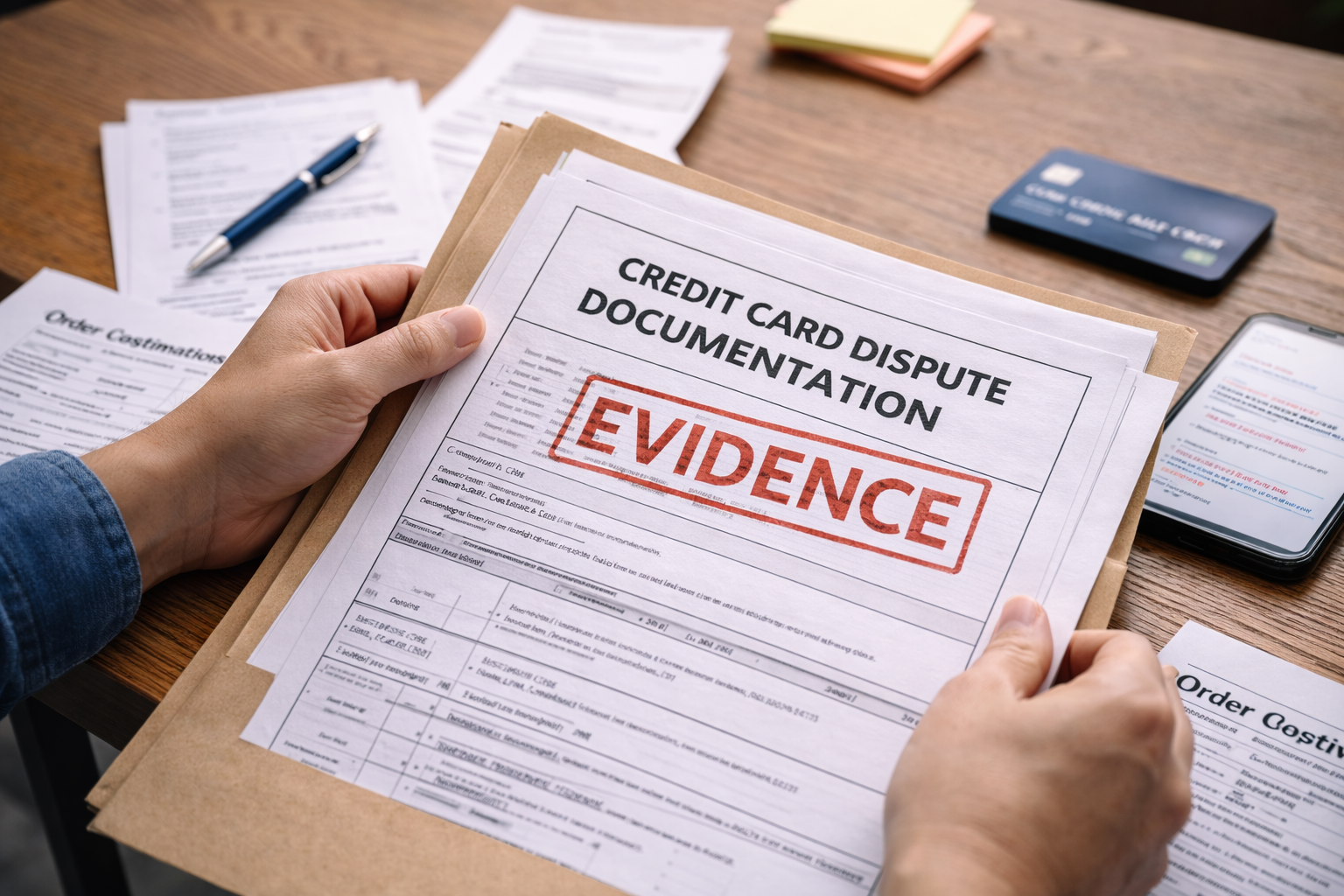
Documentation for credit card dispute — I knew the charge was wrong the moment I saw it. But the part that made my stomach drop happened later: the provisional credit disappeared. No drama, no phone call. Just a quiet reversal on my statement and a message in the portal asking me to “submit supporting documents.” That’s when I realized I hadn’t actually “won” anything yet.
I had assumed the dispute form was the dispute. It wasn’t. documentation for credit card dispute was the real case. The bank wasn’t asking for my feelings. It was asking for proof it could use in a standardized process. Once I understood that the bank is building a defensible file, my outcome changed.
If your dispute is “stuck” in review, it often means the evidence is incomplete or mismatched. This helps you diagnose the delay pattern.
Why Banks Ask for Documentation After You File
When you file a dispute, your issuer opens a case and assigns an internal category. That category determines what documents are required. documentation for credit card dispute is not “extra.” It is what allows the issuer to pursue a chargeback or defend your claim if the merchant challenges it.
Here’s the institutional reality: the issuer must follow network rules and evidentiary standards. Even if you are completely right, a weak file can lose.
That’s why your provisional credit can be reversed. The system is built to be reversible until the evidence threshold is met.
How Issuers Actually Evaluate Your Evidence
Most consumers picture a person “deciding” fairness. In practice, disputes are processed like a checklist-driven compliance file. A reviewer checks:
- Does the documentation match the transaction date and amount?
- Does the evidence match the dispute category selected?
- Does it show you tried to resolve the issue with the merchant when required?
- Is the proof time-stamped and legible?
- Was the dispute filed within required time windows?
Your submission is measured against what the merchant can produce. If the merchant submits stronger proof than you, the issuer has limited room to keep the credit.
Quick Self-Placement: Which Type of Dispute Is This Really?
This is the most common mistake: you choose the wrong category. If you submit the wrong documentation for credit card dispute category, even strong evidence can be treated as irrelevant.
- Fraud/unauthorized: “That wasn’t me.”
- Not received / not delivered: “I paid but didn’t get it.”
- Not as described / defective: “I got it, but it’s not what was promised.”
- Refund not received: “They agreed to refund but didn’t.”
- Subscription/cancelation billing: “I canceled and they still charged.”
- Wrong amount / duplicate charge: “The billing is mathematically wrong.”
Pick the true category first. Then build your packet to match it.
Situation Branch Box: Build the Right Evidence Packet
Branch A: Unauthorized Charge (Card Present or Card Not Present)
Best documentation for credit card dispute includes: proof the card was in your possession (if asked), timeline of where you were, and anything that shows the transaction pattern is inconsistent (sudden merchant category you never use, out-of-state activity, multiple rapid charges). If the issuer requests a police report, submit it only if required and truthful.
Branch B: “Merchant Did Not Deliver” (Goods/Services Not Received)
Submit: order confirmation, promised delivery window, tracking page showing no delivery or delivery failure, and your written attempts to resolve (email/chat). If the merchant claims “delivered,” your strongest move is to show carrier proof does not match your address or that the item was never signed for when signature was promised.
Branch C: “Not as Described” / Defective Item
Submit: listing screenshots showing what was promised, photos of what arrived, and a return attempt record. A short, factual comparison works better than emotional language. If there was a warranty or return policy, include it and show you followed it.
Branch D: Subscription Charged After Cancellation
Submit: cancellation confirmation email or screenshot, the date/time canceled, and the terms showing billing cycle. The key is timing. The issuer looks for proof you canceled before the billing date. If you only have a chat log, include the full conversation with timestamps.
Branch E: Refund Promised but Not Received
Submit: written refund authorization from the merchant, expected refund timeline, and statement pages showing the credit never posted. If the merchant claims they refunded, ask for the refund transaction ID and include their message. Many reversals happen because consumers submit only “they said refund” without statement proof.
Branch F: Wrong Amount Charged / Tip Changed / Currency Issue
Submit: original receipt or invoice, screenshots of advertised price, and your card statement showing the mismatch. If it’s a restaurant tip dispute, include the signed receipt (if you have it) and show the amount discrepancy clearly.
Branch G: Duplicate Charge / Charged Twice
Submit: both transactions on the statement and the one receipt showing a single purchase. If the merchant says “one is pending,” screenshot the dates and show it posted. This category is very evidence-friendly if you present it cleanly.
Your goal is to make the reviewer’s job easy. A good documentation for credit card dispute packet reads like a labeled file, not like a rant.
The “Approval-Grade Packet” Format That Works
Here is a format that consistently performs well internally because it mirrors how cases are reviewed:
- Page 1: One-paragraph timeline (transaction date, what happened, what you did, what you want).
- Page 2: Proof of the transaction (statement line + receipt/order confirmation).
- Page 3: Proof of the problem (tracking failure, cancellation confirmation, listing vs item photos, etc.).
- Page 4: Proof you attempted resolution (email/chat log; keep it short and complete).
- Page 5: Any required extras (return label, merchant denial, policy screenshots).
When documents are labeled and ordered, you look credible. And credibility matters in dispute review.
What to Say in Your Written Explanation (Short, Defensive, Specific)
Most banks allow an explanation box. Use it like this:
- State the category: “Subscription charged after cancellation.”
- State the key fact: “Canceled on [date/time], charged again on [date].”
- Reference your exhibits: “See cancellation confirmation and billing screenshot.”
- State the request: “Reverse the charge and keep the credit.”
Do not write paragraphs about how stressed you are. Stress is real, but it is not evidence.
Mistakes That Trigger Denial or Reversal
If you want to protect your provisional credit, avoid these common traps:
- Submitting cropped screenshots that remove timestamps or URLs.
- Submitting evidence that does not match the dispute category selected.
- Missing the submission deadline (even strong cases can be closed).
- Sending multiple contradictory explanations across phone/chat/email.
- Uploading everything you have instead of only the relevant pieces.
Inconsistent stories are treated as risk. Risk leads to reversals.
Consumer Rights: The One Rule That Usually Matters Most
For billing errors, U.S. consumers commonly rely on protections under federal guidance. This helps you keep your communication factual and aligned with standard dispute language.
This is an official consumer protection resource. Use its wording to keep your dispute clean and compliant.
When the Merchant Responds (and How to Counter It)
Merchants often respond with: tracking screenshots, “delivered” confirmations, IP match evidence, refund processing claims, or copies of terms. If documentation for credit card dispute is weak, those responses win by default.
Strong counters look like this:
- Carrier proof that delivery address is incomplete or incorrect.
- Merchant refund claim without any credit on your statement (show your statement window).
- Terms that don’t match what you were shown at checkout (use screenshots).
- “Subscription canceled” proof that predates the billing date.
The counter must be documentary, not argumentative.
If you’re waiting on a merchant response, this explains what the silence usually means and what to do next.
Key Takeaways
- documentation for credit card dispute is the real decision-maker, not the initial claim form.
- Evidence must match the dispute category, transaction amount, and dates.
- Time-stamped proof beats long explanations.
- Labeling and ordering documents increases approval odds.
- Submit a clean packet before the deadline to protect provisional credit.
FAQ
What if I don’t have a receipt?
Use order confirmations, email invoices, account screenshots, shipping confirmations, and merchant communication logs that show the transaction and promise.
Can I upload screenshots from my phone?
Yes, but ensure they show the full page with timestamps, URLs where relevant, and the transaction amount. Cropped screenshots are a common reason documentation for credit card dispute gets treated as insufficient.
How long does the bank have to decide?
Many disputes run 30–45+ days depending on merchant response windows and card network rules. Your priority is meeting the issuer’s documentation deadline.
What if my dispute was denied due to insufficient documentation?
You usually need to appeal with a stronger, better-matched packet. Focus on the missing proof, not the same explanation repeated louder.
If your case closed or was denied, this shows how to appeal using new evidence without contradicting your file.
Documentation for credit card dispute felt like homework at first, and I resented it. But the moment I treated it like a file the bank could defend, the case stopped drifting. I stopped sending random screenshots and started sending a labeled packet that matched the category.
Today, pick your dispute branch, collect only the documents that prove the key fact, build a one-page timeline, and submit it before your issuer’s deadline. If you do that, you don’t have to “hope” the reviewer understands. You give them a file they can approve.