
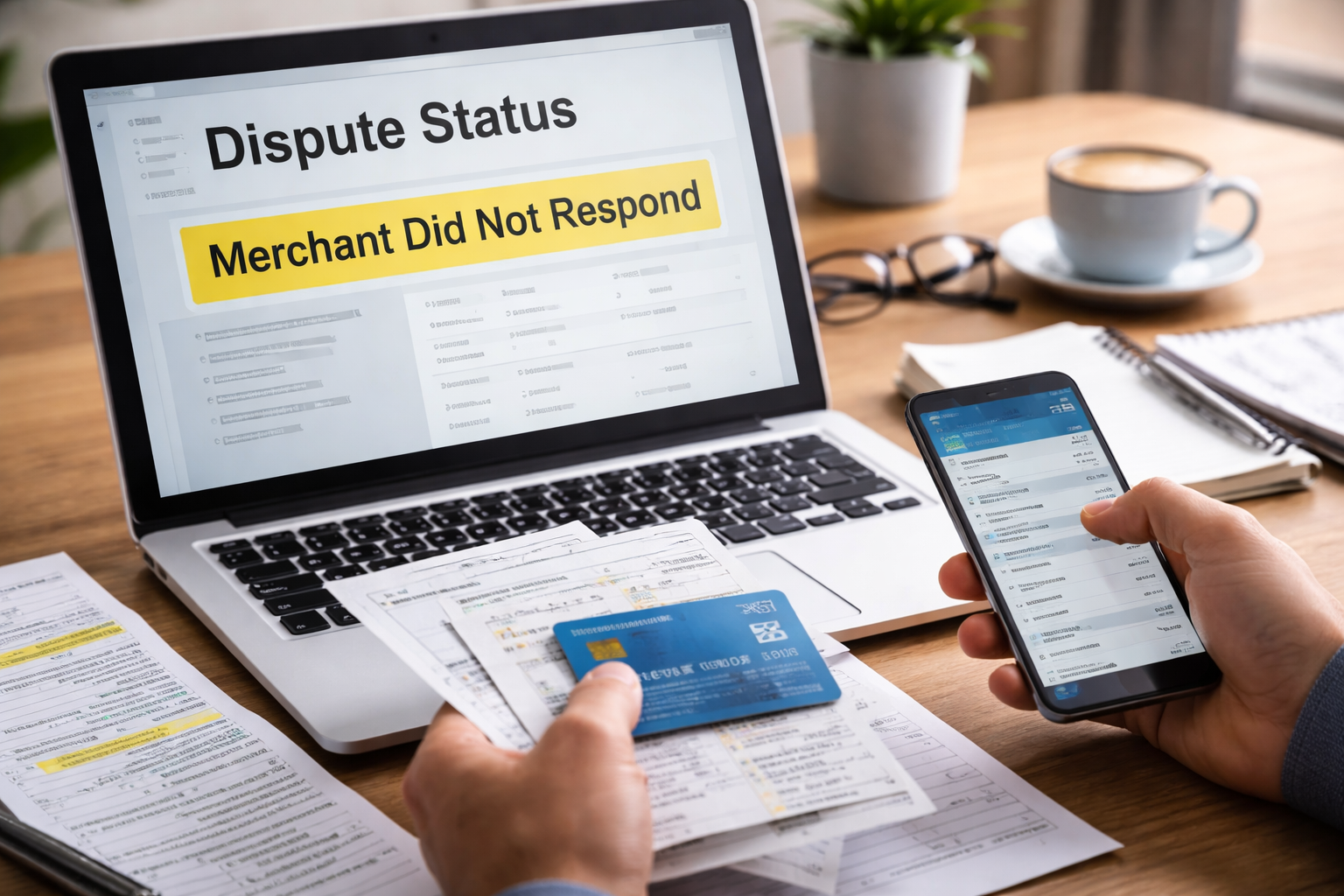
Merchant did not respond to dispute — I noticed it the same way you probably did: not through a phone call, not through a dramatic email, but as a small line of text in my dispute status. I stared at it, refreshed, then clicked around like maybe it would explain itself. No explanation. Just that sentence, sitting there like I was supposed to know what it meant.
At first, it felt like good news. If the merchant did not respond to dispute, surely the case was basically done, right? But the uneasy part was that the “temporary credit” in my account still looked… temporary. That’s the moment I realized the real risk isn’t the merchant’s silence — it’s what you do (or don’t do) while the bank is still deciding.
If you want the fastest route to “final credit” with the fewest surprises, start by getting your expectations and timeline straight. If your dispute has already been open a while, skim this hub first (you can come back):
Quick context before you continue: many readers find their case stalls not because the merchant stays silent forever, but because the issuer’s process needs one last clean “push” from the cardholder at the right time.
What “Merchant Did Not Respond to Dispute” Usually Means (In Plain English)
When a merchant did not respond to dispute, it typically means the merchant didn’t provide requested evidence within their response window. That evidence might be:
- Proof you authorized the purchase (signature, login, 3DS data)
- Delivery proof (tracking, address match)
- Terms you agreed to (refund policy, cancellation rules)
- Communication history (emails, support tickets)
Most people assume merchant silence equals automatic victory. In reality, it often means your issuer is about to decide based on what they already have. That can be great — but only if your file is clean.
The Quiet Timeline Risk: “Provisional” Is Not “Permanent”
If the merchant did not respond to dispute and you received a temporary credit, your job is to protect it. The credit can still be reversed if:
- The merchant responds late through their processor
- The issuer identifies a classification issue (wrong dispute reason)
- Your documentation conflicts with your original claim
- The issuer needs a final detail and you miss the request
The safest mindset: treat the case as unresolved until you receive a final determination notice.
Pick Your Exact Scenario
CASE 1 — You Already Have a Temporary Credit
If the merchant did not respond to dispute and you see a credit, you’re in the “protect the win” phase.
- Do not spend the credited amount until the case closes.
- Screenshot the dispute page today (status + dates).
- Call/chat and ask: “What is the investigation closure date?”
- Ask if any documents are still pending from you.
One missed bank message can flip a good case into a reversal.
CASE 2 — No Credit Issued Yet
If the merchant did not respond to dispute but you have no credit, the issuer may be waiting for internal review.
- Confirm the dispute category (fraud vs billing error vs service issue).
- Ask: “Is the merchant response window closed or still open?”
- Ask: “Can you note the file that the merchant did not respond?”
Sometimes “no credit” is simply a system policy — but you still want the case moving.
CASE 3 — The Merchant Says They Responded (But the Issuer Says They Didn’t)
This is frustrating and common. You may be dealing with processor delays.
- Ask the issuer for the exact date/time evidence was due.
- Ask if any evidence was received after that timestamp.
- If the merchant claims they responded, request they provide their submission confirmation.
Don’t argue. Just collect timestamps and keep the file clean.
CASE 4 — The Merchant Responds Late and Your Credit Disappears
If the merchant did not respond to dispute at first but later submitted something and your credit reversed, move fast.
- Request the reason for reversal in writing (or secure message).
- Ask for a summary of the evidence the merchant submitted.
- Respond with a short, consistent rebuttal and attach your proofs.
Reversals are not always final — but your response must be tight and factual.
Self-Check Checklist (This Is Where People Win or Lose)
If the merchant did not respond to dispute, the issuer might decide quickly. Before they do, run this checklist and fix weak spots:
- Is your story consistent across every message you sent the bank?
- Do your screenshots show dates, amounts, and merchant name clearly?
- Do you have proof of cancellation / return / attempted resolution?
- If it’s “not as described,” do you have photos or listing screenshots?
- If it’s “service not provided,” do you have appointment records or emails?
Anything unclear will be interpreted in the direction of “insufficient evidence.” Make it easy for the issuer to agree with you.
What to Say to the Issuer (Short Scripts That Work)
When the merchant did not respond to dispute, you want to ask the right questions without sounding like you’re trying to game the system. Use calm, procedural phrasing:
- “Can you confirm the merchant response window has closed?”
- “Is my case categorized as billing error, service issue, or fraud?”
- “Is there anything pending from me that could delay closure?”
- “What is the estimated closure date, and how will I be notified?”
Notice what’s missing: you’re not demanding, accusing, or threatening. You’re controlling the process.
If This Was Fraud vs. Billing Error: Your Next Steps Change
A big reason disputes go sideways is misclassification. Even if the merchant did not respond to dispute, the issuer can still deny if your reason code doesn’t match the facts.
- Unauthorized charge: focus on account security, device access, and replacement card.
- Wrong amount / duplicate charge: focus on receipts and statement comparisons.
- Refund not received: focus on refund confirmation and timelines.
- Service not provided: focus on contracts, communications, and missed delivery.
If fraud is in play and you’re worried about denial patterns, this guide helps you avoid the common traps:
One Official Source (U.S.) You Can Rely On
If you want the cleanest, safest official explanation of dispute timelines and issuer responsibilities, use this Consumer Financial Protection Bureau page:
When you reference an official source, keep it neutral: you’re not threatening the issuer, you’re aligning with the process.
Mistakes That Cause “Good” Disputes to Collapse
Even when the merchant did not respond to dispute, these mistakes can hurt you:
- Sending new, contradictory details late in the case
- Overexplaining (long emotional narratives create inconsistencies)
- Closing your card or charge account too early
- Accepting a partial merchant refund without documenting it
- Missing the bank’s request for one final document
Your goal is a file that reads like a timeline, not a debate.
Purchase Types That Behave Differently
CASE 5 — Subscription You Tried to Cancel
If the merchant did not respond to dispute for a subscription, cancellation proof matters most.
- Cancellation confirmation page screenshot
- Email confirmation
- Support ticket number
Subscriptions are often decided on whether you tried to cancel properly — document that.
CASE 6 — Online Order Never Arrived
If the merchant did not respond to dispute for “not received,” shipping evidence matters most.
- Tracking number screenshot
- Carrier status
- Delivery address mismatch proof (if applicable)
If tracking shows “delivered,” focus on mismatch (location, signature, address).
CASE 7 — “Not as Described” or Defective Item
If the merchant did not respond to dispute, photos and listing screenshots often win.
- Photos showing the issue clearly
- Listing screenshot showing promised features
- Return attempt proof
Don’t argue. Show contrast between promise and reality.
What “Final Credit” Looks Like (So You Don’t Guess)
You’ll usually know the case is truly done when:
- Your dispute status changes to “resolved” with a favorable decision
- You receive a secure message or letter confirming the result
- The temporary credit label disappears (varies by bank UI)
If anything is unclear, ask for a written confirmation of the final decision.
Key Takeaways
- merchant did not respond to dispute often improves your odds, but it is not a guaranteed win.
- Temporary credit can still be reversed before formal closure.
- Your best move is to keep your file consistent and respond fast to any issuer request.
- Misclassified disputes fail even when the merchant is silent.
- Proof beats explanation — keep it short, factual, and timestamped.
FAQ
Is it always good if the merchant did not respond to dispute?
It often helps, but you still need a final issuer decision. Silence is not the decision itself.
Can the merchant respond after the deadline?
Sometimes evidence shows up late through processing channels. That’s why you protect your file until closure.
Should I keep contacting the merchant?
Usually no. Once the dispute is active, keep communication primarily with the issuer unless the issuer asks otherwise.
What if my dispute closes without explanation?
Request a written explanation and the case summary, then compare it to your documentation.
Will a dispute hurt my credit score?
A standard billing dispute typically does not impact your credit score by itself, but missed payments can — keep your account current if required.
I’ve learned to treat the phrase merchant did not respond to dispute as a “good sign with conditions.” It’s not a finish line. It’s a window where you can lock the result in — or accidentally weaken it with sloppy follow-up.
Open your dispute page today, screenshot the status and dates, confirm the closure timeline with your issuer, and upload any missing proof immediately. That is the simplest way to protect your money while the system is already leaning your way.