
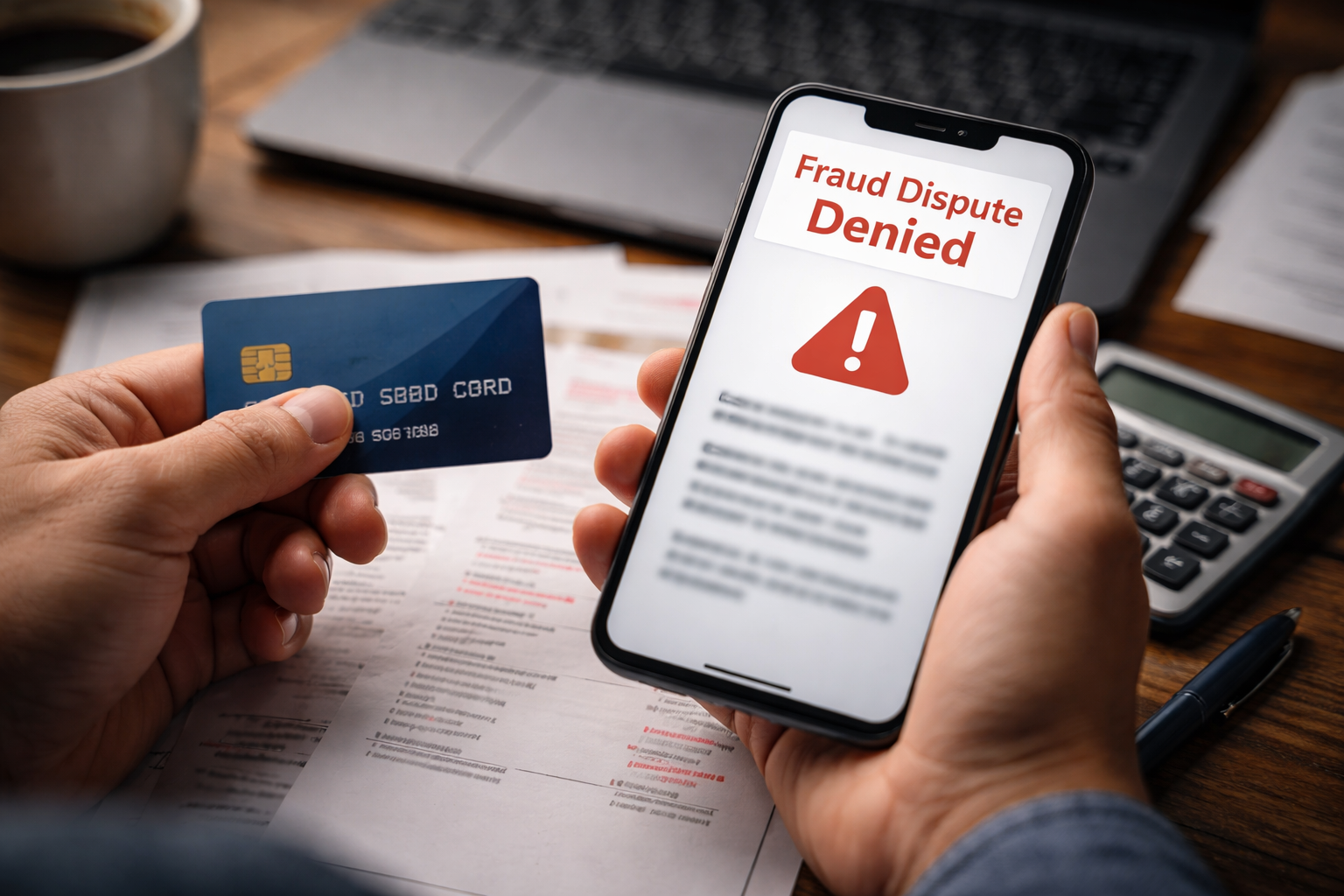
Credit card fraud dispute denied. I saw those words after refreshing my account for the third time that morning, because the temporary credit had vanished. The balance jumped like nothing happened, like the last two weeks of calls and “we’re investigating” messages never existed.
I didn’t feel panic exactly. It was more like a cold, practical realization: if I didn’t respond the right way, the bank’s decision would become my bill. The denial wasn’t loud. It was quiet, clean, and final-looking — the kind of message that makes normal people stop.
If you just got a credit card fraud dispute denied outcome, this article is built for U.S. consumers in that exact moment. Not a lecture. Not a definition. It’s a step-by-step playbook that helps you figure out what happened, what the issuer likely relied on, and what to send next so a real person is forced to re-check the file.
Important: A denial is often a classification problem, an evidence problem, or a timeline problem. The fix depends on which one you’re in.
Before you do anything else, compare this guide with the broader denial path so you don’t miss an escalation option that applies to your card issuer.
First, Confirm What “Denied” Actually Means on Your Account
When credit card fraud dispute denied appears, it usually means the issuer concluded one of these:
- They believe the transaction was authorized (by you or someone with “permission”)
- They believe the merchant’s evidence outweighed your statement
- They believe you filed it under the wrong dispute type
Here’s the quick test: open the denial message and look for language like “merchant documentation,” “card-present,” “EMV,” “3D Secure,” “verified shipping,” or “IP match.” Those phrases tell you what the bank leaned on.
Also check whether the denial is “final” or “closed for now.” Many issuers quietly allow reopening when you submit additional documentation. That is why credit card fraud dispute denied should trigger action, not surrender.
Choose the Right Branch: Your Denial Usually Fits One of These Buckets
Pick the branch that matches your reality (don’t guess):
- Branch A: True fraud (you never made the charge)
You were not present, did not benefit, and do not recognize the merchant. You may still see credit card fraud dispute denied if the bank thinks your data was used “correctly.” - Branch B: Friendly fraud / household use
A spouse, teen, roommate, or someone with access used the card. Banks often label this “authorized access.” Denials are common. - Branch C: Subscription / recurring charge disguised as fraud
You canceled, but billing continued. If filed as fraud, you may get credit card fraud dispute denied because it’s a billing dispute, not a fraud dispute. - Branch D: Card was stored (merchant vault / wallet) and reused
Breaches or account takeovers can produce evidence that looks legitimate (same address, same email), triggering credit card fraud dispute denied. - Branch E: Card-present / chip / tap claim
The issuer says the card was physically used. This branch is winnable, but only with the right evidence.
Once you know your branch, your next steps become much clearer. The worst move is sending random documents that do not address the reason for denial.
Why the System Denies Legit Claims (Without Saying It Out Loud)
Most credit card fraud dispute denied decisions are driven by automated scoring and standardized “evidence weighting.” The bank isn’t calling you a liar. It’s doing math based on signals like:
- Address verification match (AVS)
- Device fingerprinting (browser + phone characteristics)
- IP address location
- Shipping confirmation (even if it was delivered somewhere else)
- Digital authentication (wallet token, 3D Secure, passkey)
If a fraudster had access to your email, phone, or saved wallet, the transaction can appear “authenticated.” That single factor can flip the internal score and cause credit card fraud dispute denied even if you truly didn’t authorize it.
What the Merchant Sends to Beat You
When credit card fraud dispute denied happens, merchants often win by sending tidy “proof packets.” Typical items include:
- Order invoice + timestamp
- Customer account history
- Proof of delivery (sometimes only “delivered,” no signature)
- Customer service notes
- Return policy screenshots
Your job is not to argue harder — it’s to counter the exact element they used. If they relied on delivery, you counter delivery. If they relied on authentication, you counter authentication.
Branch A: True Fraud — The “Counter-Evidence Packet” That Forces Reinvestigation
If your situation is true fraud and you still got credit card fraud dispute denied, you need to submit evidence that answers one question: “How do we know it wasn’t you?”
Build a clean packet (simple, labeled, no drama):
- Timeline: when you noticed the charge, when you reported it, what the issuer said
- Location proof: work schedule, receipts, transit logs, or travel proof showing you were elsewhere
- Account compromise indicator: password reset emails, suspicious login alerts, carrier/SIM change alerts
- Statement of non-benefit: “I did not receive goods/services; shipping address is not mine”
Keep it short, factual, and focused on evidence. The goal is to move your file from an automated closure to a human reinvestigation queue.
Branch B: Household Use — What to Do When the Bank Says “It Was Authorized”
This is the hardest branch emotionally, because people often feel betrayed and still see credit card fraud dispute denied as unfair. But banks typically view household use as “permission by access.”
In this branch, the “fraud” label may not stick. Your best options often include:
- Stop future transactions (new card number, new digital wallet tokens)
- Ask the merchant for a refund or store credit (especially for digital goods)
- If it was a minor, document unauthorized use and request a goodwill review
Do not submit a false claim. If your issuer believes you knowingly misrepresented facts, that can damage your account relationship.
Branch C: Cancelled Subscription That Kept Billing — Reframe It Correctly
A large chunk of credit card fraud dispute denied results happen because a cancellation issue was filed as fraud. Banks will often deny it because it’s categorized as a billing dispute.
What to do:
- Gather cancellation proof (confirmation email, chat transcript, account screenshot)
- Request a dispute reclassification from “fraud” to “billing error”
- Submit merchant contact attempt logs (date/time, ticket numbers)
The key is to show you tried to resolve it and the charge continued anyway.
To understand your federal rights after a credit card fraud dispute denied, review the official consumer protection guidance here.
Branch D: Stored Card / Account Takeover — The Evidence Banks Actually Respect
If your card was stored on a merchant account or a wallet, and you got credit card fraud dispute denied, it often means the issuer believed “the right account” made the purchase.
In this branch, prove that the account was compromised:
- Password reset records
- Unknown device logins
- Two-factor changes
- Email forwarding rules (if discovered)
Show the compromise trail. That is more persuasive than simply saying “that wasn’t me.”
Branch E: Card-Present / Tap / Chip — The “Impossible Use” Argument
This branch triggers when the issuer believes the card was physically used. A credit card fraud dispute denied here usually means they rely on EMV (chip) data.
How to fight it:
- Prove possession: you had the card the entire time (photos, workplace policy logs, etc.)
- Prove location conflict: you were somewhere else at the exact time
- Request details: ask the issuer for the transaction method and terminal type
If the issuer refuses details, escalate with a written reinvestigation request.
What to Say on the Phone (So You Don’t Get Routed into a Dead End)
When you call after credit card fraud dispute denied, do not start with a long story. Use a structured request:
- “I am requesting reinvestigation and review by a supervisor-level fraud analyst.”
- “I have additional documentation that addresses the denial basis.”
- “Please note this is not a duplicate claim; it includes new evidence.”
Those phrases matter because they map to internal workflows.
A Checklist That Helps You Self-Apply Fast
Answer these in writing (short bullets). This becomes your evidence summary:
- Do you recognize the merchant name?
- Was the card in your possession?
- Was it online, in-person, or wallet-based?
- Did you receive any goods or service?
- Is the shipping address yours?
- Did you notice any account takeover signs?
- Do you have timeline proof (texts, receipts, logs)?
If you cannot answer these clearly, the issuer can deny again. Clarity beats emotion in a dispute file.
If this started as an obvious unauthorized transaction and you’re unsure what proof matters most, this guide helps you structure the documentation correctly.
What You Must Not Do After a Denial
After credit card fraud dispute denied, these mistakes reduce your chance of reversal:
- Waiting until the next statement closes
- Submitting screenshots without context or dates
- Threatening language instead of evidence
- Filing the same claim again with no new information
- Paying the balance and then going silent (it can look like acceptance)
You can stay current on payments to protect your credit while still disputing the charge. You do not have to choose between “fight” and “financial safety.”
Key Takeaways
- credit card fraud dispute denied is often reversible when you submit targeted counter-evidence
- The fix depends on your branch (true fraud, subscription, takeover, card-present)
- Ask for reinvestigation with new documentation — not a “new dispute”
- Keep a clean timeline and address the denial basis directly
- Move quickly before statement-cycle momentum turns against you
FAQ
How fast should I respond after credit card fraud dispute denied?
As soon as possible. If you can respond within days, you are more likely to get escalation review instead of a closed-file repeat denial.
Can I reopen a denied fraud dispute with the same evidence?
Reopening is much stronger with new or clearer documentation. If you only restate the same points, the bank can treat it as duplicate.
Should I contact the merchant if it’s true fraud?
You can, but do not rely on the merchant to fix it. Focus on evidence and issuer reinvestigation first, especially if you suspect account takeover.
What if the bank says it was “chip” or “tap”?
Ask for method details and build an “impossible use” proof set (possession + location conflict). Escalate in writing if needed.
credit card fraud dispute denied felt like a wall when I first saw it. Not because I didn’t believe my own story — but because I could see how my story would look inside a file that only accepts checkboxes and “proof.”
What changed everything was treating the denial as a document problem, not a personal insult. The moment I built a tight timeline and submitted evidence that directly contradicted the denial reason, the case stopped being automated and started being reviewed.
Here’s what you should do right now: call your issuer, request reinvestigation with new documentation, and submit your evidence packet the same day. Then keep a log of every call and message. Speed plus clarity is what turns a denial into a second look.
And if you need the next step after a denial to stay organized and escalate cleanly, use this guide as your final checklist before you submit.