
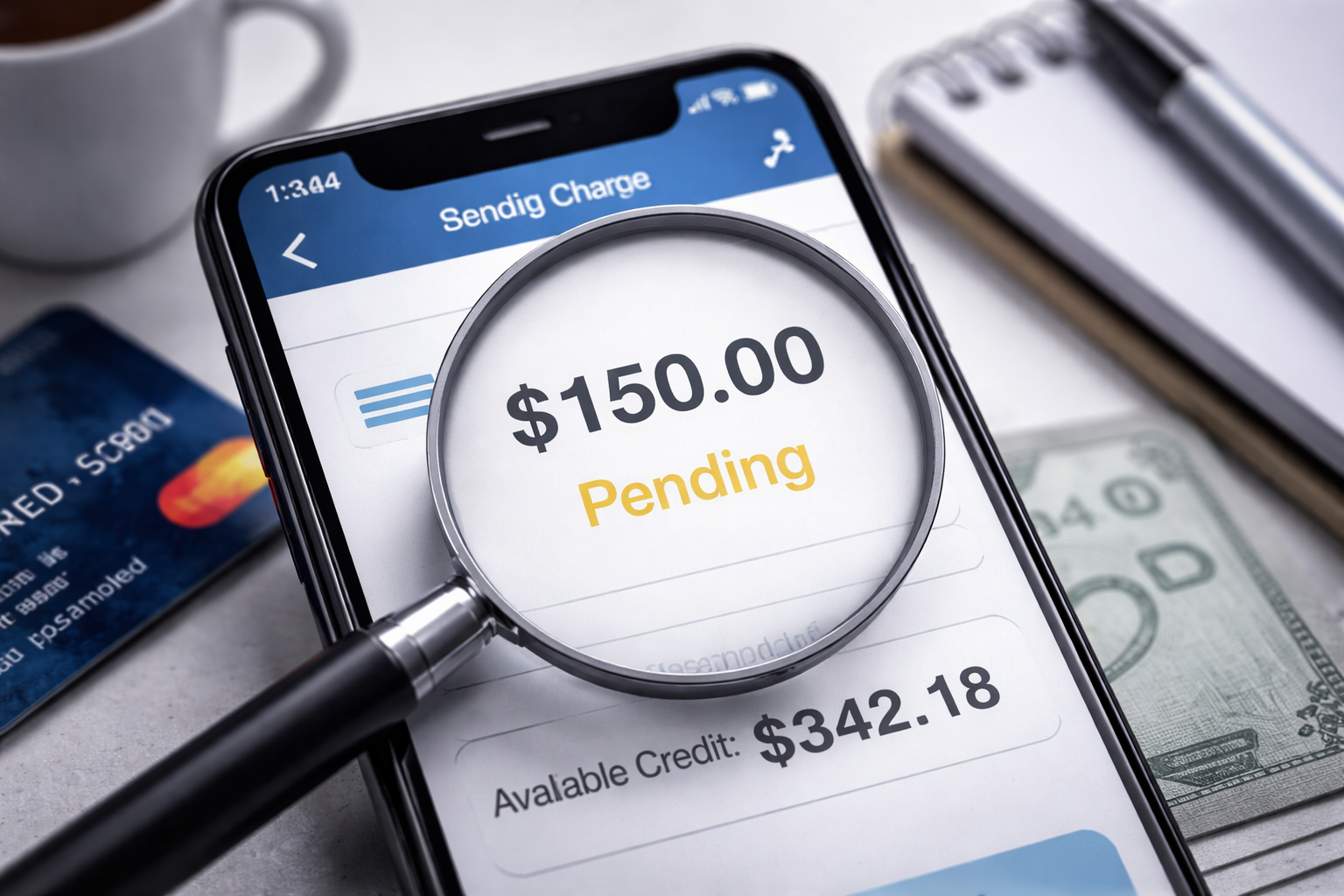
Credit card pending charge never dropped. I typed those exact words into Google while standing in my kitchen, phone in one hand, coffee in the other, trying to figure out why my available credit suddenly looked wrong. The transaction wasn’t posted. It wasn’t gone. It was just… sitting there. Day after day.
At first I told myself it was “normal processing.” Then my autopay schedule hit, and my card’s available credit stayed lower than it should have been. That’s when it stops being a minor annoyance and becomes a real-world problem you can’t ignore. If your credit card pending charge never dropped, you need a plan that restores your available credit quickly and safely—without guessing, without waiting, and without triggering unnecessary disputes.
Before you go deeper, here’s one related guide from the same site that helps you frame “billing issues” the way banks do. It’s useful context when you call support.
The Fast Reality Check
If a credit card pending charge never dropped, you’re usually dealing with an authorization hold that never got released. That hold can reduce your available credit even though the purchase never fully “settled.”
- Not posted = the merchant hasn’t completed settlement, or the system didn’t finish the process.
- Not gone = the hold is still active, so your usable credit stays restricted.
- Not harmless = it can cause declines, missed payments, and chain reactions.
Your goal is not to “wait for it to disappear.” Your goal is to get the hold released and your available credit restored.
2-minute self-diagnosis (answer honestly):
- Has it been more than 7 business days?
- Is your available credit lower than expected?
- Was the purchase canceled, voided, or replaced?
- Did you tip after the charge (restaurant/bar)?
- Is this hotel, car rental, or gas station related?
If you answered “yes” to two or more, treat this as a fix-today situation.
Timing Matters: When Waiting Is Normal vs. When It’s a Problem
A lot of people get stuck because they don’t know what “too long” really means. If your credit card pending charge never dropped, use these rough time windows to decide your next move:
- 0–3 days: Often normal, especially around weekends.
- 4–7 days: Still common for many merchants; you can start gathering info.
- 8–10 days: This is the danger zone. Don’t keep waiting quietly.
- 10+ business days: You should start a structured escalation to release the hold.
The key is business days, not calendar days. If you’re reading this and it’s already past day 8, you’re not late—but you are at the point where action is justified.
What’s Happening Behind the Scenes (No Fluff, Just the System)
When a card is used, two different things can occur:
- Authorization: The merchant “checks” that your account can cover it and places a temporary hold.
- Settlement: The merchant finalizes the amount and completes the transaction.
If the merchant never completes settlement—or if the messaging between merchant, processor, and bank glitches—the authorization can linger. That’s why a pending charge can sit there even when you canceled the order or never received the item.
So if your credit card pending charge never dropped, the most practical assumption is: the authorization wasn’t properly released, or the bank’s system needs a manual cleanup.
Case Split: Find Your Scenario and Follow the Right Fix
CASE A — Hotel / Resort / Deposit Hold
Hotels can place a hold that’s higher than the room rate. It may include “incidentals” or a security deposit.
- Most common reason: the hotel didn’t transmit a release correctly after checkout.
- Best first action: call the hotel’s front desk, then ask to be transferred to billing/accounting.
- What to ask for: “Please send an authorization reversal / release for the incidental hold.”
- What to request: an email confirmation showing the hold was released, including date/time.
If a hotel tells you “we already released it,” you still need proof you can share with your bank.
CASE B — Car Rental Hold
Car rentals are notorious for long holds, especially if there were changes (late return, fuel, tolls).
- First action: call the rental location and ask for the final receipt.
- Second action: ask if there are any open charges pending settlement (tolls, damage review, cleaning).
- Fix path: If the rental is closed and paid, ask for a hold release / authorization reversal explicitly.
If your credit card pending charge never dropped after a rental, the rental company is often the fastest party to fix it—if you reach the right department.
CASE C — Gas Station (Pre-Authorization Looks Wrong)
Gas stations may pre-authorize a larger amount. Sometimes the pre-auth hangs.
- Check if you paid at the pump vs. inside.
- Check if the final posted amount ever appeared.
- If the final amount posted but the pending remains: this is usually a “duplicate auth” situation.
When a credit card pending charge never dropped but the final charge posted correctly, banks can often remove the stale authorization quickly once you flag it.
CASE D — Restaurant / Bar Tip Adjustment
Tip-based merchants often run the initial amount, then adjust later. That can keep the transaction pending longer than expected.
- If you tipped, your final amount may be different from the pending amount.
- If the merchant never finalized the adjusted amount, the pending can linger.
- Call the merchant and ask whether the transaction was captured or still open.
Tip-adjustment pending issues are common—and fixable once you confirm whether the merchant captured the payment.
CASE E — Online Order / Backorder / “Label Created” Shipment
Some online retailers place an authorization at checkout but don’t settle until shipping.
- If it’s a backorder, the merchant may re-authorize later, which can create confusion.
- If the order was canceled, you should expect the authorization to drop—but sometimes it doesn’t.
- Ask the merchant: “Was this authorization voided, and can you confirm the authorization reversal date?”
If your credit card pending charge never dropped and the order hasn’t shipped, it can still be legitimate—but it should not stay indefinite.
CASE F — You Don’t Recognize the Merchant (Fraud Risk)
This is the one case where you do not “wait and see.”
- Call the number on the back of your card immediately.
- Tell them: “I don’t recognize this pending authorization. I want to block it and secure the account.”
- Ask whether the card should be replaced.
If a credit card pending charge never dropped and you don’t recognize it, treat it as a security event.
The 10-Minute Action Plan That Actually Works
Here’s the order that saves time (and prevents you from getting bounced between departments). If your credit card pending charge never dropped, do this:
Step 1 — Collect the “3 Proof Points” (before any call)
- Date and exact time of the pending authorization (screenshot it).
- Merchant name as shown on the pending line item.
- Amount and last 4 digits of your card.
Step 2 — Call the merchant first (in most cases)
- Ask: “Can you confirm whether this authorization was captured or voided?”
- Then: “Please send an authorization reversal / release.”
- Request email confirmation with the release timestamp.
Step 3 — Call your card issuer
- Say: “I need a stale authorization removed. The merchant confirms it was voided.”
- Ask: “Can you restore available credit today?”
- If they hesitate: ask for the “authorization department” or a supervisor.
Most people fail because they call the wrong side first or they don’t use the right language. “Stale authorization” and “authorization reversal” are the phrases that move you forward.
Official Reference: Authorization Holds & Reversals
When a merchant processes an authorization reversal, it tells the card issuer the transaction was canceled and the hold should be removed. This is the cleanest “official” explanation you can point to when you request a stale hold release.
Tip: If support pushes back, say “The merchant needs to send an authorization reversal so my open-to-buy (available credit) can be restored.”
Mistakes That Keep People Stuck
When a credit card pending charge never dropped, these mistakes waste days:
- Filing a dispute too early (you can end up disputing something that never posts).
- Calling only the bank (many holds can only be released cleanly by the merchant’s reversal).
- Assuming a refund cancels a hold (refund and hold release are not the same action).
- Not documenting proof (no timestamp = no leverage).
The biggest mistake is passive waiting after day 7–8.
Key Takeaways
- If your credit card pending charge never dropped, your available credit can remain restricted even without a posted charge.
- Identify the scenario first (hotel/rental/gas/tip/online order/fraud) so you don’t waste calls.
- Use the right phrases: “stale authorization” and “authorization reversal/release.”
- Collect proof points before calling. It speeds everything up.
- Act by day 8–10 business days, not “whenever it feels annoying.”
FAQ
How long can a pending charge realistically last?
It varies by merchant type. Past 10 business days is typically the point where you should push for a release. Hotels and rentals may take longer, but “longer” shouldn’t mean indefinite.
Will it turn into a posted charge later?
Sometimes. Especially with hotels/rentals and tip adjustments. But if your credit card pending charge never dropped after a cancellation, that’s a red flag for a capture/void mismatch.
Should I dispute it?
If it never posts, a dispute may be unnecessary. The cleaner fix is usually the hold release. If it posts incorrectly, then you move to a billing error process.
Can the bank remove it instantly?
Often yes—especially in duplicate-authorization cases. If your credit card pending charge never dropped and the final charge already posted, issuers sometimes clear the stale auth quickly once flagged.
What if the merchant refuses to help?
Ask for billing/accounting and request written confirmation that the authorization was voided. Then call your issuer with that proof. You are not asking for a favor—you are asking to restore access to your available credit.
The Ending You Actually Need (Do This Now)
When my credit card pending charge never dropped, the most frustrating part wasn’t the money. It was the uncertainty—checking the app every morning, guessing whether it would resolve, planning purchases around a number I couldn’t trust.
You don’t have to live in that limbo. Today, take two screenshots, call the merchant for an authorization reversal, then call your issuer and request a stale authorization removal. If you’re past day 8–10 business days, escalate to the authorization department or a supervisor. Your available credit is part of what you pay for, and you’re allowed to demand that it be accurate.