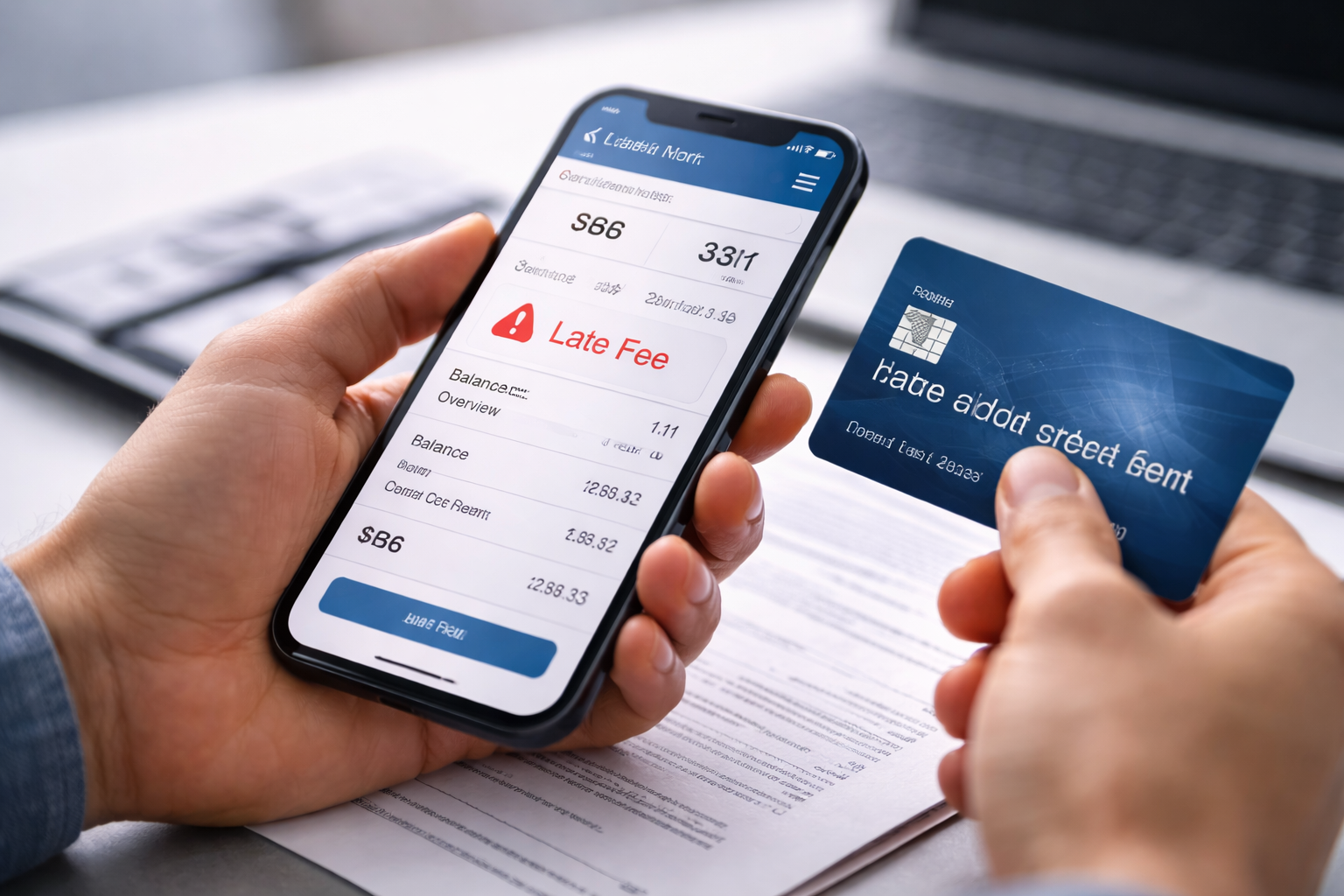
Credit card late fee error usually hits you in a very specific moment: you open your statement to confirm everything is normal, and one line looks wrong. It’s not a large number. It’s just a late fee—except you’re almost sure you weren’t late.
You check your bank app. The payment is there. The date looks right. The confirmation email still exists. And the problem shifts from “did I pay?” to something colder: if their system thinks I was late, what else will it trigger? Interest. Penalty APR. A negative mark. Or a chain reaction that takes months to unwind.
If your payment was made on time but posted late in the issuer’s system, this companion guide helps you recognize the exact trap and how it happens.
Why a late fee can appear even when you paid “on time”
A credit card late fee error is usually not about forgetting. It’s about mismatched clocks, cutoff rules, and posting workflows.
Most card issuers don’t use “midnight” as the due-date boundary. They use a cutoff time that can be earlier in the day. On top of that, many payments move through batch posting, and “submitted” is not always the same as “received” or “posted.”
The key idea: the issuer may judge lateness by their internal posting timestamp, not your submission timestamp.
Fast checklist: identify your risk level in 2 minutes
Before you call anyone, do this quick review. It turns a vague credit card late fee error complaint into a clean timeline.
- Payment method: issuer app, bank bill pay, ACH transfer, mailed check, auto-pay?
- Submission date/time: was it on the due date or earlier?
- Cutoff time: does your card use 5pm ET, 8pm ET, or “end of day”?
- Posting date on statement: does it show the payment credited after the due date?
- Minimum payment: did you pay at least the minimum required?
If you paid at least one day early and still got a fee, your case is usually strong.
What the issuer is likely looking at on their side
In most credit card late fee error situations, the issuer agent sees:
- The due date and cutoff time
- The time the payment was credited to the account
- Whether it satisfied the minimum payment rule
- Whether auto-pay failed or was modified
- Whether your account had a recent statement cycle change
This is why emotional arguments tend to fail. The agent is usually following a checklist.
Your best strategy is to match their checklist with your proof.
Case breakdown: detailed branches (find your exact scenario)
Case 1: You paid on the due date, but after the issuer’s cutoff time
This is a classic credit card late fee error scenario because it feels like you paid on time. But many issuers treat the payment as “late” if it was submitted after the cutoff, even if it was still the due date.
What to do right now:
– Confirm the cutoff time listed in your account terms or payment page
– Call and request a one-time late fee waiver
– Ask whether interest or penalty APR was triggered and request reversal
– If you have a clean history, say so clearly and briefly
Case 2: Auto-pay was enabled, but the payment processed late or failed
Auto-pay errors create a strong credit card late fee error feeling because you did “everything right.” But auto-pay can fail for reasons like bank verification, insufficient funds at the pull moment, expired bank token, or changes made too close to the due date.
What to do right now:
– Screenshot the auto-pay status page (scheduled vs processed vs failed)
– Ask the issuer to check auto-pay logs for that cycle
– Request removal of the late fee due to payment system failure
– Disable and re-enable auto-pay only after the issue is resolved (to avoid duplicates)
Case 3: Your bank shows the payment cleared on time, but issuer posted it late
This is one of the strongest credit card late fee error lanes because you have third-party proof. It often happens with bank bill-pay or ACH timing. The issuer might not credit it until it settles internally.
What to do right now:
– Save bank proof showing posting/clearing date and reference number
– Ask the issuer to trace the payment and confirm the “received date” vs “credited date”
– Request fee and interest reversal based on bank evidence
– Ask whether they can “re-age” the payment to the received date
Case 4: The payment was credited, but the system treated it as insufficient
Sometimes you paid, but not enough to satisfy the minimum payment—especially if fees or interest changed the minimum unexpectedly. This can look like a credit card late fee error even though the system flags it as “minimum not met.”
What to do right now:
– Compare your payment amount to the minimum due listed on the statement
– Ask whether the minimum due changed due to a fee or a returned payment earlier
– If you paid the listed minimum and it still flagged, request a manual review
– If you were short by a small amount, request a goodwill waiver after paying the difference
Case 5: You scheduled a payment earlier, but the scheduled date was wrong
Some people schedule payments days in advance and assume it will execute. If the scheduled date accidentally lands after the due date, the issuer may apply a late fee. It feels like a credit card late fee error because the “intent” was on time.
What to do right now:
– Screenshot the scheduling confirmation if it shows when you set it up
– Request a goodwill reversal based on payment history
– Update your schedule to 2–3 days before due dates to avoid cutoff surprises
Case 6: Due date changed this cycle (statement cycle shift)
A statement cycle change can shift the due date, sometimes with limited visibility. You pay based on your usual rhythm and suddenly get hit. This can create a real credit card late fee error pattern when notice was unclear or buried.
What to do right now:
– Compare this due date to the previous statement
– Ask the issuer when and how the change was communicated
– Request a waiver due to insufficient notice or unexpected cycle shift
– Ask them to align your due date to a consistent day if possible
Case 7: Returned or reversed payment (but you didn’t notice)
A payment can be returned due to bank issues, incorrect routing numbers, or verification failures. Then your account shows late. You may experience it as a credit card late fee error because you saw the payment “attempt” and assumed success.
What to do right now:
– Check for “returned payment” notices or emails
– Confirm whether a temporary credit was removed
– Make a new payment immediately once confirmed, then request fee waiver if the return was technical
– Ask whether the returned payment triggered penalty APR and request reversal after successful payment
Case 8: Partial grace / holiday / weekend processing confusion
Some payments submit on weekends, then post on the next business day. If your due date falls on a weekend or holiday, there may be special rules. Confusion here can become a credit card late fee error complaint if the system didn’t apply the rule correctly.
What to do right now:
– Confirm whether your due date was on a weekend/holiday
– Ask how the issuer handles payments due on non-business days
– Provide proof of submission date/time and request correction if policy supports it
If you found your lane above, you’re already ahead. Most people lose time because they talk about “fairness” instead of narrowing down what created the credit card late fee error in the system.
What to say on the call (short, effective, non-emotional)
When you call, keep it simple. The goal is to make it easy for the agent to approve a waiver or correction.
- State: “I’m calling about a credit card late fee error.”
- Give the payment date/time and method.
- Ask: “Can you confirm your cutoff time and the posting timestamp you’re using?”
- Request: “Please reverse the late fee and any interest triggered, and confirm it in writing or in account notes.”
Ask directly whether the fee triggered interest or penalty APR. Fixing only the fee is not always enough.
What not to do (these mistakes cost money or time)
- Paying the fee immediately without requesting correction
- Waiting “to see if it fixes itself” while interest accrues
- Opening multiple disputes at once with inconsistent timelines
- Assuming auto-pay is always reliable without checking status
- Ignoring whether this could appear as a late payment record
Small fees can become large problems if they trigger compounding interest or reporting.
What to do right now (a clean action plan)
If you’re dealing with a credit card late fee error, do these steps today:
- Screenshot the statement line showing the late fee
- Screenshot bank proof (date/time/reference)
- Check issuer cutoff time and due date for the cycle
- Call and request late fee reversal + interest reversal
- Ask if any negative reporting was triggered and request confirmation it won’t be reported
- Check the next statement to confirm everything was corrected
This sequence prevents a small error from turning into months of cleanup.
For an official overview of consumer rights for credit billing errors in the U.S., this federal resource is a safe reference.
FAQ
Does a late fee automatically hurt my credit score?
A fee alone usually does not, but an unresolved late payment could lead to negative reporting depending on how late it becomes.
Can the issuer reverse the late fee and interest?
Often yes, especially for a first-time event or when you have proof of timely payment.
Should I dispute in writing?
If the phone call doesn’t resolve it, a written dispute can create a strong paper trail and timeline.
What if this keeps happening?
Recurring credit card late fee error patterns often come from cutoff timing, bank bill-pay delay, or auto-pay failures that need adjustment.
Key Takeaways
- credit card late fee error is often caused by cutoff time, posting delays, or auto-pay failures
- Proof and timestamps matter more than frustration
- Request reversal of late fee and any interest/penalty effects
- Act quickly to prevent compounding charges or reporting issues
A credit card late fee error feels unfair because it often is. You took action—and the system measured it differently.
Right now, gather your timestamps, call for a correction, and confirm the fee and any related interest will be reversed today. That’s how you stop a small billing error from turning into a long financial headache.