
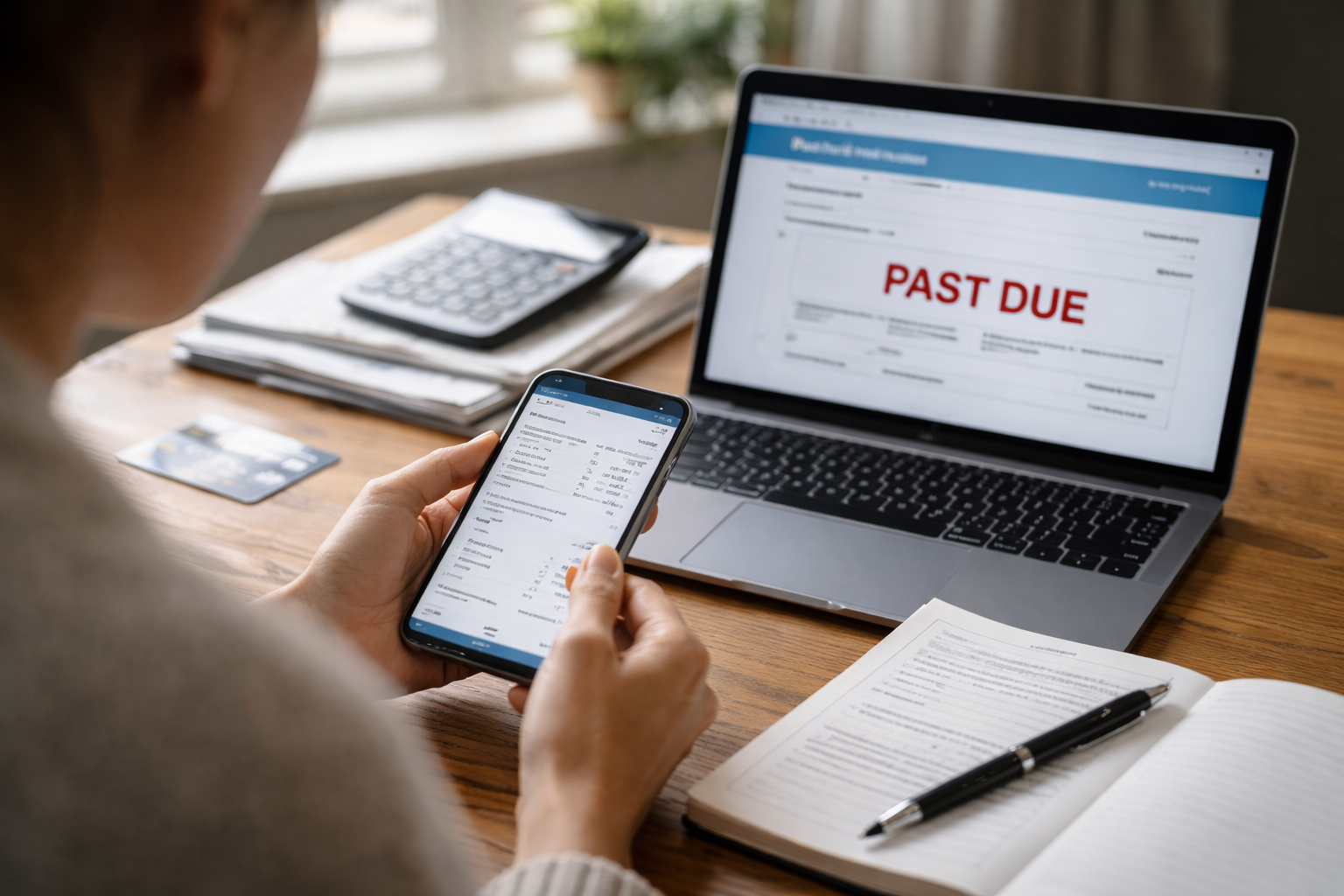
Credit card payment posted late is the kind of problem that makes you doubt your own memory. You remember paying. You remember seeing a confirmation. You might even remember the exact moment you hit “Submit” because you were doing it quickly—between errands, between meetings, before the day ended.
Then you open your account and see something that doesn’t match reality: past due, a late fee, interest you weren’t expecting, or a warning banner. You pull up your bank app and the payment is right there. The date is correct. The money left. What you don’t have is the one thing the credit card system cares about: the posting timestamp. If you’re here because credit card payment posted late just happened, this is a practical guide for what to do right now—without guessing and without waiting.
What “Posted Late” Means (And Why It’s Not the Same as “Paid Late”)
When credit card payment posted late appears, it’s easy to interpret it as an accusation. But “posted late” usually means the payment did not get fully recorded on the issuer’s ledger by the due date, even if you initiated it on time.
Credit card systems often use these stages:
- Submitted: you initiated the payment
- Pending: the issuer is verifying or waiting on bank transfer
- Posted: the payment is officially applied to your balance
Your bank can show a withdrawal while the card issuer still shows “pending.” That gap is exactly where many late fees get triggered.
Why This Happens So Often (Even for Responsible People)
There are a few predictable reasons credit card payment posted late happens. Most of them are invisible until something goes wrong:
- Cutoff time: Many issuers treat payments after a specific hour as “next day,” even if you pay on the due date.
- Weekends/holidays: Some processing pauses or slows, especially for external bill-pay channels.
- Payment channel: Paying inside the issuer app can post faster than bank bill pay or third-party apps.
- First-time transfers: A new bank account or new issuer relationship can slow verification.
So yes—two people can “pay on time” and only one gets charged a late fee. The difference is often processing, not responsibility.
Quick Self-Check (Put Yourself in the Right Lane)
If credit card payment posted late is happening, answer these in 60 seconds. Your answers determine the fastest fix:
- Did you pay on the due date itself (or earlier)?
- Do you know the exact time you submitted the payment?
- Was it paid in the card issuer portal, through your bank bill pay, or a third-party app?
- Did your due date fall on a weekend or holiday?
- Is this your first time paying this card from this bank account?
- Do you see a late fee already, or just a “past due” warning?
The goal is not to “prove you’re right.” The goal is to identify the processing path that caused the delay.
Which Situation Matches Your Payment Delay?
Below are the most common patterns behind credit card payment posted late. Read them like you’re matching symptoms—not like you’re choosing a category for life. If two boxes sound similar, start with the one that matches your payment method.
Case A: You Paid on the Due Date, But After the Issuer Cutoff
This is the most common reason a credit card payment posted late issue appears. Many issuers have cutoffs that are earlier than midnight. A payment at 9:30 PM on the due date may be treated as “next business day.”
- Find the exact time you submitted the payment (confirmation screen, email, or app history).
- Ask the issuer: “What is the cutoff time for same-day crediting?”
- If you paid inside the issuer portal, ask whether they can “backdate” crediting as a courtesy.
Best outcome: fee removed + interest reversed as a courtesy adjustment, especially if this is not a repeated habit.
What not to do: don’t argue “but it was the due date.” Ask for the cutoff policy and request a courtesy review.
Case B: Weekend / Holiday Processing Delay
Your due date or payment date landed near a weekend or a holiday. Your bank may show the money left, but processing between institutions can slow down. This can produce a credit card payment posted late flag even if you initiated the payment “in time.”
- Check if the due date fell on a Saturday, Sunday, or federal holiday.
- Ask the issuer: “Do you treat weekend payments as next business day, or do you credit by submission date?”
- Save screenshots showing the payment was initiated before the deadline window.
Best outcome: issuer removes the late fee once they confirm the delay was calendar-based.
Extra tip: if you routinely pay near weekends, switching to issuer portal payments can reduce these delays.
Case C: Bank Bill Pay Sent the Payment Later Than You Thought
Bank bill pay often shows a “scheduled date,” but the actual send date can be later, especially if the payment is mailed or routed differently. This is a common source of credit card payment posted late situations where you feel certain you paid early enough.
- Open your bank bill pay details and compare: scheduled date vs delivery date vs processed date.
- Confirm whether the payment was electronic or mailed (paper checks are slower).
- If the bank delayed sending, request documentation from the bank.
Best outcome: issuer grants courtesy adjustment; if not, the bank may need to acknowledge the delay.
Key insight: a “scheduled payment” is not the same as a “delivered payment.”
Case D: Third-Party Payment App Delay (Not the Issuer Portal)
If you paid through a third-party app, you may be seeing credit card payment posted late because the app’s timeline is separate from the issuer’s timeline. The app might show “paid,” while the issuer shows “pending.”
- Locate the app’s payment confirmation and capture timestamps.
- Ask the issuer if they see an incoming payment trace or reference.
- Ask the app for a payment trace or support record if the issuer can’t locate it.
Best outcome: payment is located and applied correctly; fees are removed if issuer confirms delay was channel-based.
Risk to watch: some apps route payments slowly around weekends—avoid using them near due dates.
Case E: Auto-Pay Didn’t Execute (Or Paid Only the Minimum)
Auto-pay is reliable—until it isn’t. If you expected auto-pay to cover it and now see credit card payment posted late, check whether the payment executed, failed, or executed for a different amount than you assumed.
- Verify whether auto-pay was set to minimum due, statement balance, or a custom amount.
- Check if the funding account had enough balance on the draft date.
- Look for “auto-pay failed” notifications you might have missed.
Best outcome: issuer grants one-time forgiveness if it’s an unusual failure and you corrected it quickly.
Important: even if the late fee is removed, update auto-pay settings so it doesn’t repeat.
What To Do in the First 24 Hours (A Clean, Repeatable Plan)
When credit card payment posted late shows up, your first day actions should be simple and document-heavy, not emotional.
- Capture proof: screenshots from your bank showing the date and amount, and from the card account showing the “late” status and fee.
- Confirm payment channel: issuer portal vs bank bill pay vs third-party app (this determines who can fix it fastest).
- Call, don’t chat: phone agents can often apply a courtesy adjustment immediately.
- Ask for two reversals: late fee removal and interest reversal (many people forget the interest piece).
Even if the fee is small, treating it as “not worth it” can normalize late-posting on your account.
Exactly What to Say (Short Scripts That Work)
When you call about credit card payment posted late, you want the conversation to stay in “review and adjust” mode:
- “I made my payment on time, but it posted late. Can you review the timestamp and cutoff policy?”
- “I’d like a courtesy adjustment for the late fee, and also a reversal of any interest charged due to the posting delay.”
- “Can you confirm whether you received the payment before the due date even if it posted later?”
- “If this needs escalation, can you transfer me to the department that handles fee adjustments?”
Notice what’s missing: accusations. You’re asking for a review based on proof.
What Not To Do (Mistakes That Quietly Cost You Money)
When credit card payment posted late happens, these are the moves that tend to make things worse:
- Waiting for the next statement cycle to “see if it fixes itself”
- Paying again immediately without confirming (you can accidentally overpay or create new confusion)
- Sending long written disputes before calling
- Assuming it will hurt your credit instantly and panicking into bad decisions
Resolve the posting issue first, then evaluate any remaining fees.
If It Happens Repeatedly (How to Prevent a Repeat)
Even after you fix a credit card payment posted late incident once, prevention matters. The simplest prevention actions:
- Pay 2–3 business days before due date when possible
- Use the issuer portal (often fastest posting)
- Confirm and memorize cutoff time for same-day credit
- If using auto-pay, review settings every statement cycle
The goal is to remove “timing risk” from your monthly routine.
Recommended Next Read (If Your Payment Never Applied)
If your payment was sent but never shows up as applied, that’s a different problem than credit card payment posted late—and it has a different fix path.
External Reference (Official)
If you need a trusted official reference for credit card billing practices and consumer protections, this is a safe place to start.
Key Takeaways
- Credit card payment posted late is often caused by cutoffs, weekends, or payment channels—not missed intent.
- Fees can often be reversed if you call early and provide proof.
- Ask for both late fee removal and interest reversal.
- Prevention is about reducing timing risk (pay earlier, use issuer portal, know cutoffs).
FAQ
Will a posted-late payment hurt my credit score immediately?
Usually no. Reporting typically occurs after a longer delinquency window (often around 30 days). A credit card payment posted late status is more about fees and account standing than instant bureau reporting.
Can the issuer remove the late fee even if their cutoff policy caused it?
Often yes. Many issuers offer courtesy adjustments, especially when you have a history of on-time payments. Ask for review and be specific about the request.
Should I pay again if I’m worried?
Not until you confirm what happened. Paying again without clarity can create overpayment, returned payments, or mismatched application.
What if the late fee is removed but interest remains?
Ask explicitly for interest reversal tied to the same posting delay. Many people fix the fee but forget the interest.
Your Next Step (Do This Today)
If credit card payment posted late just appeared, here is the simplest clean action:
- Collect screenshots proving submission date and bank withdrawal date.
- Call the issuer and request review of cutoff and posting timeline.
- Ask for late fee removal and interest reversal as a courtesy adjustment.
You paid. That matters. Now make sure the system reflects it before it turns into a bigger, more expensive problem.
One call today is usually easier than fixing a chain of fees next month.